



Related Tags
Imagine you are managing an institutional pension portfolio and need to liquidate 500,000 shares of a mid-cap stock. If you place that entire sell order directly onto an open public order book, high-frequency algorithms may detect the supply imbalance, trade ahead of your quotes, and push the execution price down against you. Instead of causing an immediate market slide, your execution desk quietly routes the block into an off-exchange venue where the shares trade without pre-trade quotation. Welcome to dark pool trading.
What Is Dark Pool Trading and How Does It Work?
Dark pool trading refers to the execution of securities orders across private, off-exchange alternative trading systems (ATS) where pre-trade order information is intentionally hidden. Unlike traditional stock exchanges that publish live bids, asks, and order sizes to the entire financial community, dark pools conceal both order volume and trader identity until after the trade executes.
Dark pool trading venues arose to solve the friction institutional asset managers face when shifting massive equity positions. While a retail trader executing 100 shares receives immediate fills without shifting national quotes, institutional block transactions can easily distort supply and demand if broadcast publicly.
By masking resting order intentions, these off-market platforms permit institutional funds to exchange sizeable equity blocks directly without revealing their intentions to predatory market algorithms.
Lit Exchange vs Dark Pool: Pre-Trade Visibility Compared
A lit exchange—such as the New York Stock Exchange or Nasdaq—operates a public, centralized limit order book where every bid, ask, and order depth is visible before trade execution.
In contrast, dark pool trading offers no pre-trade quotes. The book remains completely blind to public participants until a fill occurs, transforming visible price discovery into private execution matching.
How Dark Pools Function: Alternative Trading Systems and the NBBO
Most modern private venues operate under US Securities and Exchange Commission (SEC) regulations as an alternative trading system (ATS), conforming to strict federal frameworks such as Regulation ATS and detailed Form ATS-N operational disclosures. Rather than discovering independent prices through public bidding auctions, dark pools match non-displayed orders by pegging transactions directly to the National Best Bid and Offer (NBBO) established across lit exchanges.
When buying and selling, institutional counterparties submit resting orders into a dark pool, and its matching engine typically executes trades at the NBBO midpoint. For example, if a stock shows an NBBO bid of $50.00 and an offer of $50.04 across lit markets, the dark pool engine crosses the trade at $50.02. This grants price improvement to both sides while ensuring execution complies with standard best-execution mandates.
Quantitative trading desks often use these venues alongside statistical arbitrage strategies (trading small, temporary price gaps between related securities), aiming to capture small price differences while keeping execution costs low.
The Three Main Models of Dark Pools
Not every off-exchange matching book operates under the same commercial incentive or ownership structure. Institutional market participants generally encounter three distinct venue models:
- Broker-Dealer-Owned Pools: Operated by major global investment banks (such as Goldman Sachs’ Sigma X or Morgan Stanley’s MS POOL), these platforms match client orders internally against one another or against the broker’s proprietary desk.
- Agency-Independent Pools: Run by independent agency brokerages that do not engage in proprietary trading, functioning strictly as conflict-free crossing platforms (such as Liquidnet).
- Exchange-Operated Dark Pools: Established by lit exchanges themselves to capture off-book volume, providing non-displayed order types nestled alongside primary public matching engines.
In several broker-dealer-operated pools, liquidity from market makers can interact with institutional client flow, which requires careful monitoring to ensure fair order treatment.
Why Institutions Use Dark Pools: Slippage and Predatory Algorithms
The core motivation behind off-exchange liquidity routing boils down to mitigating market impact and front-running. In public trading venues, some high-speed trading algorithms may monitor market data for signs of large institutional buying or selling. Once they detect it, they may trade ahead of the remaining order, which can worsen the institution’s execution prices.
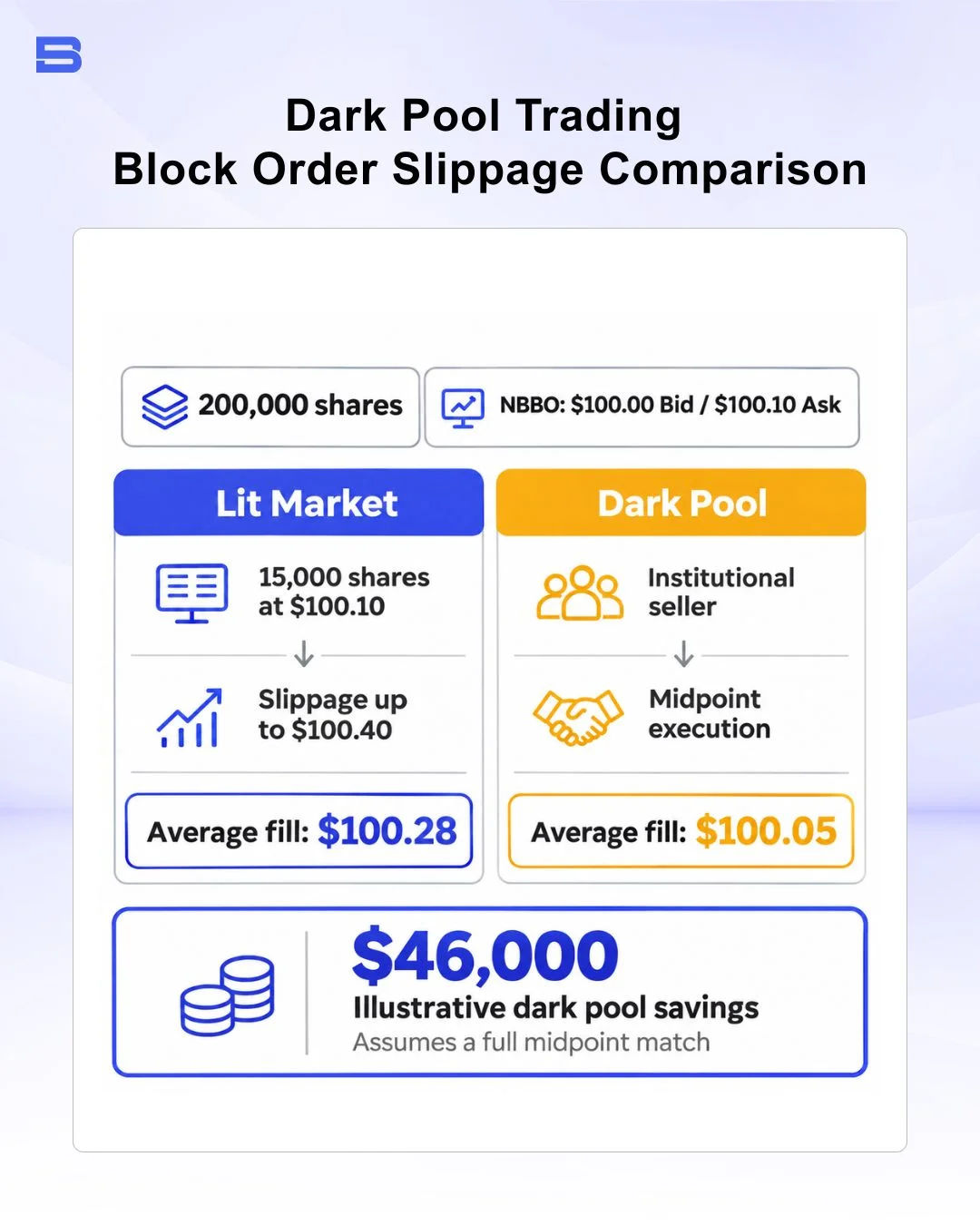
Consider a concrete execution scenario involving a mutual fund purchasing 200,000 shares of a stock currently trading with an NBBO of $100.00 Bid / $100.10 Ask:
- Lit Market Execution: If the desk routes the entire 200,000-share buy order into public lit exchanges, available liquidity at the $100.10 ask covers only 15,000 shares. Algorithmic traders immediately step ahead, clearing out resting ask levels. The fund experiences slippage, absorbing liquidity up through $100.40, resulting in an average fill price of $100.28 per share. That costs the fund an additional $46,000 above the $100.05 starting midpoint.
- Dark Pool Execution: The desk routes the block trade execution into an ATS crossed at the midpoint ($100.05). If an institutional seller is resting on the opposite side with enough shares, the 200,000-share block could match at $100.05, saving $46,000 compared to the lit execution above. However, a match is never guaranteed, and the order may fill only partly or not at all.
Desks specializing in order flow trading constantly analyze order execution prints to determine whether off-market midpoint routing delivers meaningful price savings over lit execution routes.
Risks, Downsides, and Regulatory Scrutiny
While dark pool trading offers valuable execution efficiency for block trades, it also introduces notable market structure trade-offs. The potential for execution improvement must always be weighed against structural disadvantages, including adverse selection, information asymmetry, and venue operator conflicts of interest.
Off-exchange trading reduces the volume flowing through public exchanges, which can fragment lit price discovery and widen spreads for everyday investors if excessive volume bypasses the public tape. Within the pool itself, buy-side institutions frequently grapple with adverse selection: aggressive high-frequency firms may interact with resting institutional orders precisely when adverse market momentum is building, leaving the fund filled on losing positions.
Furthermore, conflicts of interest in dark pools have triggered major enforcement scrutiny by the SEC and global regulators. Broker-dealers faced significant penalties during the mid-2010s for favoring their proprietary trading desks over client orders, improperly sharing confidential dark order flow with predatory algorithmic subscribers, and misrepresenting client routing controls.
Trading off-exchange also presents clear execution uncertainty: because orders are hidden, there is no guarantee a resting block order will find a matching counterparty, potentially causing costly execution delays during fast-moving markets.
Reporting Requirements: The Consolidated Tape vs Delayed Venue Attribution
A common misconception is that dark pools enable secret, unregistered trading. In reality, modern securities regulations enforce post-trade transparency across all registered platforms.
While pre-trade quotations remain hidden, all completed transactions must be submitted within seconds to the Financial Industry Regulatory Authority (FINRA) Trade Reporting Facility (TRF). The FINRA Trade Reporting Facility disseminates transaction prices and share volumes directly to the public Consolidated Tape in real time, alerting the broader market that an off-exchange trade occurred.
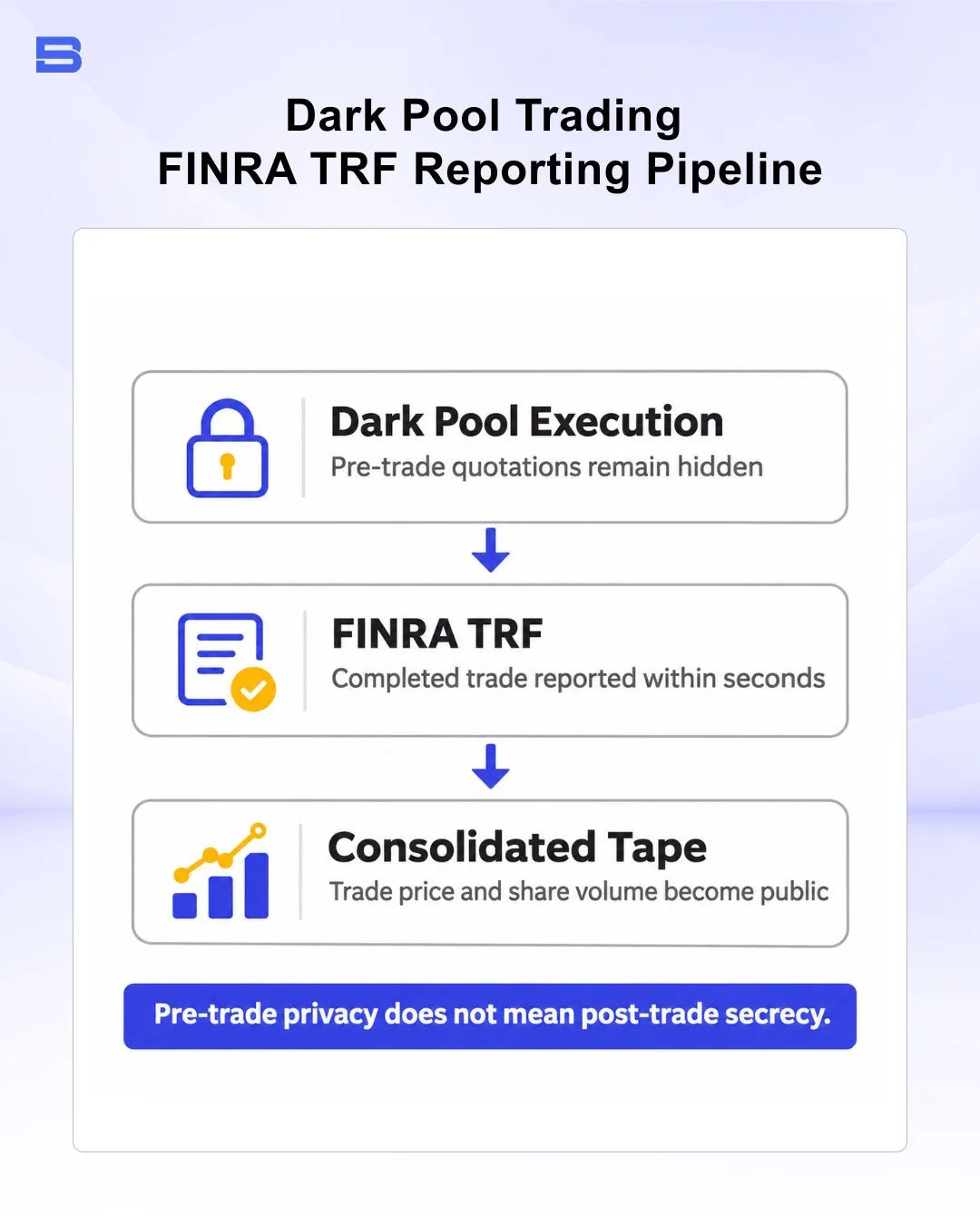
However, the specific venue where the trade crossed (such as an individual broker-dealer ATS) is not identified on the immediate tape print. FINRA publishes aggregated, venue-attributed weekly volume reports on a two-to-four-week delayed basis, balancing institutional order protection with post-trade market oversight.
Key Takeaways on Dark Pool Trading
Dark pool trading is a specialized execution infrastructure designed to accommodate institutional scale. While dark pools can help large block traders limit slippage and price impact, they demand careful regulatory balance to avoid fragmenting public price discovery. Understanding how non-displayed liquidity interacts with lit markets provides essential insight into the mechanics governing modern financial market structure.
- How to Build an Investment Plan That Actually Works for You?
- What Is the MACD Indicator and How to Use It
- What Is a Wedge Pattern in Trading?
- What Is Ichimoku Cloud Strategy? A Complete Trading System
- Mastering Elliott Wave Theory: Rules and Trading Strategies
- News Trading: Strategies, Execution Risks, and Risk Control
- What Is an Iron Condor Options Strategy?
- Backtesting Explained: What It Is and Why It Really Matters
- Grid Trading: Mechanics, Parameters, and Risk Strategies
- What Is Breakout Trading and How Does It Work?
- Mean Reversion: Technical Strategies and Risk Frameworks
- Momentum Trading: Indicators, Strategies, and Risk Control
- Hammer Candlestick: Structure, Meaning, and Strategy
- Doji Candlestick: Types, Signals, and Trading Strategies
- What Is the Sharpe Ratio and How to Calculate It
- What Is VWAP and How Do Traders Use It?
- Trade the Ascending Triangle: A Step-by-Step Practical Guide
- What Is the Stochastic Oscillator and How to Use It
- How to Trade the Descending Triangle Pattern
- High Frequency Trading: Speed, Algorithms, and Market Impact
- What Is Volume Profile and How to Use It in Trading
- What Is a Morning Star Pattern Candlestick?
- Trade with Parabolic SAR: A Practical Analysis Guide
- Evening Star Pattern: Structure, Rules, and Risk Controls
- Kelly Criterion: Formula, Position Sizing, and Risk
- What Is the NYSE Minimum Trading Price? Rules Explained
Disclaimer: The content on this page is intended for educational and informational purposes only. It does not constitute financial, investment, tax, or legal advice, and should not be interpreted as a recommendation to buy, sell, or hold any financial instrument or asset. Trading and investing involve significant risk, including the possible loss of your entire capital. Products such as forex, CFDs, and cryptocurrencies carry additional risks due to leverage, high volatility, and limited regulatory protection in some jurisdictions. Past performance of any financial instrument does not guarantee future results. Any market views, forecasts, or opinions expressed are those of the author at the time of writing and may not reflect current market conditions. Platform features, fees, and regulatory status are subject to change — always verify information directly with the relevant provider or regulator before making any financial decision. BrokerSpecs may receive compensation from third parties featured on this site. Always conduct your own due diligence and consider seeking advice from a licensed financial professional before investing. Portions of this article were prepared with the assistance of AI tools and reviewed by our editorial team before publication.