


Related Tags
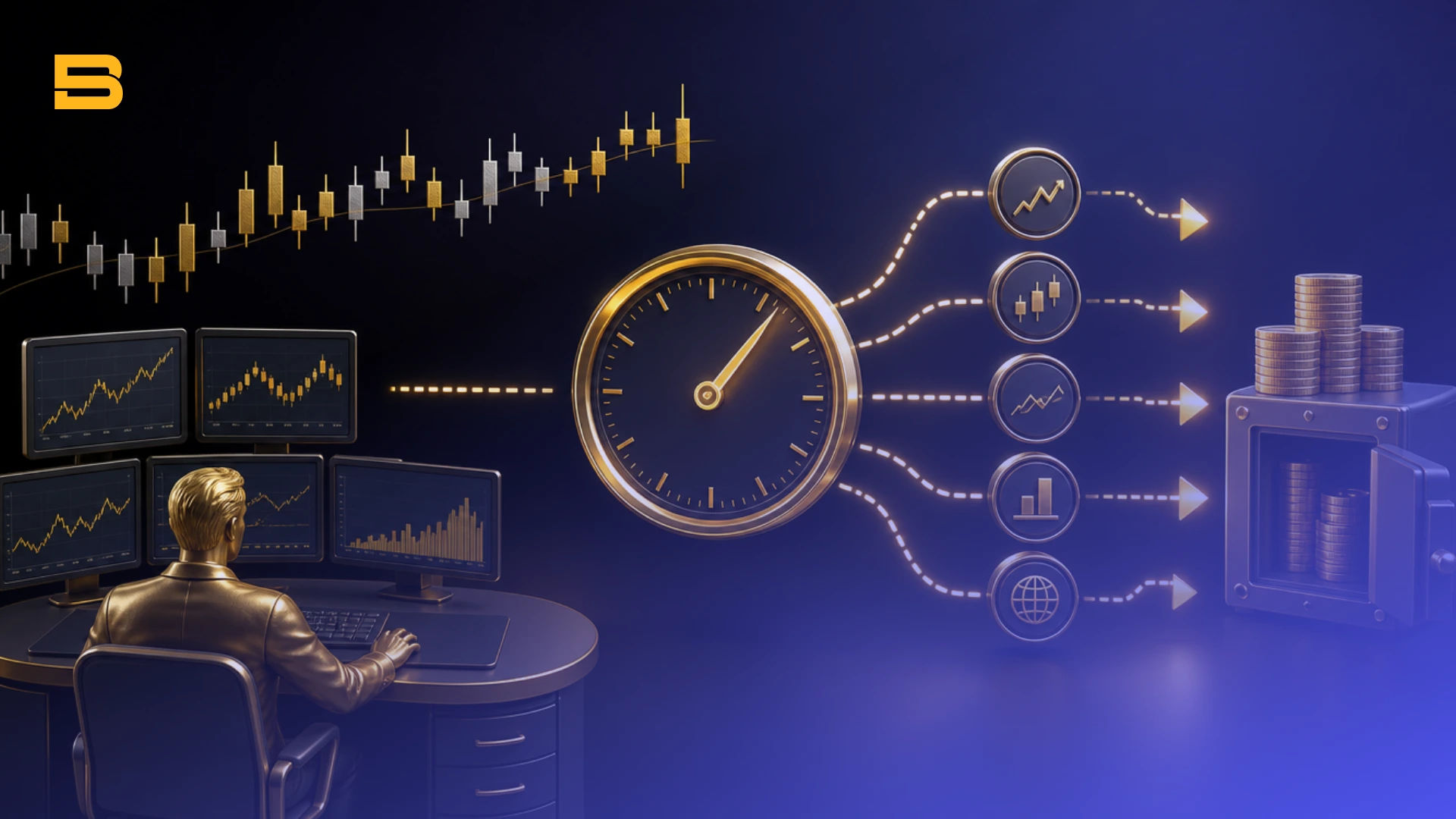
The market clock ticks down toward 4:00 PM as a trader monitors five open positions across stocks and market indices. Rather than holding these positions overnight and risking unexpected market news, the trader executes market orders to exit every position before the closing bell rings. By the time the session ends, their account balance is completely in cash, resetting their market exposure to zero until tomorrow's opening bell.
What Is Intraday Trading and How Does It Work?
Intraday trading is the practice of purchasing and selling financial instruments within the exact same trading day so that all positions are closed before the market closes. Because positions are liquidated before the session ends, traders eliminate overnight gap risk — the possibility that prices open significantly higher or lower the next day due to after-hours earnings reports, economic data, or geopolitical events.
To capitalize on short-term price movements, day traders rely on execution speed and real-time order execution platforms. While closing positions same-day protects capital from unpredictable overnight jumps, it requires managing intraday market noise, short-term volatility, and execution slippage during rapid market fluctuations.
Day Trading for Beginners vs. Other Trading Styles
When evaluating day trading for beginners, it is essential to understand how short-term execution compares to medium-term and long-term methodologies. Beginners often compare intraday trading with swing trading and position trading to determine which schedule and risk profile fits their resources. Beginners who want to observe experienced traders execute strategies without committing real capital immediately can also explore copy trading as an educational reference.

Swing trading for beginners focuses on capturing multi-day market swings, allowing more time for price setups to develop without requiring constant screen monitoring. Position trading takes an even broader view, relying on fundamental macroeconomic trends to hold assets across several months. Intraday trading, by contrast, demands active screen monitoring and quick decision-making, as trades are entered and exited in minutes or hours.
Mechanics of Intraday Trading: Costs and Leverage
Intraday trading relies heavily on execution efficiency, as transaction costs directly erode small daily profit margins. Traders frequently use intraday leverage offered by brokers to increase position sizing on small intraday price fluctuations.
Leverage amplifies potential investment returns when the market moves in your favor, but it accelerates capital loss just as quickly when prices move against your position — trading RM100,000 worth of asset exposure on RM10,000 margin capital with 10:1 leverage means a 1% adverse price move causes a 10% loss of your total margin capital.
Beyond leverage, short-term traders must account for three core transaction costs:
- Bid-Ask Spread: The difference between the highest buy price and lowest sell price quoted by brokers.
- Commissions: Fixed or percentage fees charged per order entry and exit.
- Slippage: The difference between the expected price of a trade order and the price at which the order is actually filled during volatile periods.
For example, if you place a trade with RM10,000 margin capital at 10:1 leverage to command an RM100,000 position, a bid-ask spread of 0.1% instantly creates an RM100 entry cost that your trade must overcome just to reach breakeven. Regulators such as the Financial Conduct Authority (FCA) maintain strict caps on retail leverage limits to ensure traders maintain adequate margin buffers against rapid market movements.
Capital Requirements and the Pattern Day Trader Rule
Capital requirements for intraday execution vary depending on the regulatory jurisdiction and the asset class being traded. In the United States equities market, the US Securities and Exchange Commission (SEC) enforces regulatory oversight that defines a pattern day trader (PDT).
Under PDT rules, any margin account trader who executes four or more day trades within five business days (provided those trades constitute more than 6% of total trade activity) must maintain a minimum equity balance of $25,000. If the account falls below this threshold, day trading privileges are restricted until the minimum balance is restored.
In contrast, traders dealing in spot forex or Contracts for Difference (CFDs) operate under different capital structures. Retail forex and CFD platforms often permit account creation with minimum deposits starting from RM100 to RM1,000, as fractional lot sizing and margin leverage lower the initial capital required to enter the market.
Core Setups and Indicators for Intraday Traders
Common Intraday Setups
Successful intraday execution requires structured entry and exit rules based on technical setups. A widespread strategy is the opening range breakout, where traders mark the high and low price bounds during the first 15 to 30 minutes of the trading session and enter positions when price breaks beyond those boundaries with high volume. Momentum strategies similarly seek to enter assets showing strong directional price movement fueled by volume spikes or early-session news releases.
Key Indicators for Day Traders
Short-term technical traders rely on specialized technical tools to confirm trend strength and entry timing:
- VWAP Strategy: Volume-Weighted Average Price calculates the average price of an asset weighted by total volume, helping traders identify institutional fair value throughout the day.
- Support and Resistance: Identifying key horizontal pricing levels where buying or selling interest has historically paused price moves.
- Moving Average: Utilizing short-term exponential or simple moving averages to identify intra-session trend direction.
- Scalping: An ultra-short timeframe technique where traders enter and exit positions within seconds or minutes to capture fractional price movements.
The Utility of Intraday Trading
Intraday trading offers active market access without overnight gap risks, but it demands technical discipline, fast execution, and continuous risk management. By understanding capital requirements, managing execution costs like spreads and slippage, and employing strict loss controls, traders can evaluate whether same-day trading aligns with their financial goals and risk tolerance.
- How to Build an Investment Plan That Actually Works for You?
- What Is the MACD Indicator and How to Use It
- What Is a Wedge Pattern in Trading?
- What Is Ichimoku Cloud Strategy? A Complete Trading System
- Mastering Elliott Wave Theory: Rules and Trading Strategies
- News Trading: Strategies, Execution Risks, and Risk Control
- What Is an Iron Condor Options Strategy?
- Backtesting Explained: What It Is and Why It Really Matters
- Grid Trading: Mechanics, Parameters, and Risk Strategies
- What Is Breakout Trading and How Does It Work?
- Mean Reversion: Technical Strategies and Risk Frameworks
- Momentum Trading: Indicators, Strategies, and Risk Control
- Hammer Candlestick: Structure, Meaning, and Strategy
- Doji Candlestick: Types, Signals, and Trading Strategies
- What Is the Sharpe Ratio and How to Calculate It
- What Is VWAP and How Do Traders Use It?
- Trade the Ascending Triangle: A Step-by-Step Practical Guide
- What Is the Stochastic Oscillator and How to Use It
- How to Trade the Descending Triangle Pattern
- High Frequency Trading: Speed, Algorithms, and Market Impact
- What Is Volume Profile and How to Use It in Trading
- What Is a Morning Star Pattern Candlestick?
- Trade with Parabolic SAR: A Practical Analysis Guide
- Evening Star Pattern: Structure, Rules, and Risk Controls
- Kelly Criterion: Formula, Position Sizing, and Risk
- What Is the NYSE Minimum Trading Price? Rules Explained
Disclaimer: The content on this page is intended for educational and informational purposes only. It does not constitute financial, investment, tax, or legal advice, and should not be interpreted as a recommendation to buy, sell, or hold any financial instrument or asset. Trading and investing involve significant risk, including the possible loss of your entire capital. Products such as forex, CFDs, and cryptocurrencies carry additional risks due to leverage, high volatility, and limited regulatory protection in some jurisdictions. Past performance of any financial instrument does not guarantee future results. Any market views, forecasts, or opinions expressed are those of the author at the time of writing and may not reflect current market conditions. Platform features, fees, and regulatory status are subject to change — always verify information directly with the relevant provider or regulator before making any financial decision. BrokerSpecs may receive compensation from third parties featured on this site. Always conduct your own due diligence and consider seeking advice from a licensed financial professional before investing. Portions of this article were prepared with the assistance of AI tools and reviewed by our editorial team before publication.