



Related Tags
Entering the financial markets as a retail investor often presents a difficult trade-off. Traditional fixed deposits offer security but deliver yields that barely outpace inflation, while equities and cryptocurrencies introduce significant price volatility.
Peer-to-peer (P2P) financing has emerged as a regulated alternative for investors seeking predictable, fixed-income streams by directly backing local micro, small, and medium enterprises (MSMEs).
What Is P2P Lending in Malaysia and How Does It Work?
P2P lending in Malaysia is a debt crowdfunding mechanism regulated by the Securities Commission Malaysia (SC) that enables retail investors to pool funds to finance loans for local small businesses in exchange for interest returns.
Instead of a traditional bank acting as an intermediary and retaining the spread between deposit and loan rates, a licensed platform connects business borrowers directly with individual investors. The lending process follows a structured lifecycle:
- Issuer Application & Credit Scoring: An MSME applies for funding on a registered P2P platform. The platform performs risk assessments, checks credit bureau records, evaluates financial statements, and assigns an internal credit rating.
- Campaign Listing: Once approved, the business funding requirement is listed as a note on the platform marketplace, detailing the target funding amount, tenure, coupon rate (interest yield), and repayment schedule.
- Crowdfunding Phase: Individual investors review listed notes and allocate capital to fractionalize the total loan amount.
- Disbursement & Repayment: Upon reaching the funding target, capital is disbursed to the borrower. The borrower makes monthly repayments comprising principal and interest, which are distributed proportionally back to investors' platform accounts.
For instance, an investor allocating RM1,000 across 20 individual business notes at RM50 per note reduces individual borrower default exposure while building a diversified portfolio of debt instruments.
Core P2P Models: Working Capital vs. Invoice Financing in Malaysia
P2P financing notes in Malaysia generally fall under two primary structures: working capital loans and invoice financing notes. Understanding the difference between these structures helps investors balance liquidity requirements against credit risk.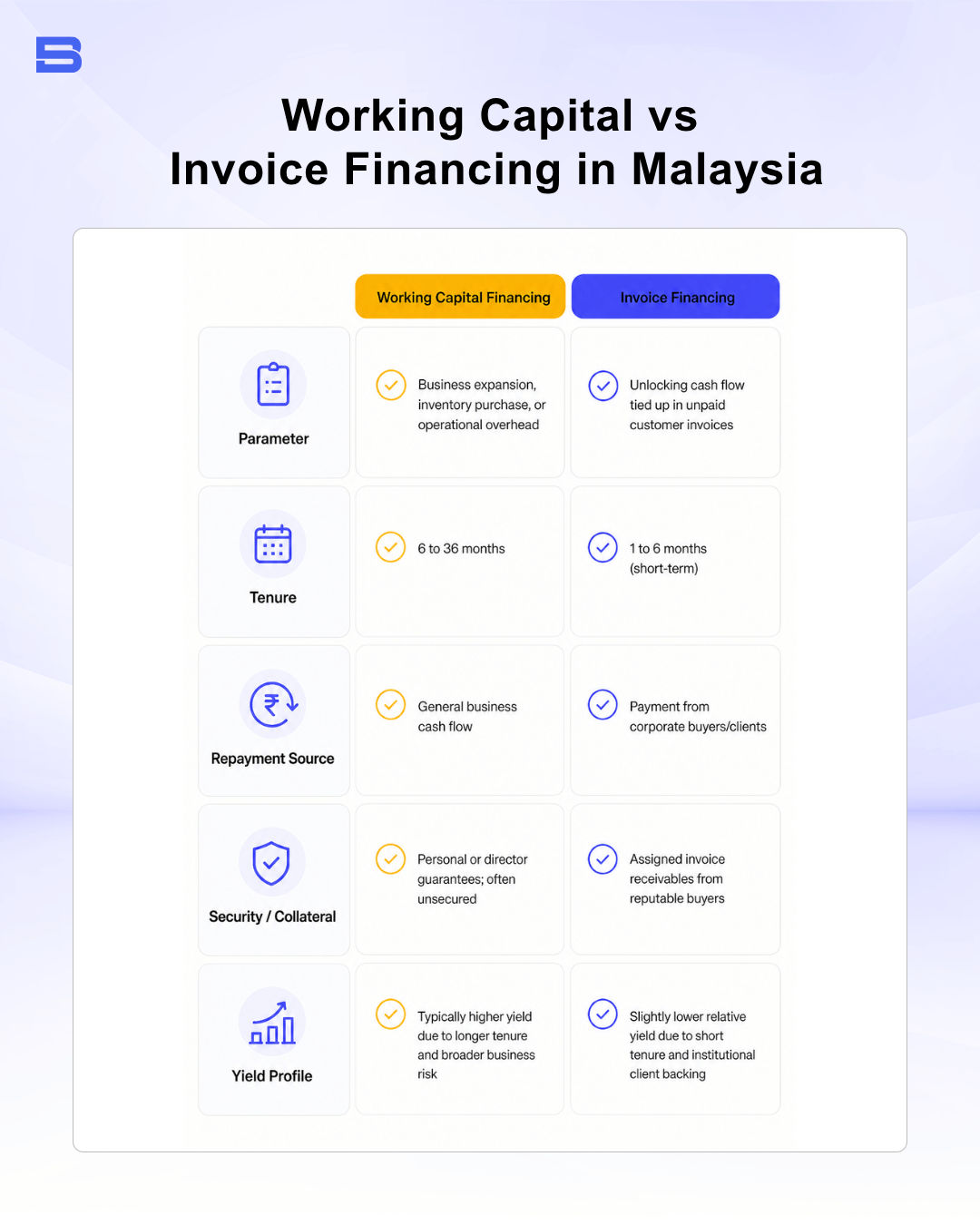
Islamic P2P Notes (Shariah-Compliant Debt Crowdfunding)
For investors seeking ethical or Shariah-compliant allocations, registered Malaysian P2P platforms offer Islamic investment notes. These notes replace conventional interest (Riba) structures with approved Islamic finance contracts:
- Commodity Murabahah (Cost-Plus Financing): The platform acts as an agent to trade underlying commodities, establishing a cost-plus-profit sale contract where the profit margin replaces interest.
- Wakalah (Agency Agreement): Investors appoint the platform as an agent to invest their capital into business ventures in exchange for a calculated profit distribution.
Islamic P2P notes undergo vetting by appointed Shariah advisors to ensure underlying business activities comply with Islamic principles.
Regulatory Oversight: Is P2P Lending Safe in Malaysia?
P2P lending is fully legal in Malaysia, governed strictly under the Guidelines on Recognised Markets issued by the Securities Commission Malaysia (SC). The SC regulates platform operators as Recognised Market Operators (RMOs) to safeguard retail investors. Key regulatory protections include:
Securities Commission Malaysia (SC)—Recognised Market Operator oversight covers:
- Mandatory Ring-Fenced Trust Account: Investor funds are held at third-party licensed banks, safe from platform insolvency.
- Platform Prudential Controls: Minimum paid-up capital of RM5 million; background checks on directors and key officers.
While SC framework enforcement minimizes platform-level operational risk, regulatory oversight does not eliminate credit default risk tied to individual business borrowers.
SC Investment Limits for Retail Investors
To prevent retail investors from over-concentrating capital into high-risk unlisted debt, the SC established specific investment threshold recommendations:
- Retail Investors: Recommended maximum exposure limit of RM50,000 total net investment across all P2P platforms at any given time.
- Angel Investors: Maximum net investment limit capped at RM500,000.
- Sophisticated Investors (High-Net-Worth Individuals & Entities): No investment limits imposed by the SC.
Limiting retail capital exposure protects non-accredited investors from over-leveraging into private debt markets.
Potential Returns and Risk Assessment: Balancing Yield and Default Risk
P2P lending in Malaysia can offer you higher potential returns than traditional fixed-income products, but you'll need to weigh yield targets against the risk of losing your capital.
- Historical Gross Returns: According to yield data reported across licensed Securities Commission Malaysia-regulated platforms, P2P notes have historically advertised gross yields ranging between 8% to 18% per annum, depending on the borrower's risk tier and note tenure.
- Net Expected Yield: Platform management fees (typically 1% of repayments or interest earned) and credit defaults reduce gross yields. Based on this platform-reported yield data, investors should target net portfolio yields of 6% to 12% per annum after deducting fees and defaults.
P2P notes are unsecured debt obligations issued by private companies. They are not insured by Perbadanan Insurans Deposit Malaysia (PIDM) or guaranteed by Bank Negara Malaysia (BNM) or platform operators. If a borrower defaults, investors face principal loss.
Understanding Default Rate Calculations: P2P vs. Bank NPLs
Investors evaluating platform risk must distinguish between P2P platform default calculations and traditional commercial bank Non-Performing Loans (NPLs):
P2P Cumulative Default Rate = (Total Defaulted Note Value Since Inception ÷ Total Disbursed Note Value Since Inception) × 100
Commercial banks define NPLs based on active loans past due over 90 days relative to total active outstanding loans. In contrast, P2P platform default rates reflect cumulative defaulted capital over total historical volume disbursed since platform launch. A young platform may show a low default rate due to rapid disbursement growth masking late-stage repayments, while mature platforms show stable historical risk metrics.
P2P Lending vs. Equity Crowdfunding: Key Differences
Debt crowdfunding and equity crowdfunding represent two distinct alternative asset classes regulated by the SC.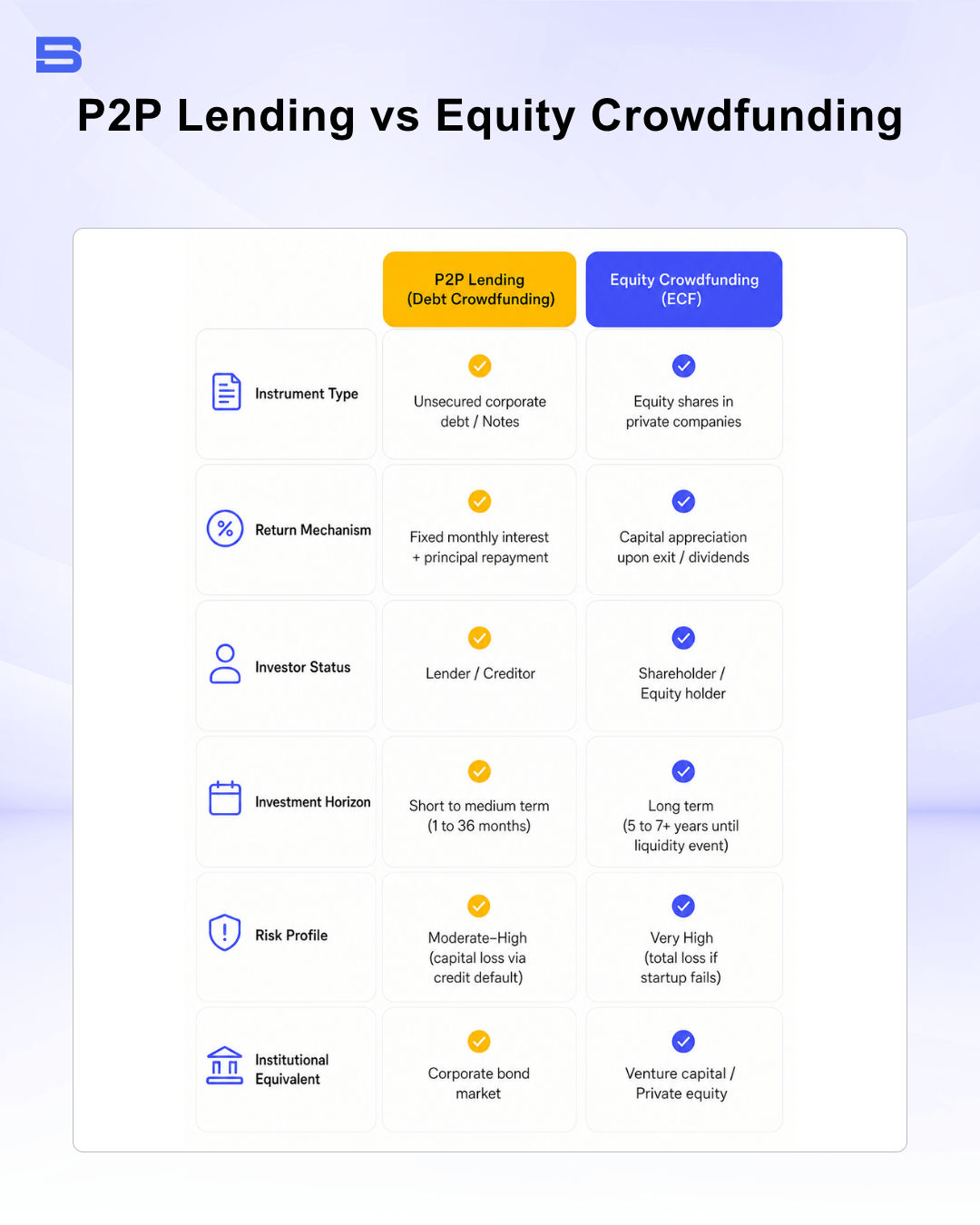 Investors seeking consistent monthly cash flow generally favor P2P lending, whereas investors seeking high long-term capital multiples target equity crowdfunding.
P2P Lending in an Alternative Investment Portfolio
P2P financing functions as a non-correlated asset class within a broader yield-generating strategy. When constructing a modern alternative asset portfolio, investors allocate across diverse non-traditional instruments:
Yield & Debt Assets
- P2P & Invoice Financing
- Sukuk & Private Debt
- Private Equity Holdings
Tangible & Real Asset Class
- Timber Investment
- Carbon Credit Trading
- Direct Real Estate / REITs
Including cash-flowing P2P notes alongside longer-horizon positions like timber investment or carbon credit trading creates liquidity buffers while stabilizing portfolio performance against public equity market swings.
P2P Lending As a Tool
If you're exploring fixed-income alternatives, P2P lending gives you a regulated, diversifiable way to earn stable cash flow while supporting local small businesses. By maintaining auto-allocation rules, diversifying capital across dozens of individual notes, and operating within the Securities Commission Malaysia's RM50,000 retail guidelines, investors can effectively manage borrower credit default risks while accumulating stable cash flow.
- What Can You Trade? A Guide to Forex, Stocks, and More
- CFD Trading for Beginners
- What is CFD Trading and How Does It Work?
- Forex vs. Stocks: Which Market Suits You Best?
- How to Diversify a Portfolio Across Asset Classes
- How Dividend Stocks Work: Yields, Risks, and Strategies
- Silver Trading Explained: A Guide for Retail Investors
- Precious Metals Trading: A Complete Guide for Beginners
- Natural Gas Trading: A Guide to the Market
- Structured Warrants Malaysia: How They Work and Risks
- What Is the KLCI Index and How to Trade It
- Gold Investment in Malaysia: A Complete Guide for Beginners
- What Is Kijang Emas and How to Invest in It
- Value Investing Explained: How to Find Undervalued Stocks
- How to Trade Bitcoin Safely: A Complete Market Guide
- Growth Investing Explained: Strategies, Metrics, and Risks
- What Is Digital Gold Malaysia and How to Invest
- Crypto Trading Strategies for Beginners
- Gold vs Bitcoin: Key Differences, Risks, and Strategies
- Sukuk: A Guide for Beginners to Islamic Bonds
- What Is FCPO (Crude Palm Oil Futures) and How to Trade It
- How to Identify and Invest in Shariah-Compliant Stocks
- Timber Investment: Is It Worth It?
- Gold ETF Malaysia: A Guide for Beginners
- What Are Malaysian Government Securities (MGS)?
- Corporate Bonds Malaysia: A Guide for Beginners
- China A-Shares Trading Guide for Malaysian Investors
- What Is a Silver ETF and How to Invest in It?
- How to Trade XRP: A Practical Guide for Retail Investors
- How to Trade Solana (SOL): A Guide for Beginners
- What Are Gold Futures and How Do They Work?
- Money Market Fund in Malaysia: A Guide for Beginners
- Property Investment Malaysia: Direct Real Estate or M-REITs?
- What Is Binance Coin and How Does It Work?
- Green Sukuk: A Guide for Beginners to Islamic ESG Investing
- What Is Shiba Inu (SHIB) and How to Trade It
- What Is USDT? A Complete Guide to Tether for Beginners
- What Is Dogecoin and How to Trade It Safely for Beginners
- Cardano: A Guide for Beginners to Trade This Cryptocurrency
- Polkadot: A Guide to Trading This Cryptocurrency
- Tron: A Guide for Beginners to Trading This Cryptocurrency
- What Is Litecoin (LTC)? A Guide to Trading Digital Silver
- What Is Chainlink (LINK) and How to Trade It
- How to Trade Pepe Coin: Spot, Leverage, and Risk Management
- Near Protocol: A Guide to Trading This Cryptocurrency
- Trading Polygon Crypto: A Practical Guide for Beginners
- Trade Toncoin: Understanding the TON Ecosystem and Risks
- Cosmos Crypto: Ecosystem Architecture, Tokenomics, and Risks
- Stellar Crypto: A Guide to Trading This Cryptocurrency
- Avalanche Crypto Explained: A Practical Guide for Traders
- What Is Worldcoin? How to Trade WLD and Manage Risk
- Aptos: A Guide for Beginners to Trading This Cryptocurrency
- Sui Crypto Explained: Tokenomics and Trading Guide
- Celestia: A Guide to Trading This Cryptocurrency
- Decentraland: A Guide to Trading This Cryptocurrency
- What Is Arbitrum? How to Trade the Leading Layer 2 Network
- Sei Crypto: A Guide to Trading This Cryptocurrency
- What Is Injective Protocol and How to Trade INJ Safely
Disclaimer: The content on this page is intended for educational and informational purposes only. It does not constitute financial, investment, tax, or legal advice, and should not be interpreted as a recommendation to buy, sell, or hold any financial instrument or asset. Trading and investing involve significant risk, including the possible loss of your entire capital. Products such as forex, CFDs, and cryptocurrencies carry additional risks due to leverage, high volatility, and limited regulatory protection in some jurisdictions. Past performance of any financial instrument does not guarantee future results. Any market views, forecasts, or opinions expressed are those of the author at the time of writing and may not reflect current market conditions. Platform features, fees, and regulatory status are subject to change — always verify information directly with the relevant provider or regulator before making any financial decision. BrokerSpecs may receive compensation from third parties featured on this site. Always conduct your own due diligence and consider seeking advice from a licensed financial professional before investing. Portions of this article were prepared with the assistance of AI tools and reviewed by our editorial team before publication.