


Related Tags
When heavy rains stall tapping across southern Thailand or container vessels face shipping bottlenecks at regional ports, global tire manufacturers feel the pinch almost immediately. Natural rubber is not just an agricultural commodity harvested from trees—it is the industrial backbone of modern transportation and commercial logistics.
If you have ever considered trading soft commodities beyond gold or crude oil, rubber presents a unique combination of agricultural supply dynamics and industrial demand. Navigating rubber trading effectively requires understanding how physical production, synthetic alternatives, and international exchange contracts interconnect.
What Is Rubber Trading and How Does It Work?
Rubber trading is the buying and selling of standardized derivative contracts, primarily futures and Contracts for Difference (CFDs), based on the global market prices of natural latex and processed rubber grades.
Rather than taking delivery of physical rubber sheets or liquid latex bales, retail traders participate in paper markets to speculate on short-term price movements or hedge against physical supply chain volatility. Like broader commodity trading across agricultural and industrial sectors, rubber prices respond directly to shifting macroeconomic conditions, currency fluctuations, and trade policy updates.
How does a standard derivative trade work in practice? When you trade rubber futures or CFDs, contract values are typically quoted in US cents or Japanese yen per kilogram. Position sizes are standardized into metric tons (MT), allowing market participants to gain exposure to large physical volumes through fractional margin deposits.
Consider a practical example: imagine you take a long position on 1 lot of SGX SICOM Technically Specified Rubber 20 (TSR20) futures, which represents 5 metric tons (5,000 kg). If the market price is $1.60 per kg, the total underlying contract value equals $8,000.
Assuming a 10% initial margin requirement ($800), a $0.05 increase in price to $1.65 per kg yields a $250 profit (0.05 x 5,000 kg), representing a 31.25% return on your margin deposit.
Conversely, if the price drops by $0.05 to $1.55 per kg, you incur a $250 loss. Because financial leverage amplifies both profits and losses equally, a modest 3.125% adverse price movement erodes nearly a third of your deposited margin capital.
Market Fundamentals: Natural vs. Synthetic Rubber
Understanding natural vs synthetic rubber dynamics is fundamental for any trader tracking soft commodity markets. While both materials serve manufacturing industries, their production processes, cost structures, and price drivers differ significantly.
Natural rubber is harvested as liquid latex from Hevea brasiliensis trees, primarily across Southeast Asian nations like Thailand, Indonesia, and Malaysia. Because rubber trees require roughly seven years of growth before tapping can begin, natural rubber supply cannot adjust instantly to sudden spikes in industrial demand.
Synthetic rubber, on the other hand, is derived from petroleum by-products such as butadiene and styrene. When crude oil prices surge, the cost of manufacturing synthetic rubber rises, prompting industrial buyers to substitute toward natural rubber.
This economic substitution creates a tight structural relationship between global energy markets and natural rubber benchmark pricing.
Natural Rubber Grades: TSR20 vs. RSS3 Contracts
When trading natural rubber futures, market participants select between two primary standardized market grades: TSR20 and RSS3.
Technically Specified Rubber 20 (TSR20) is a block-grade rubber processed under standardized technical specifications. It accounts for the vast majority of global tire manufacturing consumption, making it the primary benchmark for industrial demand.
Ribbed Smoked Sheet 3 (RSS3) represents raw latex coagulated, rolled into sheets, and smoked in kilns. RSS3 carries higher purity standards and trades actively on regional Asian exchanges, though TSR20 remains the dominant global benchmark for commercial hedging.
Where Is Rubber Traded? Key Commodity Exchanges (SGX, TOCOM, SHFE)
If you are evaluating where rubber is traded, the primary liquidity venues are concentrated across major Asian financial exchanges.
The dominant international derivative exchanges include:
- Singapore Exchange (SGX SICOM): Home to the world's primary pricing benchmark for TSR20 futures. SGX SICOM rubber futures are globally recognized as the standard reference for physical rubber procurement and tire industry contracts.
- Osaka Exchange (JPX / TOCOM): Japan's premier derivatives market trades RSS3 futures quoted in JPY per kilogram. It attracts significant regional speculative trading alongside commercial hedging.
- Shanghai Futures Exchange (SHFE): China represents the single largest national consumer of natural rubber globally. SHFE natural rubber contracts provide massive liquidity, though international retail access requires specific offshore brokerage connections.
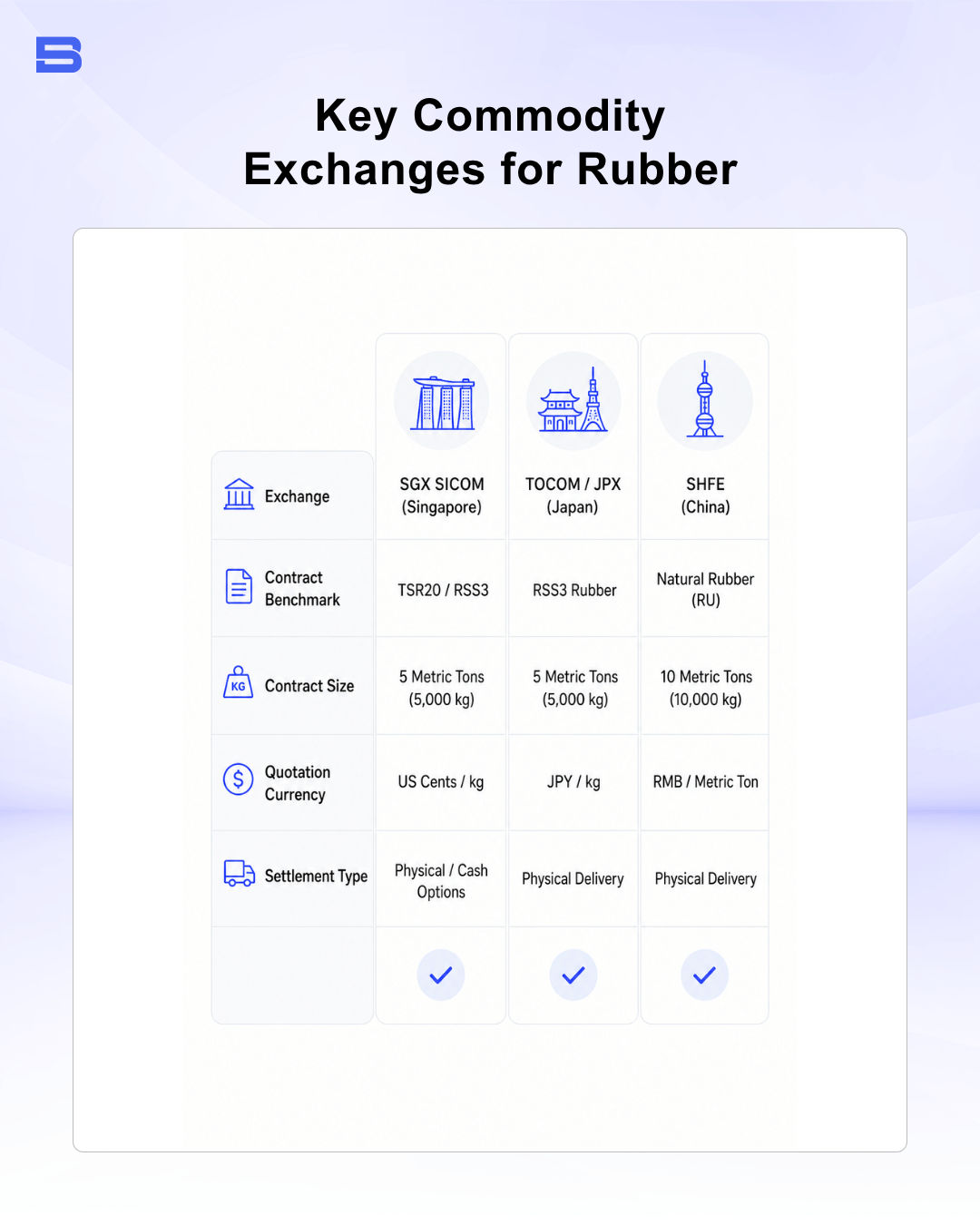 Traders accessing these venues must account for regional operating hours and market holiday schedules across Singapore, Tokyo, and Shanghai to avoid liquidity gaps between trading sessions.
Key Drivers of Rubber Prices
Rubber prices fluctuate based on an intricate blend of industrial manufacturing output, energy market trends, and climate conditions across primary producing nations.
Primary Price Drivers: Automotive Industry and Tire Production
The commercial automotive sector drives global rubber consumption, with automotive tire demand absorbing roughly 70% of all harvested natural rubber, according to data compiled by the Association of Natural Rubber Producing Countries (ANRPC).
When global vehicle sales increase, commercial truck freight expands, or electric vehicle assembly scales up, tire manufacturers increase raw latex procurement orders. Conversely, global economic downturns or supply chain disruptions in automobile manufacturing directly depress raw rubber prices.
Crude Oil Link and Weather Seasonality
Because synthetic rubber relies on petroleum feedstocks, decisions when you trade oil exert a direct economic influence on natural rubber valuations. Higher crude oil prices make synthetic alternatives more expensive, encouraging industrial buyers to switch to natural latex.
Climate seasonality across Southeast Asia also heavily dictates physical supply. During the annual "wintering" period from February through May, rubber trees shed leaves and latex production drops substantially. Heavy monsoon seasons or flooding in Thailand, Indonesia, or Malaysia can disrupt harvesting schedules, generating short-term supply deficits.
This is what makes rubber trading distinct from other soft commodities: its direct link to a single dominant end-use industry.
Comparing Commodity Futures: Rubber Trading vs. FCPO (Crude Palm Oil)
For traders assessing regional Asian soft commodities, contrasting rubber derivatives against FCPO (crude palm oil futures) reveals distinct operational profiles.
Both contracts depend heavily on Southeast Asian agricultural output and global export demand, yet they respond to different economic drivers. While rubber prices track commercial vehicle manufacturing, crude palm oil reacts to global food processing and biofuel mandates.
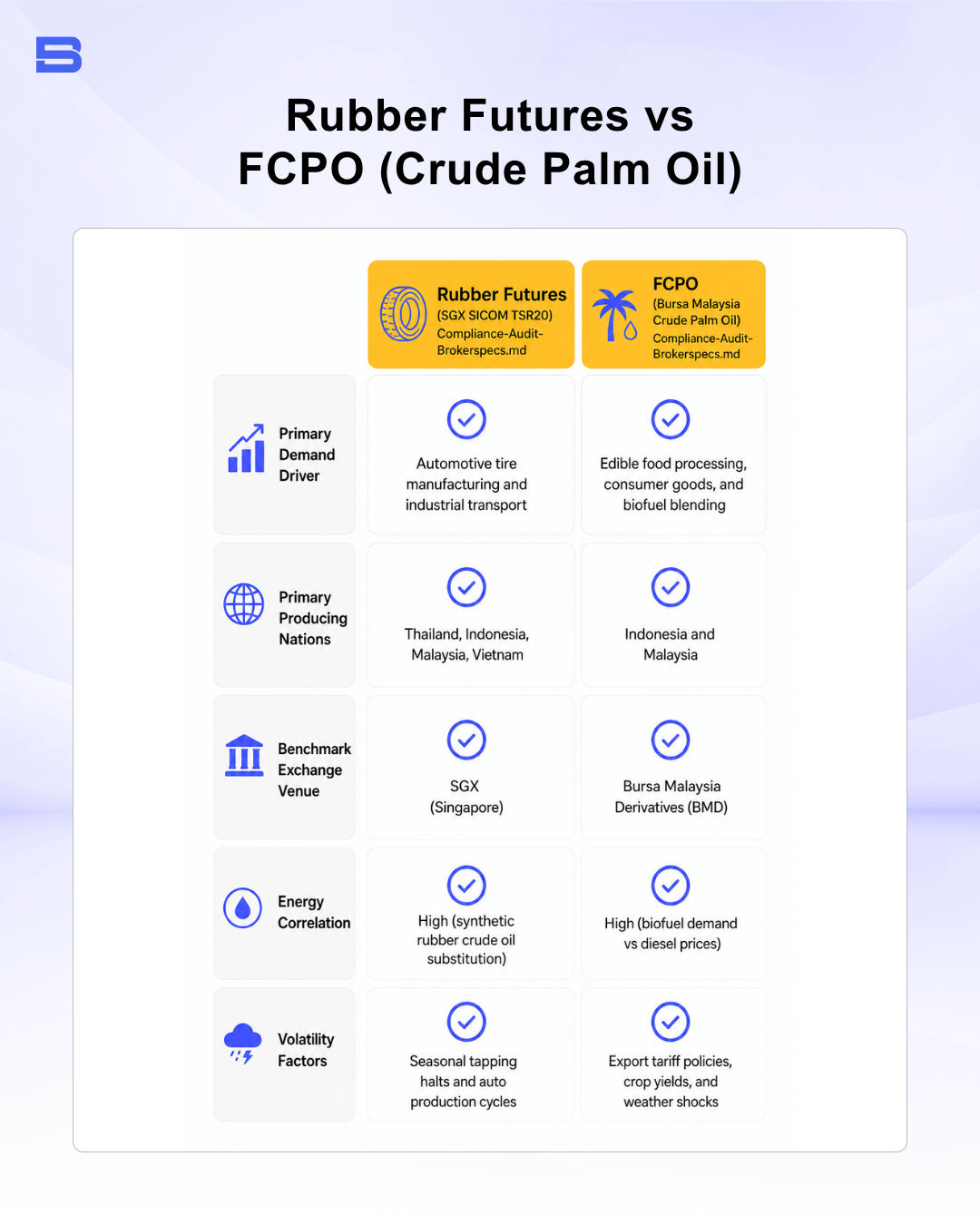
Traders comparing agricultural commodity derivatives can review regulatory structures directly through official exchange operators like Bursa Malaysia.
Key Trading Risks: Leverage, Seasonality, and Physical Delivery
While agricultural derivatives offer valuable portfolio diversification, trading rubber involves structural risks that require careful risk management.
Structural Trading Risks and Mitigation
- Leverage and Margin Risk: Futures and CFDs rely on leverage, which expands potential returns when markets move favorably, but accelerates total capital loss when prices move against your position.
- Physical Settlement Risk: Standard futures contracts listed on exchanges like TOCOM or SHFE often require physical delivery upon expiration. Retail traders using futures accounts must roll over or close expiring positions prior to the first notice date to avoid unexpected physical settlement risk.
- Currency Exposure and Trade Tariffs: Because rubber is priced in US Dollars, Japanese Yen, or Renminbi across international markets, shifts in the forex market and bilateral trade tariffs can rapidly alter profit margins for regional exporters and industrial buyers.
Understanding the Rubber Market
Rubber trading provides targeted exposure to the convergence of global automotive manufacturing and regional agricultural supply chains.
By monitoring automotive production trends, synthetic petroleum substitution costs, and weather patterns across Southeast Asia, traders can identify structural opportunities across regional commodity exchanges. Maintaining strict position sizing and respecting contract expiration schedules remains essential for navigating commodity volatility safely.
For traders new to soft commodities, rubber trading offers a distinct entry point compared to metals or energy markets.
- What Can You Trade? A Guide to Forex, Stocks, and More
- CFD Trading for Beginners
- What is CFD Trading and How Does It Work?
- Forex vs. Stocks: Which Market Suits You Best?
- How to Diversify a Portfolio Across Asset Classes
- How Dividend Stocks Work: Yields, Risks, and Strategies
- Silver Trading Explained: A Guide for Retail Investors
- Precious Metals Trading: A Complete Guide for Beginners
- Natural Gas Trading: A Guide to the Market
- Structured Warrants Malaysia: How They Work and Risks
- What Is the KLCI Index and How to Trade It
- Gold Investment in Malaysia: A Complete Guide for Beginners
- What Is Kijang Emas and How to Invest in It
- Value Investing Explained: How to Find Undervalued Stocks
- How to Trade Bitcoin Safely: A Complete Market Guide
- Growth Investing Explained: Strategies, Metrics, and Risks
- What Is Digital Gold Malaysia and How to Invest
- Crypto Trading Strategies for Beginners
- Gold vs Bitcoin: Key Differences, Risks, and Strategies
- Sukuk: A Guide for Beginners to Islamic Bonds
- What Is FCPO (Crude Palm Oil Futures) and How to Trade It
- How to Identify and Invest in Shariah-Compliant Stocks
- Timber Investment: Is It Worth It?
- Gold ETF Malaysia: A Guide for Beginners
- What Are Malaysian Government Securities (MGS)?
- Corporate Bonds Malaysia: A Guide for Beginners
- China A-Shares Trading Guide for Malaysian Investors
- What Is a Silver ETF and How to Invest in It?
- How to Trade XRP: A Practical Guide for Retail Investors
- How to Trade Solana (SOL): A Guide for Beginners
- What Are Gold Futures and How Do They Work?
- Money Market Fund in Malaysia: A Guide for Beginners
- Property Investment Malaysia: Direct Real Estate or M-REITs?
- What Is Binance Coin and How Does It Work?
- Green Sukuk: A Guide for Beginners to Islamic ESG Investing
- What Is Shiba Inu (SHIB) and How to Trade It
- What Is USDT? A Complete Guide to Tether for Beginners
- What Is Dogecoin and How to Trade It Safely for Beginners
- Cardano: A Guide for Beginners to Trade This Cryptocurrency
- Polkadot: A Guide to Trading This Cryptocurrency
- Tron: A Guide for Beginners to Trading This Cryptocurrency
- What Is Litecoin (LTC)? A Guide to Trading Digital Silver
- What Is Chainlink (LINK) and How to Trade It
- How to Trade Pepe Coin: Spot, Leverage, and Risk Management
- Near Protocol: A Guide to Trading This Cryptocurrency
- Trading Polygon Crypto: A Practical Guide for Beginners
- Trade Toncoin: Understanding the TON Ecosystem and Risks
- Cosmos Crypto: Ecosystem Architecture, Tokenomics, and Risks
- Stellar Crypto: A Guide to Trading This Cryptocurrency
- Avalanche Crypto Explained: A Practical Guide for Traders
- What Is Worldcoin? How to Trade WLD and Manage Risk
- Aptos: A Guide for Beginners to Trading This Cryptocurrency
- Sui Crypto Explained: Tokenomics and Trading Guide
- Celestia: A Guide to Trading This Cryptocurrency
- Decentraland: A Guide to Trading This Cryptocurrency
- What Is Arbitrum? How to Trade the Leading Layer 2 Network
- Sei Crypto: A Guide to Trading This Cryptocurrency
- What Is Injective Protocol and How to Trade INJ Safely
Disclaimer: The content on this page is intended for educational and informational purposes only. It does not constitute financial, investment, tax, or legal advice, and should not be interpreted as a recommendation to buy, sell, or hold any financial instrument or asset. Trading and investing involve significant risk, including the possible loss of your entire capital. Products such as forex, CFDs, and cryptocurrencies carry additional risks due to leverage, high volatility, and limited regulatory protection in some jurisdictions. Past performance of any financial instrument does not guarantee future results. Any market views, forecasts, or opinions expressed are those of the author at the time of writing and may not reflect current market conditions. Platform features, fees, and regulatory status are subject to change — always verify information directly with the relevant provider or regulator before making any financial decision. BrokerSpecs may receive compensation from third parties featured on this site. Always conduct your own due diligence and consider seeking advice from a licensed financial professional before investing. Portions of this article were prepared with the assistance of AI tools and reviewed by our editorial team before publication.