



Related Tags
You close your fourth consecutive winning trade of the week, watch your account balance tick higher, and suddenly the market feels predictable. It is easy to convince yourself in that moment that you have finally cracked the code, transforming initial caution into an assumption of personal mastery. That quiet sense of invulnerability is precisely where danger begins, setting you up for disproportionate downside just when you feel safest.
What Is Overconfidence Bias in Trading?
Overconfidence bias is a cognitive distortion where a trader overestimates their personal knowledge, skill, and predictive accuracy relative to objective market realities. It causes you to believe your judgment is superior to statistical probabilities, leading you to take unwarranted risks.
When trades go well, human psychology naturally attributes the profitable outcome to exceptional skill, sharp analysis, or market intuition. Conversely, random market luck or favorable prevailing trends often drive short-term success far more than execution precision. Confusing temporary luck with durable competence creates an emotional trap.
Healthy confidence relies on statistical feedback, strict execution of an edge, and complete acceptance of uncertainty. Emotional overconfidence, by contrast, relies on recent winning streaks and assumes future outcomes can be controlled.
Common Forms of Overconfidence Bias
Overconfidence shows up in several distinct patterns, and traders often combine them with related biases that influence how you interpret data and price action.
Overprecision and Overestimation
Overprecision happens when you express excessive certainty about an exact price target or outcome. You might convince yourself that support will hold down to the exact pip, refusing to account for normal market noise.
Overestimation involves rating your personal trading ability, speed, and analytical edge much higher than objective performance records show. You assume you can outsmart market volatility, which encourages aggressive entries without adequate confirmation.
The Illusion of Control and Prediction Bias
The illusion of control is the belief that you can steer or forecast outcomes in an environment driven entirely by external probabilities. Staring at complex charting indicators, news feeds, or proprietary algorithms creates a false sense of security.
This illusion feeds directly into prediction bias and confirmation bias, where you selectively gather data confirming your position while discarding conflicting signals. You begin trading your personal expectations rather than actual price behavior.
How Overconfidence Distorts Risk Management
Overconfidence rarely damages accounts through flawed technical analysis alone. Instead, it often does its damage by dismantling capital protection rules.
How Overconfidence Triggers Overtrading and Excessive Risk
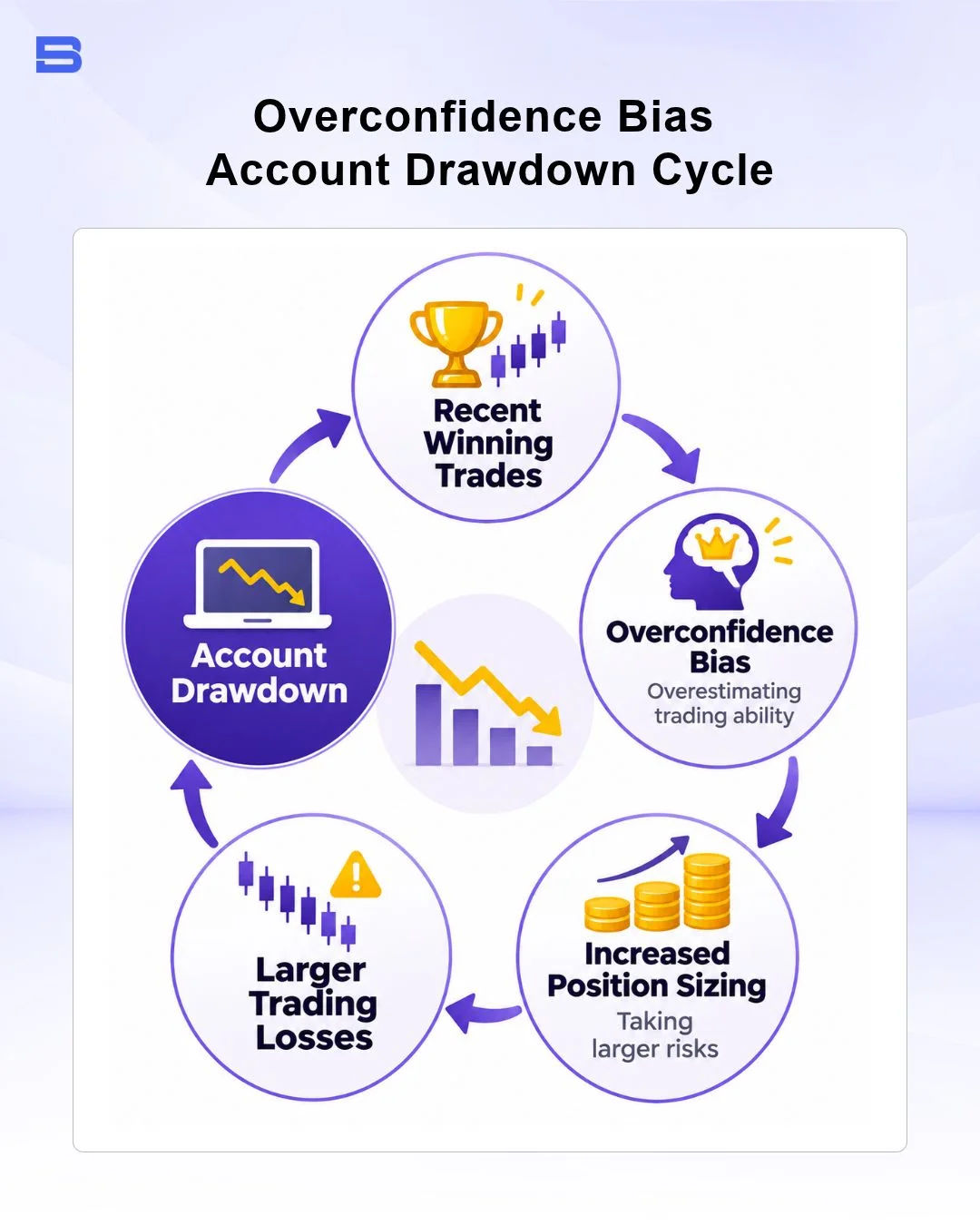
Once you feel invincible, standard risk limits begin to feel like unnecessary restrictions. You may experience position size creep, doubling or tripling your lot sizes simply because your conviction is high.
Stop-loss orders get pushed further away or removed altogether under the belief that the market will inevitably turn back in your favor. When an oversized position hits an unexpected reversal, severe capital loss can trigger shock, often escalating into panic or revenge trading to recoup capital immediately.
Common Overconfidence Bias Examples in Financial Markets
Consider a concrete position-sizing scenario on a $10,000 account. Under your standard trading plan, you commit to risking 1% per setup, representing $100 of risk.
After five consecutive wins, your balance sits at $10,800. Convinced that your strategy cannot fail under current market conditions, you raise your risk to 5% ($540) on the next idea.
A sudden economic headline triggers a sharp market gap, resulting in three consecutive losses at this higher exposure. Your capital drops by $1,620 in three trades, wiping out weeks of disciplined progress and pushing your account into a sharp 15% drawdown.
CFA Institute research on behavioral finance highlights that overconfidence bias can encourage excessive trading among investors, including retail and professional market participants. This tendency may increase trading costs and reduce investment returns over time.
How to Overcome Overconfidence Bias: Four Capital Protection Rules
Overcoming cognitive bias does not mean eliminating confidence. It means building external systems that restrain emotional overreach. Developing an objective trading mindset requires strict execution rules that operate independently of how you feel.
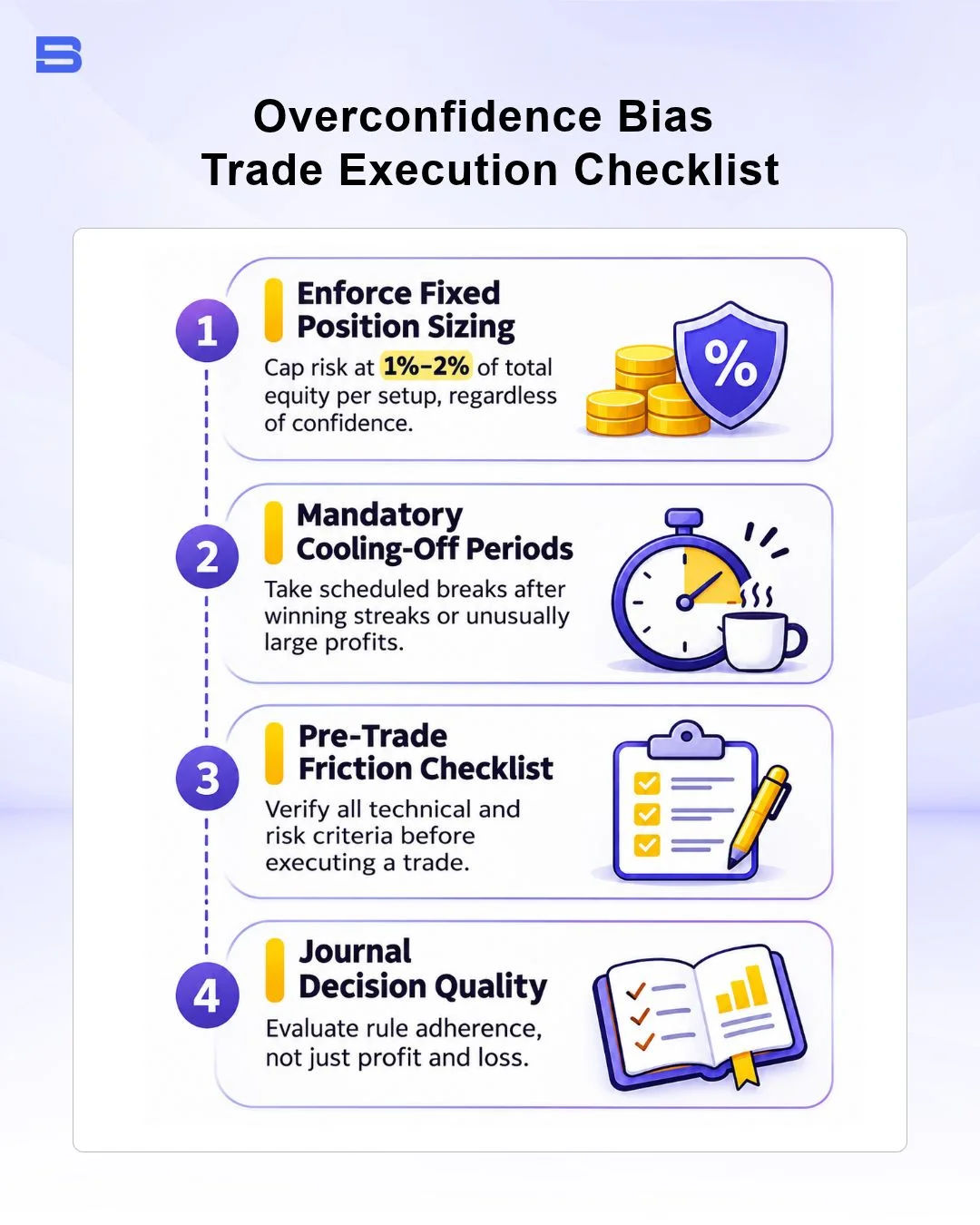
- Enforce Fixed Position Sizing: Maintain a rule capping maximum risk at 1% to 2% of total equity per setup. Conviction should never dictate lot size. Your edge plays out across hundreds of trades, not a single speculative bet.
- Implement Mandatory Cooling-Off Periods: Step away from execution screens after a significant winning run or unusually large profit. Enforcing scheduled downtime may help prevent dopamine-driven trades from eroding capital.
- Use Pre-Trade Friction Checklists: Review a written checklist verifying every technical and risk criterion before clicking buy or sell. Introducing deliberate operational friction can help you trade your documented rules rather than pure excitement. Structured decision boundaries, such as a written checklist, may help traders avoid impulsive execution errors.
- Journal Decision Quality Over P&L: Grade your trading day by how strictly you followed your risk management plan, rather than net profits. A trade that ignores your plan but still makes money is a behavioral error that can reinforce costly habits.
Conclusion
Sustainable trading is not about predicting every market movement but managing downside risk when unexpected volatility occurs. Recognizing overconfidence bias helps traders maintain objective decision-making, avoid excessive risk-taking, and protect their capital beyond short-lived winning streaks.
Disclaimer: The content on this page is intended for educational and informational purposes only. It does not constitute financial, investment, tax, or legal advice, and should not be interpreted as a recommendation to buy, sell, or hold any financial instrument or asset. Trading and investing involve significant risk, including the possible loss of your entire capital. Products such as forex, CFDs, and cryptocurrencies carry additional risks due to leverage, high volatility, and limited regulatory protection in some jurisdictions. Past performance of any financial instrument does not guarantee future results. Any market views, forecasts, or opinions expressed are those of the author at the time of writing and may not reflect current market conditions. Platform features, fees, and regulatory status are subject to change — always verify information directly with the relevant provider or regulator before making any financial decision. BrokerSpecs may receive compensation from third parties featured on this site. Always conduct your own due diligence and consider seeking advice from a licensed financial professional before investing. Portions of this article were prepared with the assistance of AI tools and reviewed by our editorial team before publication.