



Related Tags
You are sitting in front of your trading terminal in late December, watching beaten-down equities drift toward new yearly lows. The financial media begins buzzing about an impending seasonal rally, tempting you to buy beaten-down assets in anticipation of a predictable new-year surge. While seasonal patterns sound enticing, betting real capital on historical calendar tendencies requires separating structural market mechanics from retail folklore.
What Is the January Effect in Stocks?
The January effect in stocks is a seasonal market anomaly where equity prices, especially small-cap equities, historically rise during the first month of the year.
First documented in 1942 by investment banker Sidney Wachtel, the January effect describes the historical tendency of stocks, particularly small-cap equities, to generate unusually high returns during January compared with other months. Subsequent empirical research by Rozeff and Kinney (1976) provided statistical evidence of this seasonal market anomaly.
Researchers tracked this outperformance across decades, discovering that the first few trading sessions of January often captured the bulk of these gains.
As academic finance evolved, researchers scrutinized whether this calendar quirk represented a true market inefficiency or merely an artifact of unadjusted risk. To understand why it captured traders’ attention for over half a century, you must examine the tax and reporting pressures that generate year-end liquidity imbalances.
Why Does the January Effect Happen? Core Drivers and Mechanics
The phenomenon is commonly linked to institutional and retail cash-flow dynamics that may shift overall market sentiment as the tax year closes, rather than to random calendar optimism. Two primary forces historically drove these concentrated flows: tax compliance and portfolio presentation.
December Tax-Loss Harvesting and Reinvestment Pressure
Tax-loss harvesting occurs when retail and institutional investors intentionally sell depreciated assets before December 31 to realize capital losses. These realized losses offset taxable capital gains generated across their broader portfolios, lowering total tax liabilities.
This can create selling pressure on underperforming stocks toward the end of the fourth quarter. Once the new calendar year starts, investors may redeploy that sidelined cash back into equities, which can add buying volume and help lift depressed prices in early January.
Institutional Window Dressing and Year-End Reporting
Institutional fund managers face strict quarterly and annual disclosure mandates to show their holdings to clients. Portfolio managers frequently sell their worst-performing holdings before year-end so those losing tickers do not appear on their published annual statements—a practice known as window dressing.
After the reporting snapshot passes on December 31, managers rotate capital back into undervalued opportunities. This systematic unloading and repurchasing can create calendar-based volume clusters across institutional equity desks.
Why Small-Cap Stocks Historically Led the Anomaly
Large-cap companies with hundreds of billions in market capitalization absorb institutional flows with minimal price distortion. In contrast, small-cap stocks feature thin liquidity profiles, lower free-float volumes, and wider trading bands.
When year-end tax sellers dump micro-cap and small-cap shares, the lack of immediate buyer support causes sharp price declines. When cash flows back into these same names in January, the relatively small capital injection can trigger sharp upward percentage moves.
This structural asymmetry created heightened volatility that historically allowed small-cap benchmarks, such as the Russell 2000, to outpace large-cap benchmarks like the S&P 500 during the first weeks of the year.
Does the January Effect Still Work Today? Modern Market Realities
If you are planning to build an active trading strategy around the January effect today, modern market efficiency can present significant challenges. The widespread awareness of the anomaly may have altered its timing and statistical reliability.
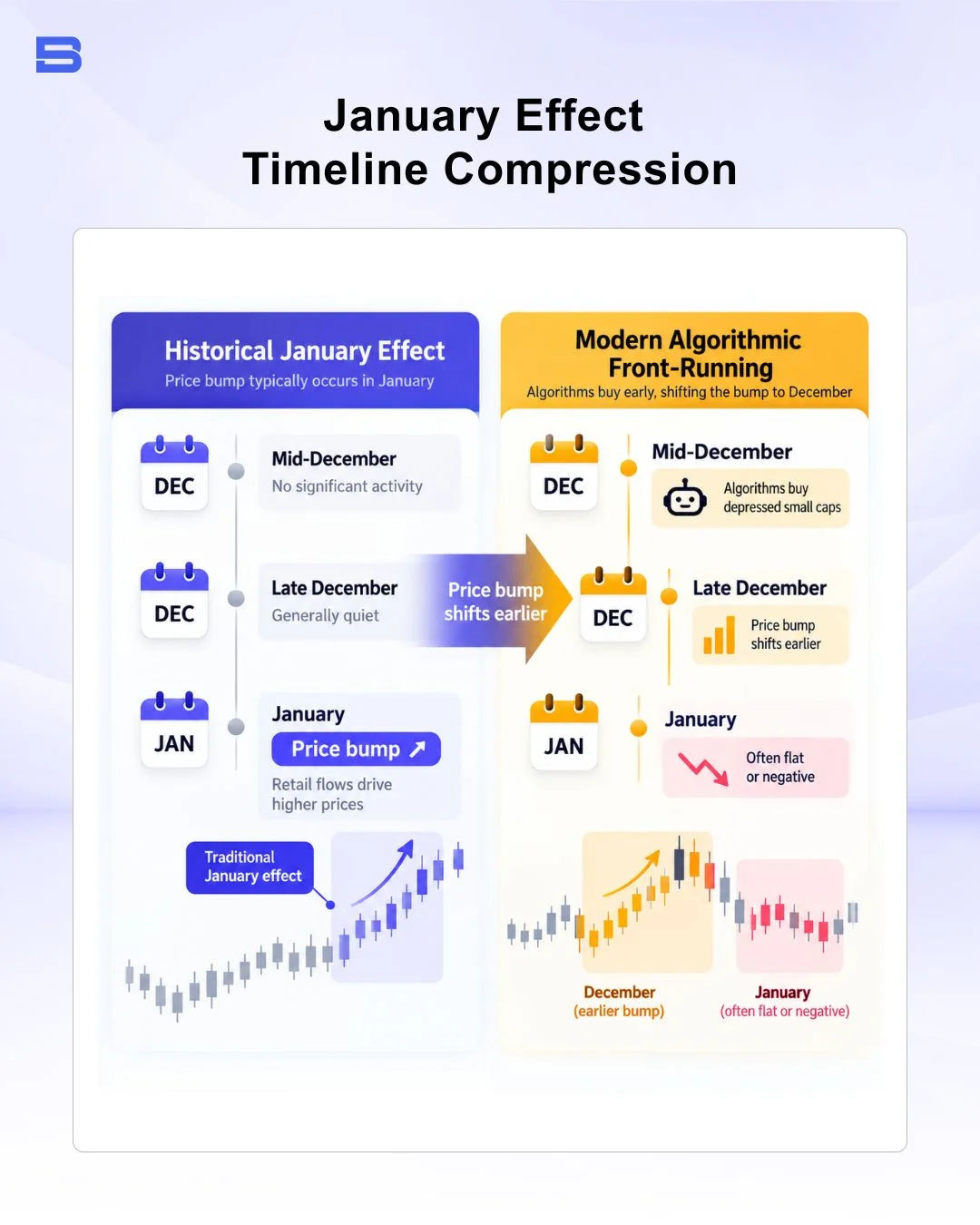
Financial markets adapt quickly when edges become public knowledge. As hedge funds and quantitative firms deployed automated algorithms, some may have begun buying depressed small caps in mid-December to front-run the expected January retail flows. This front-running may have shifted the historical price bump backward into late December, which could leave January trading sessions flat or negative.
Broad macroeconomic conditions can outweigh seasonal market tendencies. During periods of heightened uncertainty and elevated VIX readings, increased risk aversion, portfolio adjustments, and macro-driven selling can weaken or even reverse the January effect, making historical seasonal patterns less reliable as standalone trading signals.
Relying on a calendar pattern without assessing macro liquidity or trend structure exposes traders to significant market risk.
The Hidden Execution Trap: Spreads, Slippage, and Net Returns
Many backtested studies demonstrate paper profits for calendar anomalies while completely ignoring the real-world transaction friction of small-cap trading. Wide bid-ask spreads and order execution slippage frequently transform a theoretical gain into a net trading loss.
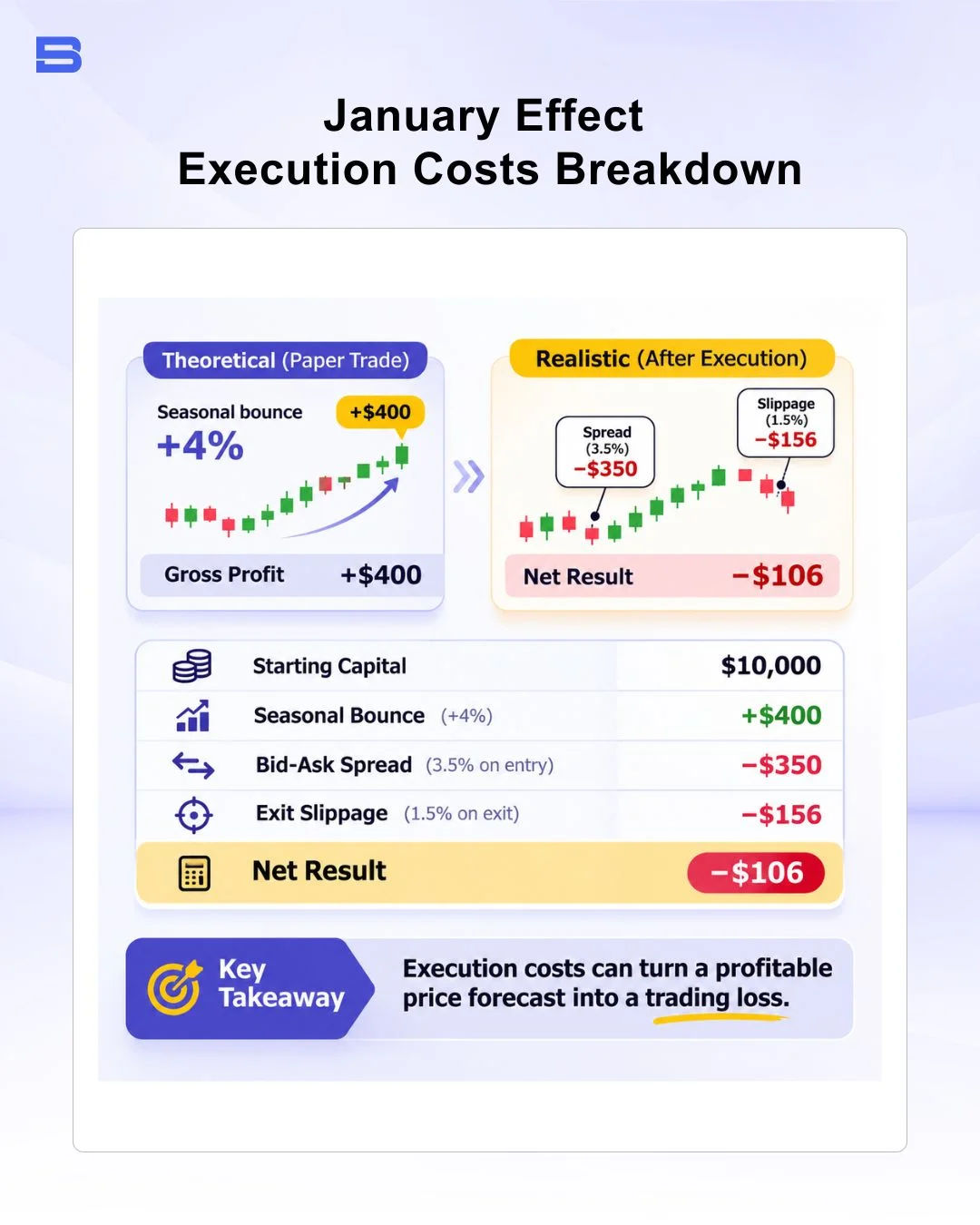
Consider a scenario where you allocate $10,000 to trade a basket of beaten-down micro-cap stocks targeting a seasonal 4% bounce. Because these equities suffer from low market liquidity, you face an average bid-ask spread of 3.5% on entry and 1.5% execution slippage when exiting into thin order books.
Your gross paper gain of $400 is quickly eliminated by $350 in spread costs and $156 in exit slippage, leaving you with a net loss of $106. In illiquid markets, entering an aggressive position without disciplined risk management and tight slippage controls can trigger an unexpected portfolio drawdown, even when your theoretical price thesis is correct.
Bottom Line: How to Treat the January Effect
Calendar anomalies offer fascinating insights into market history and human behavior, but treating them as predictable cash machines can lead to frustration. Modern markets are highly competitive, and algorithmic traders have largely priced out simplistic seasonal advantages. Instead of relying on the calendar to dictate your trades, focus on verifiable market data, liquidity realities, and robust risk management.
Disclaimer: The content on this page is intended for educational and informational purposes only. It does not constitute financial, investment, tax, or legal advice, and should not be interpreted as a recommendation to buy, sell, or hold any financial instrument or asset. Trading and investing involve significant risk, including the possible loss of your entire capital. Products such as forex, CFDs, and cryptocurrencies carry additional risks due to leverage, high volatility, and limited regulatory protection in some jurisdictions. Past performance of any financial instrument does not guarantee future results. Any market views, forecasts, or opinions expressed are those of the author at the time of writing and may not reflect current market conditions. Platform features, fees, and regulatory status are subject to change — always verify information directly with the relevant provider or regulator before making any financial decision. BrokerSpecs may receive compensation from third parties featured on this site. Always conduct your own due diligence and consider seeking advice from a licensed financial professional before investing. Portions of this article were prepared with the assistance of AI tools and reviewed by our editorial team before publication.