



Related Tags
You buy a position, and within minutes, the market ticks up a few points into green territory. Your heart rate accelerates, your cursor hovers over the close button, and you exit immediately with a $40 gain, relieved to lock in a victory. Later that afternoon, another position drops into the red, but instead of cutting it, you freeze, move your protective order further out, and whisper that it will bounce back.
That urge to bank small wins while tolerating large drawdowns is known as the disposition effect, and it may quietly erode trading accounts as much as flawed market analysis can.
What Is the Disposition Effect in Trading?
The disposition effect is an investor behavioral bias where traders sell winning assets prematurely to secure gains while stubbornly holding losing assets too long in hopes of breaking even.
This psychological tendency stems from how human brains separate paper gains from paper losses. As long as a declining position remains open, you can tell yourself that the loss is unrealized and therefore not real. Closing a winning trade provides an immediate dopamine hit of validation, whereas closing a trade in the red forces you to confront an objective mistake. An academic study of US brokerage accounts covering 1987 to 1993 found that investors realized gains at roughly 1.5 times the rate of losses, creating an inverted payoff curve across their portfolios.
Why Traders Fall for It: Prospect Theory and Loss Aversion
The underlying mechanics of this error were first mapped out by Daniel Kahneman and Amos Tversky in their foundational work on prospect theory in trading. Standard financial theory assumes humans evaluate financial outcomes purely on net wealth, but real individuals evaluate choices based on perceived gains and losses relative to an arbitrary reference point, usually their purchase price.
Because the psychological pain of losing $500 is roughly twice as intense as the joy of winning $500, humans develop severe loss aversion. When a trade sits in profit, you become risk-averse, wanting to grab the sure thing before it vanishes. Conversely, once an asset dips below your entry price, your behavior shifts into risk-seeking mode: you gamble that holding on through deeper turbulence is preferable to taking a certain loss right now.
Regret Aversion and Mental Accounting
Beyond basic loss aversion, two cognitive forces reinforce the disposition effect: regret aversion and mental accounting. Regret aversion makes you fear the frustration of watching a realized profit turn into a loss, pushing you to sell too early. At the same time, mental accounting isolates every individual trade into its own private scoreboard. Instead of viewing your account as a cohesive pool of capital where small operational losses are standard business expenses, you treat an individual losing ticket as a personal failure that must be redeemed.
A Worked Example: How Cutting Winners Short Destroys Expectancy
To see how damaging this bias is to your capital, look at the mathematics of trading expectancy rather than relying on gut feelings.
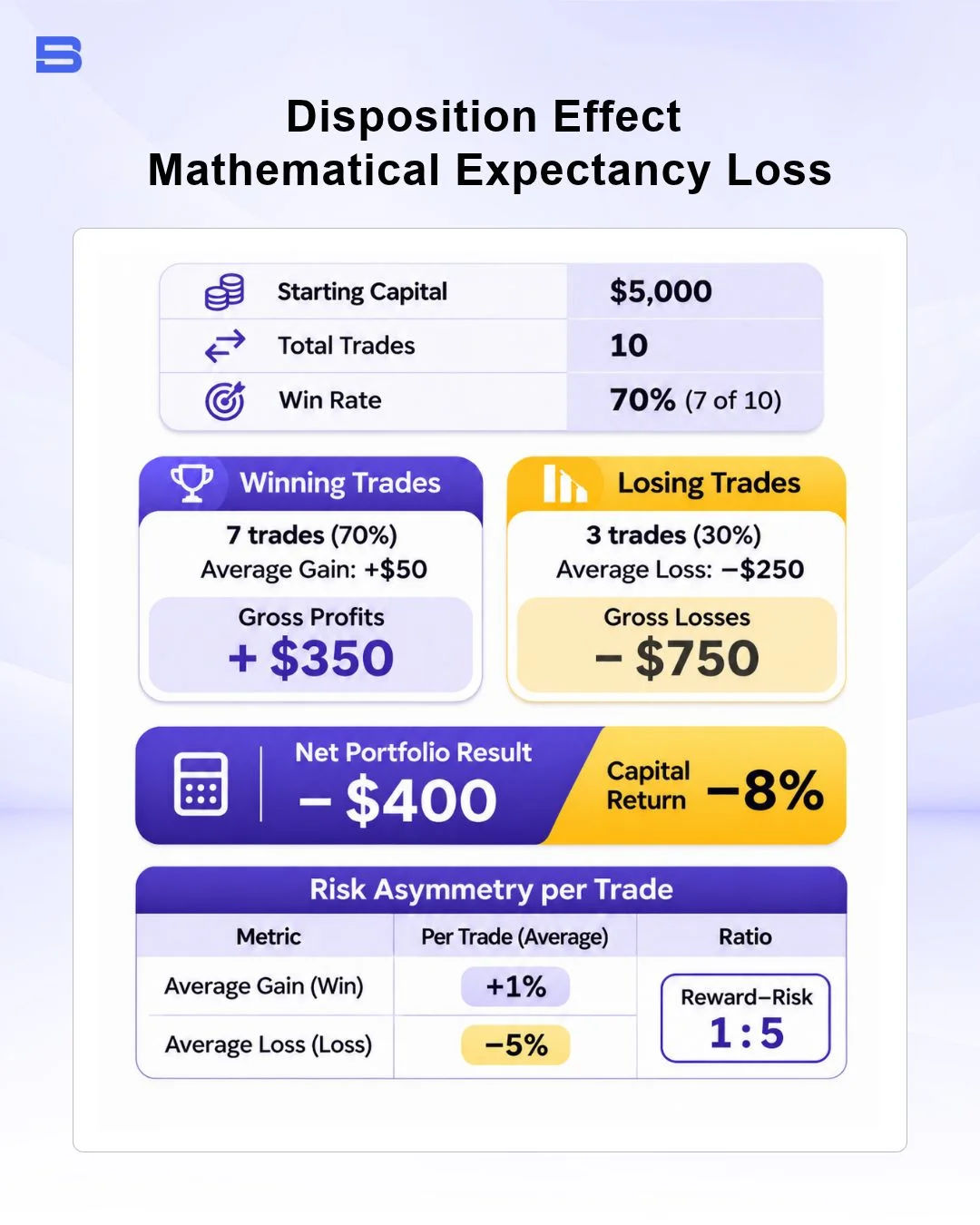
Consider a sample series of 10 trades executed by a trader caught in the disposition effect:
- Starting Capital: $5,000
- Total Trades: 10
- Winning Trades (70% Win Rate): 7 trades, closed prematurely at an average gain of +$50 each
- Losing Trades (30% Loss Rate): 3 trades, held while hoping for a rebound, stopped out at -$250 each
The mathematical outcome reveals an uncomfortable truth:
- Gross Profits: 7 x $50 = $350
- Gross Losses: 3 x -$250 = -$750
- Net Portfolio Result: $350 - $750 = -$400 (an 8% loss of capital despite a 70% win rate)
Even though seven out of 10 decisions were technically profitable, the asymmetric loss profile eroded the balance. When you cut profits at +1% while letting losing trades drift to -5%, your edge evaporates.
The Real Cost: Why Win Rate Does Not Save a Flawed Risk Profile
Many retail participants believe that improving technical entries will fix their results, but a high win rate does not always overcome an inverted reward-to-risk ratio. For example, a reward-to-risk ratio of 1:5 needs a win rate above roughly 83% to break even. In leveraged derivatives like CFDs or forex pairs, the disposition effect is especially damaging because borrowed margin magnifies both upside and downside exposure. Letting a losing trade run with high leverage accelerates margin exhaustion, turning a recoverable pullback into a total liquidation.
When a trader realizes their portfolio is bleeding despite winning most trades, psychological panic often triggers revenge trading or impulsive overtrading. Developing a sustainable trading mindset may require accepting that no single trade outcome defines your results. Aggregate expectancy over hundreds of setups is a better guide to long-term survival.
How to Overcome the Disposition Effect in Your Trading
Breaking this behavioral pattern requires removing emotional decision-making from live price action and replacing it with strict execution boundaries.
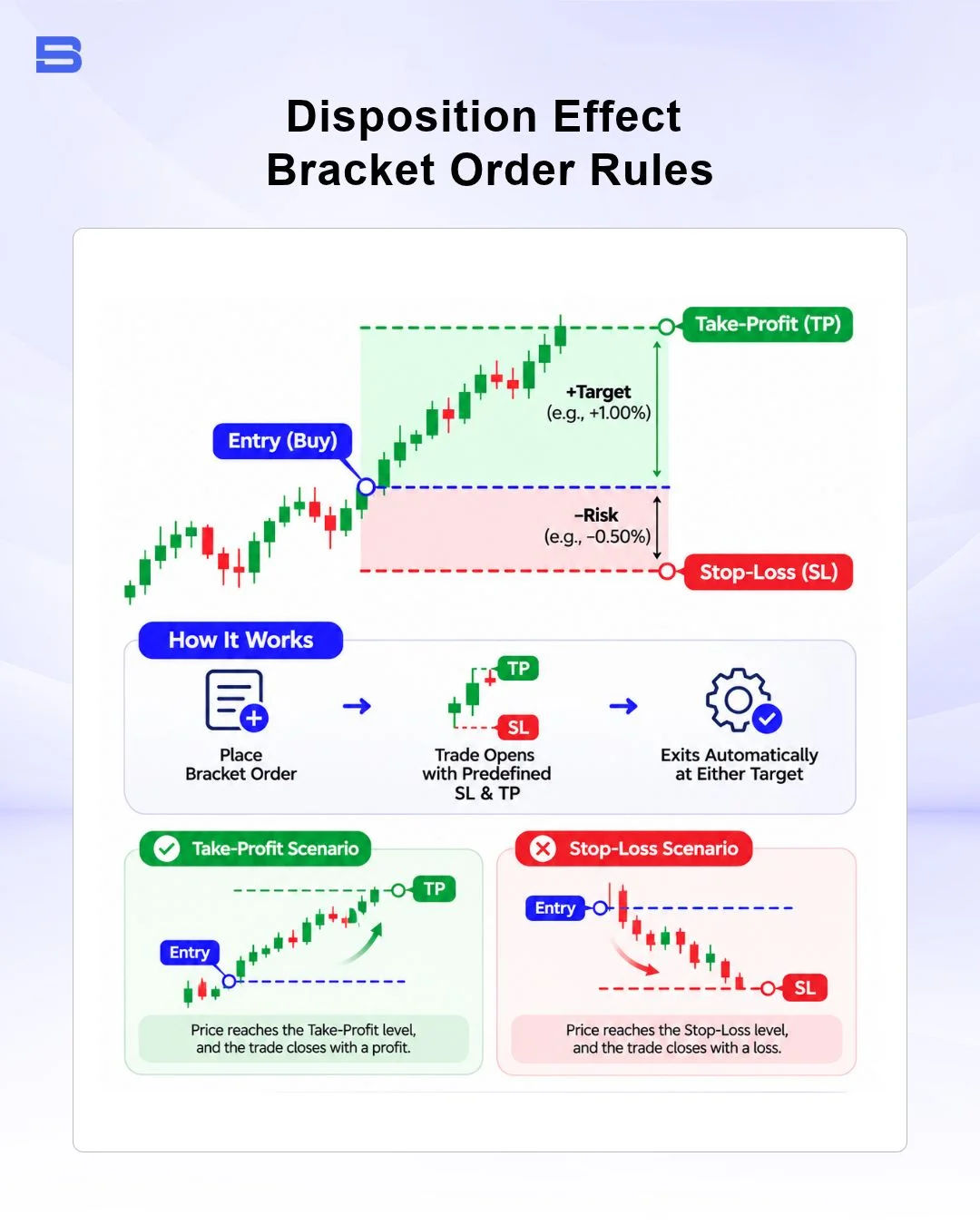
Use Pre-Set Bracket Orders: Submit your stop-loss and profit target orders simultaneously at the moment of trade entry. Once submitted, adopt a hands-off rule where orders are only moved to lock in profit, never widened to give a losing position breathing room.
- Maintain an Objective Record: Keep a detailed trading journal that logs the objective setup rationale, planned reward-to-risk ratio, and emotional state during entry and exit. Reviewing this log helps separate disciplined executions from impulse trades.
- Base Targets on Market Structure: Determine profit targets using technical resistance, support, or volatility measures like the Average True Range rather than arbitrary account currency targets. Slicing winners early just because the dollar figure looks pleasant is a classic disposition symptom.
- Follow Regulatory Risk Frameworks: Authoritative institutions such as the Securities Commission Malaysia (SC) emphasize investor education and informed decision-making based on each investor’s risk appetite as part of investor protection.
Conclusion
The disposition effect is hardwired into human psychology, making it a natural reaction rather than an isolated flaw in your character. Market success does not require eliminating your emotions. It requires setting structural boundaries that prevent those emotions from dictating trade exits. When you treat losses as routine operational expenses and give your winning positions room to reach their targets, you may move your strategy closer to positive mathematical expectancy.
Disclaimer: The content on this page is intended for educational and informational purposes only. It does not constitute financial, investment, tax, or legal advice, and should not be interpreted as a recommendation to buy, sell, or hold any financial instrument or asset. Trading and investing involve significant risk, including the possible loss of your entire capital. Products such as forex, CFDs, and cryptocurrencies carry additional risks due to leverage, high volatility, and limited regulatory protection in some jurisdictions. Past performance of any financial instrument does not guarantee future results. Any market views, forecasts, or opinions expressed are those of the author at the time of writing and may not reflect current market conditions. Platform features, fees, and regulatory status are subject to change — always verify information directly with the relevant provider or regulator before making any financial decision. BrokerSpecs may receive compensation from third parties featured on this site. Always conduct your own due diligence and consider seeking advice from a licensed financial professional before investing. Portions of this article were prepared with the assistance of AI tools and reviewed by our editorial team before publication.