



Related Tags
You are staring at your trading terminal, watching an open stock trade sink deeper into the red. You bought the shares at $50, the price currently hovers at $30, and every technical indicator signals further downside momentum. Despite knowing the setup is broken, your hand freezes over the sell button because clicking it transforms a theoretical paper loss into permanent, realized damage.
This hesitation reveals how past investments of cash, time, and emotional energy distort present market reality. In financial markets, failing to recognize this psychological trap is why manageable pullbacks turn into drawdowns large enough to wipe out an account.
What Is the Sunk Cost Fallacy in Trading?
The sunk cost fallacy is the cognitive error of continuing an investment based on past capital already spent rather than future expected returns.
When you purchase an asset, the cash used to buy those shares is gone. In financial theory, that historical outlay is a sunk cost: unrecoverable, fixed, and completely irrelevant to the asset's future trajectory. Yet retail traders frequently treat past purchase prices as an anchor, convincing themselves that holding until break-even avoids an actual loss.
Markets do not know where you entered, nor do they care about your personal cost basis. Every trading day represents a fresh balance sheet decision. If you hold a losing position simply because you have already endured painful downside, you are actively deciding to purchase that asset at today's price with your remaining equity.
When trading with margin or derivatives, holding without an active thesis compounds risk by tying up maintenance margin and exposing your remaining capital to forced liquidations.
The Psychology Behind Sunk Cost Bias: Loss Aversion and Ego Defense
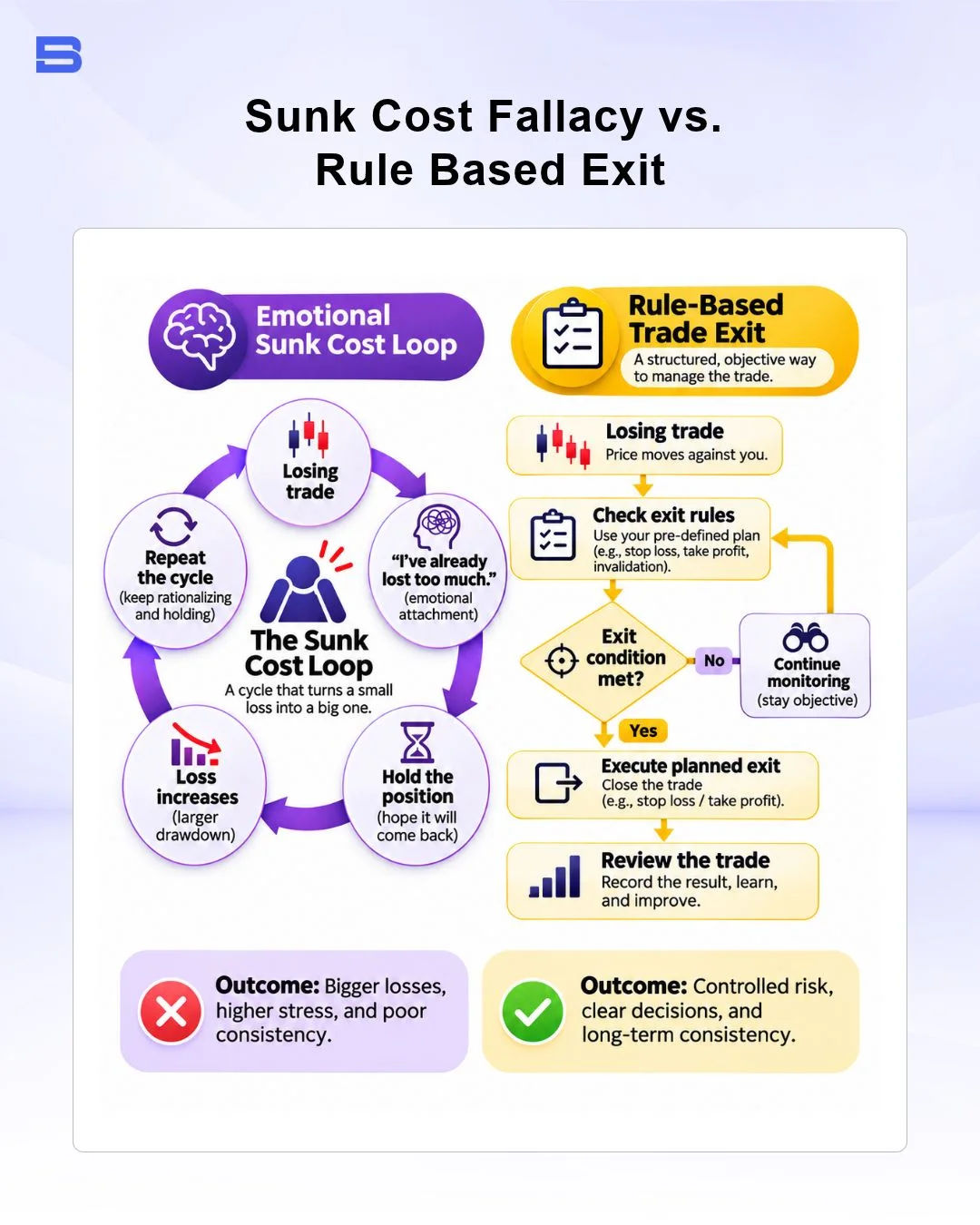
Falling into this trap rarely stems from analytical ignorance; it is driven by hardwired human psychology. When you manage active trades, the sunk cost bias acts as an emotional armor designed to protect your self-image. Admitting that a trade idea failed requires confronting poor timing, flawed analysis, or simple bad luck.
Traders frequently escalate their commitment to avoid that internal discomfort. Instead of cutting losses according to an objective setup, an investor might average down into a falling stock, pouring additional capital into a broken asset to lower the average purchase price. When emotional desperation mounts, traders often fall into the Gambler's Fallacy, convincing themselves that after five consecutive red candles, a green recovery candle is statistically overdue.
How Loss Aversion Traps Retail Investors
The core fuel behind this escalation is loss aversion, a fundamental concept documented across behavioral economics research by institutions like the CFA Institute. Human brains register the psychological pain of a monetary loss roughly twice as intensely as the pleasure derived from an equivalent gain.
Because a paper loss feels provisional, closing the trade feels like voluntarily accepting absolute defeat. Retail traders will take outsized speculative risks to avoid a certain loss, holding declining assets all the way to insolvency, still hoping to break even. Understanding this biological asymmetry through structured trading psychology helps you separate emotional discomfort from disciplined risk management.
Sunk Cost vs Opportunity Cost: Why Past Capital Should Never Dictate Future Trades
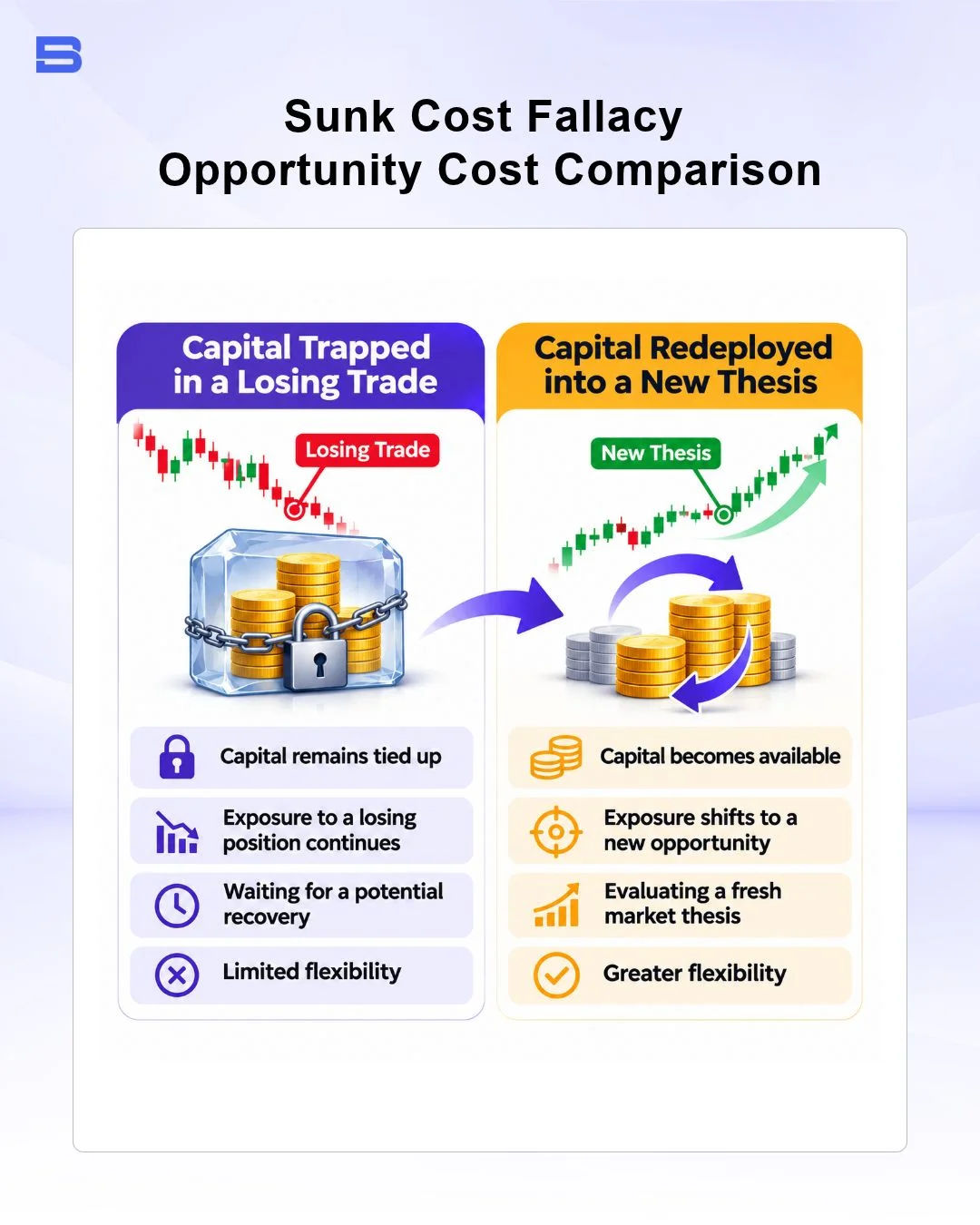
Every dollar trapped in a stagnant position carries a direct sunk cost in the past and a real opportunity cost in the future. Capital is a finite tool. While you wait months or years for a distressed asset to climb back to your original entry price, that money remains unavailable for compounding in high-probability trends.
Evaluating a portfolio requires measuring future opportunity rather than past expenditure. If your money is immobilized in a dead-weight position, you forfeit the returns of healthier market sectors.
Real-World Example: Holding a Losing Stock Down 40%
Consider one of the most common sunk cost fallacy examples in trading. Suppose you deploy $10,000 into a growth stock at $100 per share. Over three months, fundamental earnings deteriorate, and the price drops to $60, leaving your account balance at $6,000.
A trader trapped by sunk costs refuses to sell, declaring they will exit once the stock returns to $100. However, recovering from $60 to $100 requires a 66.7% gain just to break even.
Now compare that with an objective trader who cuts the position at $60. With $6,000 in liquid cash, they can redeploy that capital across three balanced, trending setups with clear structural support. If those new positions generate a modest 15% combined return, the account grows to $6,900. Meanwhile, the distressed asset may drift sideways for years, losing additional value to inflation and market volatility.
How to Overcome Sunk Cost Fallacy: 4 Practical Trading Rules
Overcoming cognitive bias requires removing real-time discretion from trade execution. As behavioral investor education from regulatory bodies like the US Securities and Exchange Commission (SEC) highlights, systematic rules protect traders from predictable behavioral pitfalls.
- Automate Hard Stop-Losses Before Entry: Define your trade invalidation level and submit an automated stop-loss order simultaneously with your entry. Once a stop order rests on the broker's server, market price alone dictates your exit, preventing emotional second-guessing mid-trade.
- Execute the "Blank Slate" Test: Ask yourself: "If I were completely flat right now with cash in hand, would I buy this asset at this current market price?" If the answer is no, holding the position is irrational, and you should exit immediately.
- Focus on Setup Invalidation Over P&L: Track whether the technical or fundamental premise that triggered your trade remains valid. If your support level breaks, the trade is finished regardless of whether your balance is green or red.
- Enforce Cooldowns to Protect Trading Discipline: Cutting a painful loss can trigger impulsive emotional reactions. Maintaining strict trading discipline means stepping away from the screens immediately after an exit to avoid spiraling into revenge trading that compounds the original loss.
Final Thoughts
Profitable market participation is not about avoiding losses; it is about keeping losses small enough that they never impair your capital base. The market has no memory of where you entered, and your past transactions cannot influence future price action. Protect your active equity, measure every trade by its forward-looking expectancy, and treat every dollar on your screen as a brand-new allocation decision.
Disclaimer: The content on this page is intended for educational and informational purposes only. It does not constitute financial, investment, tax, or legal advice, and should not be interpreted as a recommendation to buy, sell, or hold any financial instrument or asset. Trading and investing involve significant risk, including the possible loss of your entire capital. Products such as forex, CFDs, and cryptocurrencies carry additional risks due to leverage, high volatility, and limited regulatory protection in some jurisdictions. Past performance of any financial instrument does not guarantee future results. Any market views, forecasts, or opinions expressed are those of the author at the time of writing and may not reflect current market conditions. Platform features, fees, and regulatory status are subject to change — always verify information directly with the relevant provider or regulator before making any financial decision. BrokerSpecs may receive compensation from third parties featured on this site. Always conduct your own due diligence and consider seeking advice from a licensed financial professional before investing. Portions of this article were prepared with the assistance of AI tools and reviewed by our editorial team before publication.