



Related Tags
Entering a trade for the first time can be thrilling, but imagine this scenario: you've gone long on the EUR/USD, fully expecting a bounce, but your stop-loss gets hit. You try again, and get stopped out a second time. By the fourth consecutive loss, frustration sets in, and you think, "It can't possibly keep dropping; a win is mathematically due."
So, you double your position size on the fifth trade. This instinct—believing a streak has to end just because it's gone on for a while—is a trap that has wiped out many trading accounts.
What Is the Gambler's Fallacy and How Does It Work?
The gambler's fallacy is the mistaken belief that if a random event happens more frequently than normal during a given period, it will happen less frequently in the future. In trading, it's the dangerous assumption that after a series of losses, a winning trade is "due" to balance the scales.
This flaw in logic stems from a psychological trap known as the law of small numbers, where our brains mistakenly expect short-term sequences to perfectly reflect long-term probability. If a coin lands on heads four times in a row, people feel tails is inevitable on the fifth flip. But the coin has no memory; the odds of the fifth flip are still exactly 50/50. This is a common cognitive bias that tricks traders into ignoring the current market conditions in favor of an imagined balancing force.
The Monte Carlo Incident: The Classic Fallacy Example
The most famous demonstration of this bias is the Monte Carlo incident. According to widely documented historical accounts, the roulette wheel at a Monte Carlo casino landed on black 26 times in a row on August 18, 1913. As the streak continued, players reportedly lost millions of francs betting heavily on red, convinced it was mathematically overdue. This event is so well known that the gambler's fallacy is also called the Monte Carlo fallacy.
They failed to grasp that each spin of the wheel is an independent event, entirely unaffected by the previous spins. The odds of red were always 48.6%, regardless of whether black had hit once or twenty times prior. This historical event perfectly illustrates why relying on past random outcomes to predict future ones can steadily erode your capital, blurring the line between trading and gambling if you aren't using a strategic edge.
Gambler's Fallacy vs Hot Hand Fallacy: Spotting the Difference
While the gambler's fallacy expects a reversal, its twin cognitive trap expects a streak to continue indefinitely. Understanding the distinction is crucial for maintaining objectivity.
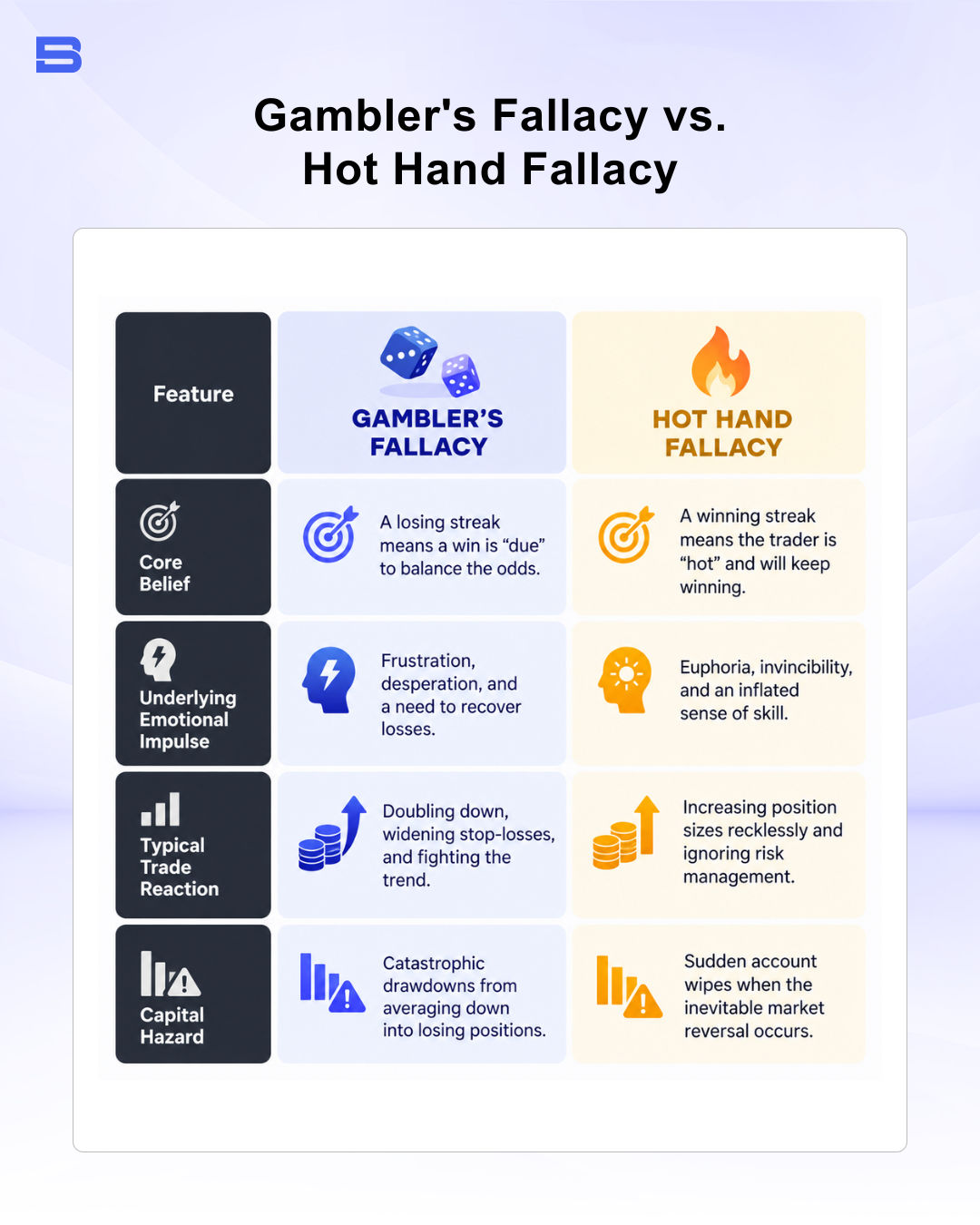
The hot hand fallacy is essentially an overconfidence bias, where traders confuse a lucky streak with permanent genius. Both fallacies stem from a misunderstanding of probability and a failure to separate verified market facts from emotional estimates.
How Gambler's Fallacy Destroys Capital in Trading
The danger of the gambler's fallacy in trading is that financial markets are far more complex than a coin flip. While coin flips are strictly independent events, market prices often exhibit trends, momentum, and autocorrelation, a tendency for one price move to be followed by a similar one. If an asset is dropping sharply, there is usually a fundamental or institutional reason driving that movement.
Assuming a market is "due" for a reversal simply because it has dropped for three consecutive days can be very costly. Traders falling into this trap often rely on a misunderstanding of regression to the mean, believing prices will instantly snap back to an average. However, in trending markets, betting on an immediate reversal means fighting strong momentum without any technical evidence. A stock dropping 10% isn't "due" to bounce 10%; it might drop another 20% before finding support.
Averaging Down and Martingale Sizing Under Leverage
One of the most damaging ways the gambler's fallacy shows up is the martingale strategy—doubling your trade size after every loss, believing the inevitable win will recover all previous losses. Averaging down, which means adding to a losing position in the hope of lowering your average entry price, follows the same flawed logic. When combined with leverage, this approach can lead to rapid account ruin.
Let's look at a worked example using a 1:30 leverage ratio. A trader buys 1 mini lot (10,000 units) of EUR/USD and loses $50. Driven by the fallacy and loss aversion (the tendency to feel losses more strongly than equivalent gains), they buy 2 mini lots, losing $100. Convinced the bounce is "due," they buy 4 mini lots and lose $200.
Finally, desperate to recover, they buy 8 mini lots, but the market continues its trend, resulting in a $400 loss. In just four trades, the trader has lost $750. Leverage amplifies your returns when you're right, but it accelerates capital destruction just as quickly when the market moves against you.
Practical Rules: How to Overcome the Gambler's Fallacy in Your Trading
To protect your capital from this cognitive trap, you need to rely on strict rules rather than emotional instincts. Here is a practical framework to keep your trading objective.
- Risk a Fixed Percentage: Never increase your position size simply because you had a losing trade. Commit to a fixed 1% to 2% equity risk per trade, ensuring that a string of losses won't wipe out your account.
- Use Non-Negotiable Stop-Losses: A stop-loss is one of your most important defenses against fighting a trend, although orders can fill at worse prices during gaps or fast-moving markets. Set it based on technical levels, not emotional pain thresholds, and never widen it mid-trade hoping for a reversal.
- Follow a Mechanical Plan: Define exactly what a valid setup looks like before you open your platform. If the market doesn't present your setup, do not execute a trade based on the feeling that a move is "due."
- Evaluate in Blocks: Don't judge your strategy on three or four trades. Analyze your performance in blocks of 20 to 50 trades to get a more reliable picture than three or four trades can give, while remembering that even these samples are small, neutralizing the availability heuristic where recent losses skew your perspective.
Letting Rules, Not Feelings, Drive Every Trade
The market has no memory of your last trade, and it certainly doesn't care if you've had a bad week. Relying on the feeling that a winning trade is "due" can lead to severe drawdowns, especially when leverage is involved. To survive and thrive in trading, you must abandon emotional forecasting and let a disciplined, statistically sound risk management strategy dictate every execution.
Disclaimer: The content on this page is intended for educational and informational purposes only. It does not constitute financial, investment, tax, or legal advice, and should not be interpreted as a recommendation to buy, sell, or hold any financial instrument or asset. Trading and investing involve significant risk, including the possible loss of your entire capital. Products such as forex, CFDs, and cryptocurrencies carry additional risks due to leverage, high volatility, and limited regulatory protection in some jurisdictions. Past performance of any financial instrument does not guarantee future results. Any market views, forecasts, or opinions expressed are those of the author at the time of writing and may not reflect current market conditions. Platform features, fees, and regulatory status are subject to change — always verify information directly with the relevant provider or regulator before making any financial decision. BrokerSpecs may receive compensation from third parties featured on this site. Always conduct your own due diligence and consider seeking advice from a licensed financial professional before investing. Portions of this article were prepared with the assistance of AI tools and reviewed by our editorial team before publication.