



Related Tags
You click “buy” on EUR/USD, and your terminal confirms the execution in under 20 milliseconds. During quiet market hours, that seamless fill feels instantaneous and effortless. Yet behind that simple click lies a competitive institutional system designed to supply pricing and absorb transaction volume without breaking the quote.
What Is a Forex Liquidity Provider and How Does Pricing Flow?
In the liquidity provider forex model, a liquidity provider is an institutional financial entity that holds extensive currency reserves and continuously quotes executable buy and sell prices to facilitate market transactions. Without these entities quoting both sides of the book, currency trading would suffer from extreme price gaps and severe execution delays.
Retail brokerages typically do not maintain the balance sheets required to hold opposing sides of every client position. Instead, a low spread broker connects directly to institutional liquidity streams to ingest live price feeds and offset net order volume.
The mechanics of price pass-through come down to raw quotes and broker markups. For instance, an institutional provider may quote EUR/USD with a 0.2-pip raw spread at 1.08500 bid and 1.08502 ask. Your retail broker adds a standard markup of 0.8 pips to cover operating overhead, displaying a final retail quote of 1.08496 bid and 1.08506 ask (a 1.0-pip spread).
When you execute a trade, your broker either nets it against internal retail positions or routes the risk directly to a wholesale pool through its liquidity provider forex network. This process helps ensure that even large multi-lot positions can receive faster execution with minimal disruption to the quoted rate, depending on available market liquidity and conditions.
Tier 1 vs Tier 2 Liquidity Providers: Understanding the Institutional Hierarchy
The institutional liquidity architecture functions as a tiered hierarchy governed by capitalization, regulatory standing, and credit relationships. At the top sit Tier 1 providers, which include global investment banks such as JPMorgan Chase, Deutsche Bank, Citigroup, and UBS. According to foreign exchange turnover data published by the Bank for International Settlements (BIS), trading activity is concentrated among a small group of major dealer banks, which is why these institutions sit at the center of interbank pricing.
Connecting directly to a Tier 1 institution as a liquidity provider forex client requires prime brokerage agreements backed by substantial collateral, alongside rigorous credit assessments. Since many mid-sized brokerages cannot meet these institutional balance sheet requirements, Tier 2 liquidity providers step in to bridge the gap and provide access to wholesale market liquidity.
Tier 2 entities include non-bank electronic market makers and Prime of Prime (PoP) aggregators. PoPs hold institutional accounts with Tier 1 prime brokers, aggregate wholesale liquidity from multiple banks, and subdivide that volume into accessible trading streams for retail brokers.
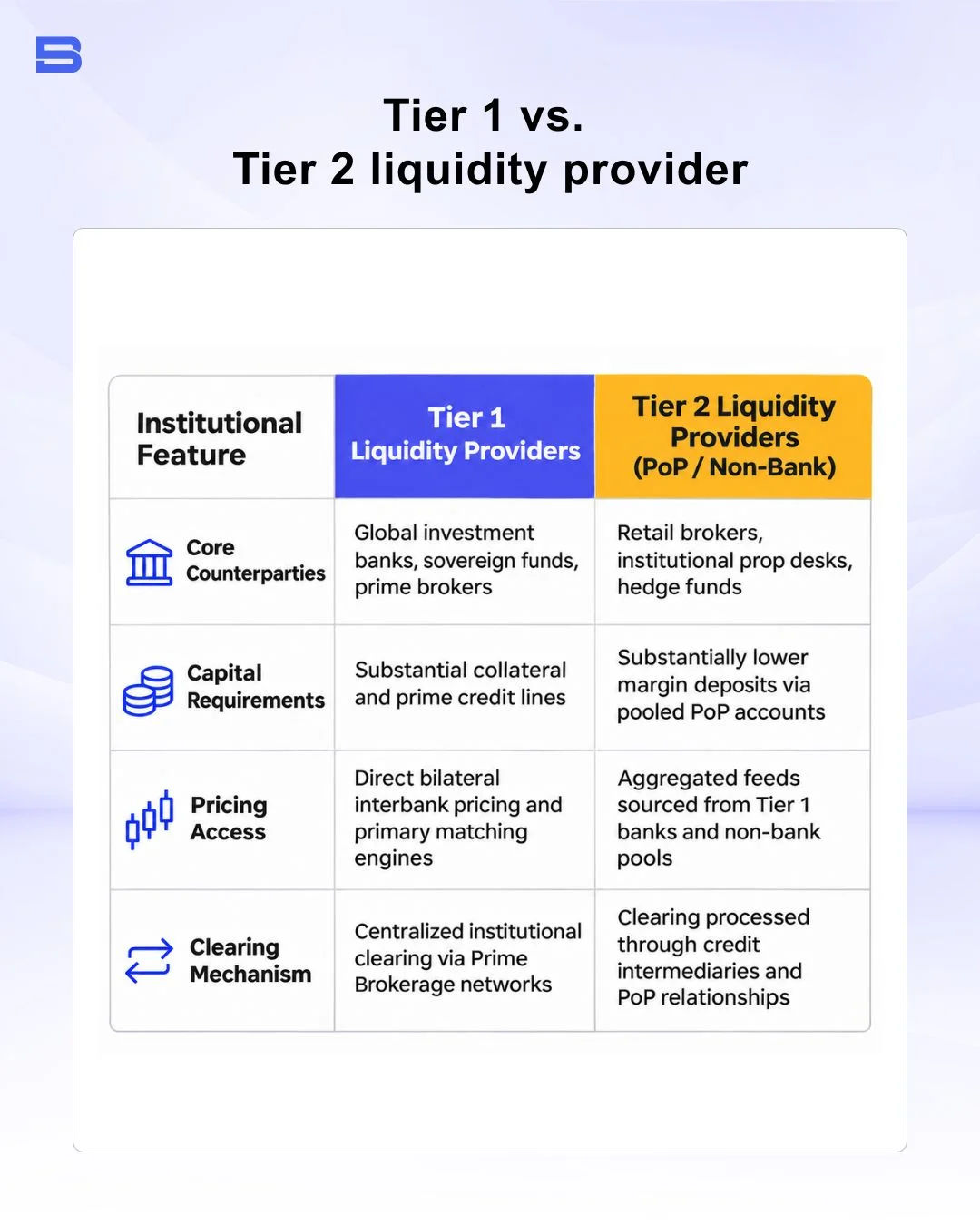
The primary differences across these two operational tiers involve capital access and clearing:
Market Maker vs Liquidity Provider: Key Operational Differences
Traders frequently confuse market makers with liquidity providers, but their core operational incentives differ substantially. A traditional market-making broker acts as a dealing desk (B-Book model), effectively taking the counterparty position against its clients. When a trader buys, the dealing desk sells from its own book, creating an inherent conflict of interest where the broker gains when the client loses.
In contrast, a genuine wholesale liquidity provider acts as a commercial liquidity engine, generating income from high-volume transaction turnover and small spread captures rather than speculating against client direction. When you execute through a true ECN broker, your trades bypass internal dealing desks and route directly to external liquidity streams.
Trade execution disclosures mandated by regulators such as the Financial Conduct Authority (FCA) require brokers to clearly define whether they act as principal or pass risk to external execution venues. Brokers connected to genuine wholesale providers may offer more transparent pricing, but some still run hybrid models, so check the broker’s order execution policy to see how your trades are handled.
Execution Infrastructure: FIX API and Liquidity Aggregation Engines
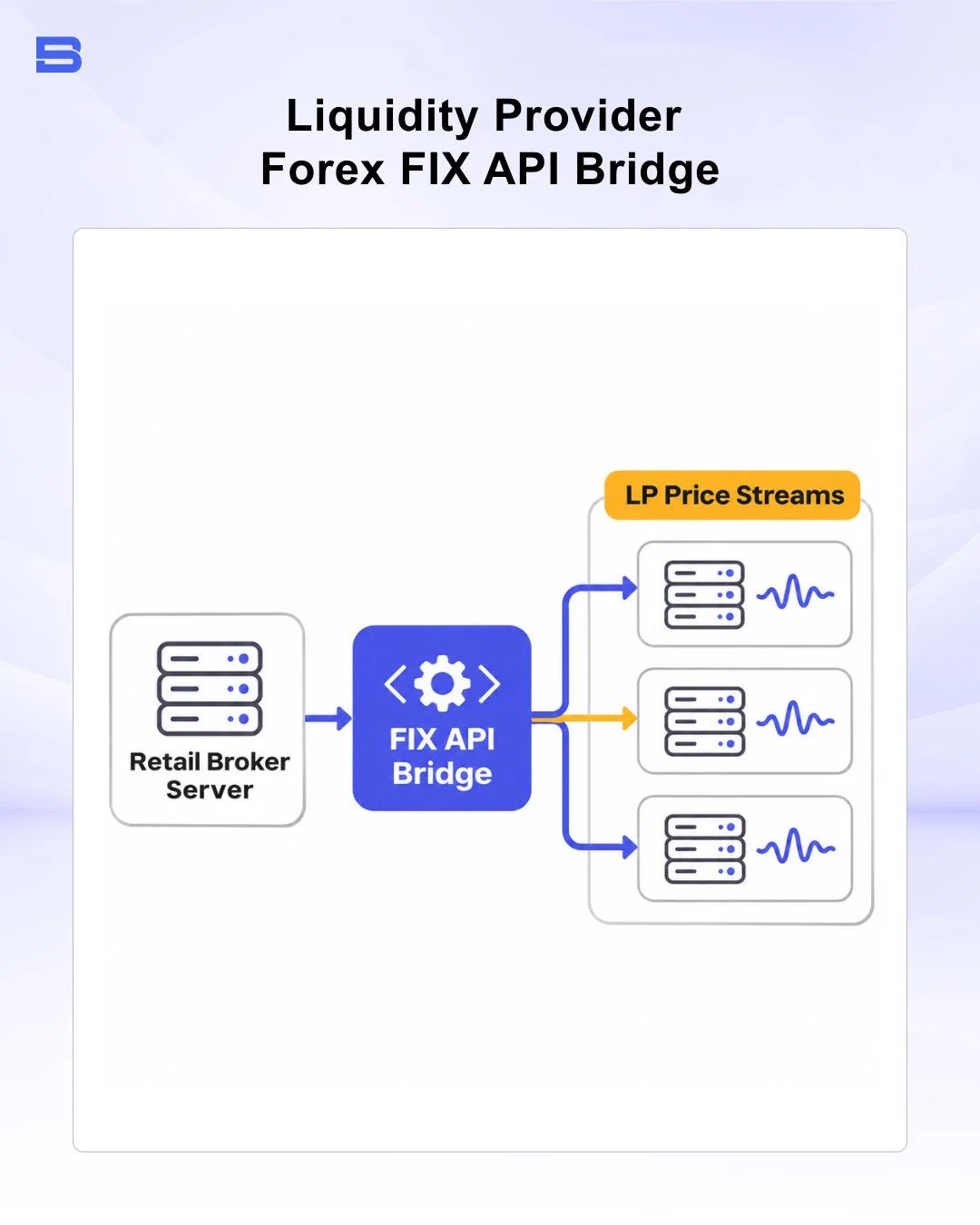
Delivering raw institutional quotes to your screen in milliseconds requires a specialized technological bridge between retail platforms and wholesale banking servers.
Bridge Technology and Liquidity Aggregation Engines
Smart Order Routers (SOR) and aggregation engines gather live price streams from dozens of distinct banks and market makers simultaneously. The aggregator engine scans every incoming feed, strips out redundant layers, and constructs a single, consolidated Best Bid and Offer (BBO) order book. When you click buy, the router automatically targets the provider currently quoting the tightest price and the deepest available volume at that exact millisecond.
Low-Latency Routing via FIX API Protocol
The communication bridge between retail broker platforms (such as MetaTrader 4, MetaTrader 5, or cTrader) and institutional hubs relies on the Financial Information eXchange (FIX) API protocol. FIX allows fast, standardized transmission of order and quote data between trading platforms and liquidity providers. This infrastructure helps keep quotes current, which can reduce latency drift between the institutional feed and your home terminal.
Last Look vs No Last Look: Why Execution Delays and Slippage Happen
When evaluating institutional pricing, a liquidity provider forex arrangement can significantly influence trade execution quality, particularly depending on whether orders are routed through "Last Look" or "No Last Look" liquidity streams.
Last Look is a convention where a quoting liquidity provider receives an execution request and holds it for a brief buffer window. During this brief delay, the provider checks whether the broader market price has moved adversely against its quote. If the price shifted unfavorably, the provider rejects the fill, triggering order rejections or routing your ticket to a worse price level.
Liquidity providers utilize Last Look to protect their desks against latency arbitrage (trading on outdated quotes from slower price feeds), but the practice can result in asymmetric execution fills (orders go through when the price moves against you but are rejected when it moves in your favor) for retail traders. When rapid price volatility strikes during major economic data releases, market orders routed through Last Look streams frequently encounter slippage in forex, filling significantly away from the price shown on screen.
Conversely, "No Last Look" streams guarantee firm quotes, accepting execution immediately upon arrival. While No Last Look spreads may appear slightly wider during calm market hours, they can offer more predictable execution, although spreads may still widen sharply or quotes may be withdrawn when markets turn volatile.
Counterparty Risk and the Reality of Market Liquidity Freezes
While institutional liquidity engines are engineered to handle high trading volume, liquidity is never infinite or guaranteed. In periods of extreme market stress or black-swan events, institutional counterparties face genuine solvency and balance sheet constraints that can disrupt execution.
During severe volatility shocks, a liquidity provider forex network can experience significant disruption as Tier 1 banks widen their quoted spreads or withdraw quotes entirely to protect their balance sheets. When multiple liquidity providers pull their quotes simultaneously, an acute market freeze can occur. Traders with open market orders may face sudden price gaps, execution suspensions, and severe negative slippage as insufficient institutional bids remain to absorb selling pressure.
Evaluating counterparty risk is essential when selecting a brokerage. Institutional financial regulations outlined by bodies such as Bank Negara Malaysia (BNM) emphasize the importance of robust risk governance, capital adequacy, and counterparty oversight. Before opening an account, check the broker’s license on the regulator’s own register and confirm that it does not appear on BNM’s Financial Consumer Alert List. A broker that partners with several Tier 1 clearing institutions may reduce, though not remove, the risk of execution failures when wholesale markets face distress.
Conclusion
Understanding the liquidity provider forex relationship helps traders see how broker pricing works behind the scenes. Liquidity providers connect brokers to the wider foreign exchange market by supplying buy and sell quotes, supporting trade execution, and helping maintain market depth. Their pricing, available liquidity, and execution conditions directly influence spreads, slippage, and the speed at which orders are filled.
Disclaimer: The content on this page is intended for educational and informational purposes only. It does not constitute financial, investment, tax, or legal advice, and should not be interpreted as a recommendation to buy, sell, or hold any financial instrument or asset. Trading and investing involve significant risk, including the possible loss of your entire capital. Products such as forex, CFDs, and cryptocurrencies carry additional risks due to leverage, high volatility, and limited regulatory protection in some jurisdictions. Past performance of any financial instrument does not guarantee future results. Any market views, forecasts, or opinions expressed are those of the author at the time of writing and may not reflect current market conditions. Platform features, fees, and regulatory status are subject to change — always verify information directly with the relevant provider or regulator before making any financial decision. BrokerSpecs may receive compensation from third parties featured on this site. Always conduct your own due diligence and consider seeking advice from a licensed financial professional before investing. Portions of this article were prepared with the assistance of AI tools and reviewed by our editorial team before publication.