



Related Tags
EUR/USD spreads sit at a fraction of a pip for most of the trading day. Then a major economic release hits, and the same spread can widen several times over within seconds, even though your broker never touched its pricing page.
That shift rarely starts with your broker. Your broker does not hold endless pools of cash waiting to take the other side of your position. Instead, the price you see and the speed of your fill depend on specialized entities operating in the background known as liquidity providers. Understanding this plumbing reveals the actual cost of your trades, why spreads widen during news releases, and how execution conflicts arise.
What Is a Liquidity Provider? Meaning and Market Mechanism
A liquidity provider (LP) is an entity that continuously quotes two-way bid and ask prices to financial markets, acting as an active trading counterparty.
In liquid markets, every buyer requires an immediate seller, and every seller needs an immediate buyer. Without centralized liquidity hubs, large market orders would struggle to find matching counterparties, triggering dramatic price dislocations. Liquidity providers absorb this volume by maintaining standing orders on both sides of the book, establishing market depth across varying price tiers.
This mechanism stabilizes overall quoted pricing and compresses the spread between what participants pay to enter and what they receive to exit. For brokers and active market participants, an LP transforms an otherwise fragmented over-the-counter market into a continuous, tradable feed.
What Is a Liquidity Provider in Forex?
A forex liquidity provider is an institution that quotes executable currency prices in the decentralized foreign exchange market, where trading happens over the counter rather than on one central exchange. According to the 2025 Triennial Central Bank Survey by the Bank for International Settlements (BIS), global over-the-counter foreign exchange turnover averaged about $9.6 trillion per day in April 2025, much of it flowing through institutional dealer networks.
Retail brokerages handle customer orders using two distinct models that interact with these providers: Straight-Through Processing (STP/A-Book) and internal dealing desk warehousing (B-Book). In an A-Book model, the broker acts solely as an intermediary, instantly offloading client trades to an external LP via automated routing. In a pure B-Book model, the broker acts as a market maker.
In a pure B-Book model, the broker acts as a market maker, taking the opposite side of the client’s trade internally and avoiding external LP execution altogether. Many modern brokerages use hybrid routing, matching offsetting client orders internally first and passing the remaining net exposure to external providers. Counterparty risk remains an operational reality in foreign exchange. If an upstream provider experiences a credit freeze or insolvency, downstream broker execution can halt immediately.
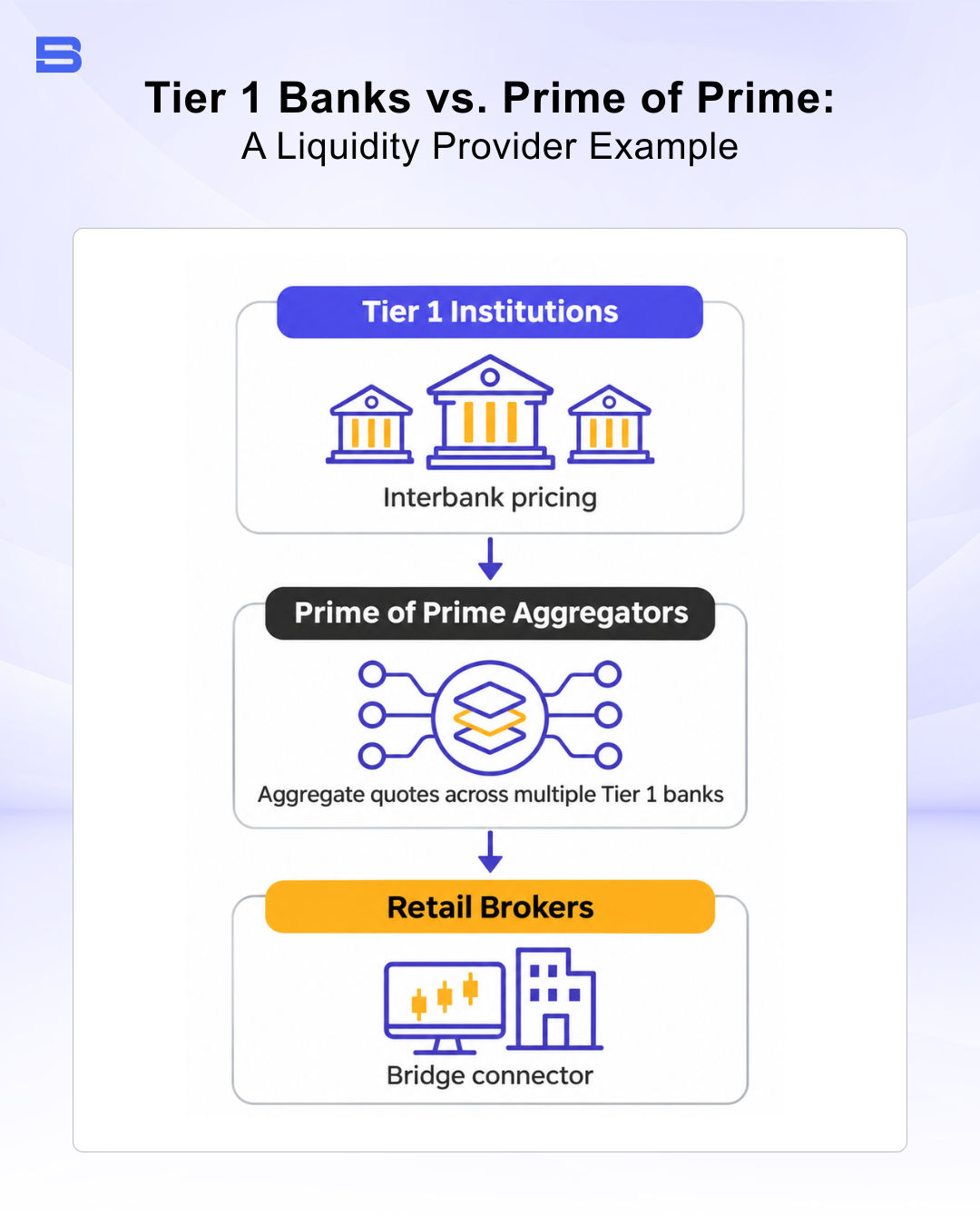
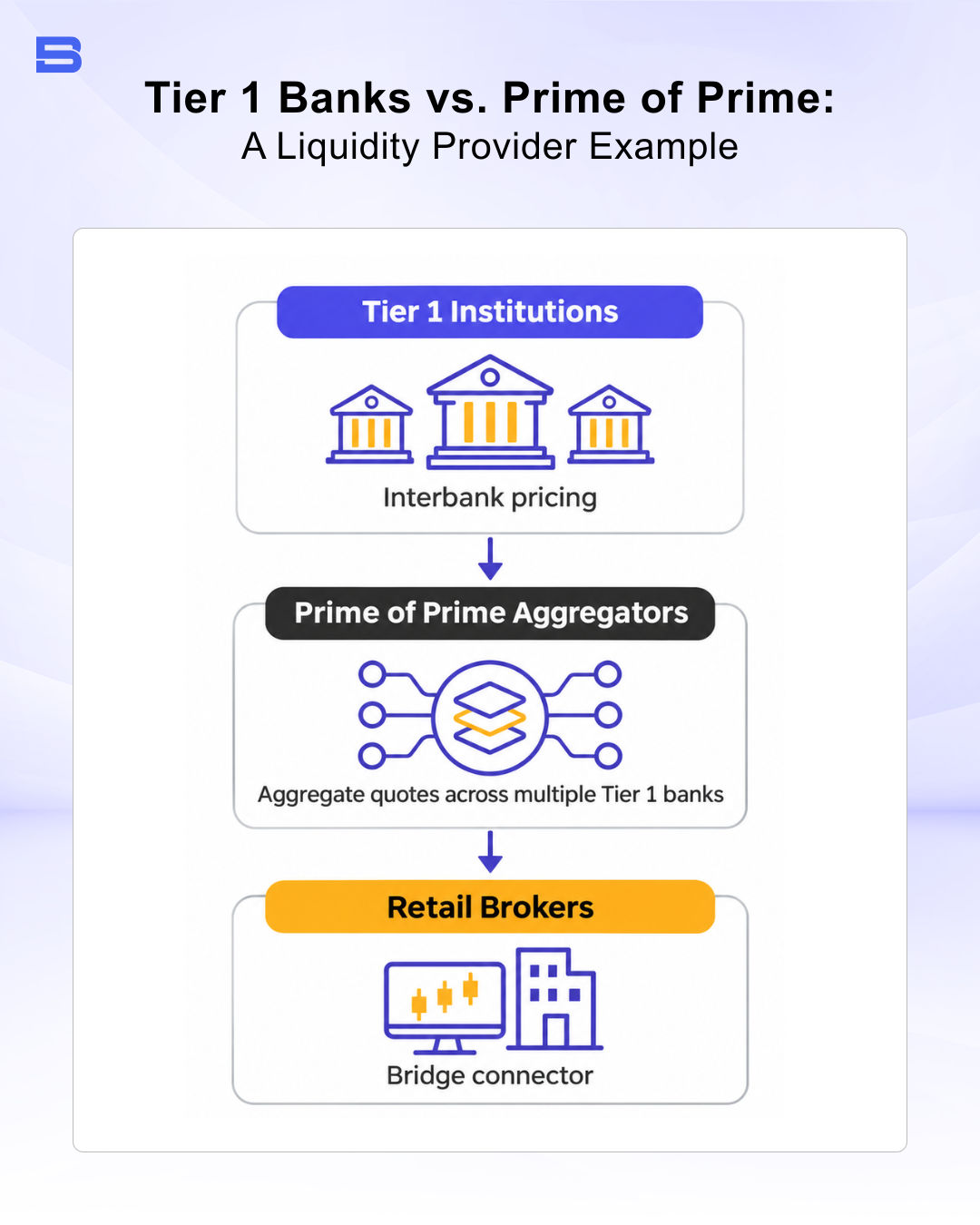
Tier 1 Banks vs. Prime of Prime: A Liquidity Provider Example
Institutional foreign exchange liquidity is structured in a clear hierarchy divided between Tier 1 market makers and non-bank or Prime of Prime (PoP) aggregators. Tier 1 institutions represent global money-center banks that set benchmark pricing for the interbank market. Prominent Tier 1 institutions include:
- JPMorgan Chase
- Citibank
- UBS
- Deutsche Bank
- Barclays
These institutions deal in large institutional trade sizes and typically require direct bilateral credit agreements and multi-million-dollar collateral accounts. Because a mid-sized retail brokerage rarely meets these capital thresholds (one of the practical hurdles when you start a brokerage firm), intermediary institutions bridge the gap.
Prime of Prime providers maintain Tier 1 credit lines and aggregate quotes across multiple Tier 1 banks and non-bank electronic market makers. Specialist providers servicing retail forex and CFD brokerages include:
- LMAX Group: Operates central limit order books (CLOB) regulated by the Financial Conduct Authority (FCA), offering strict exchange-style execution with transparent matching.
- B2BROKER: An institutional liquidity aggregator delivering multi-asset liquidity feeds and PoP setups across foreign exchange and CFDs.
- Swissquote: A licensed banking institution providing institutional prime brokerage and liquidity distribution to financial intermediaries.
- Drovix: An institutional liquidity provider whose Mauritius entity is licensed by the Financial Services Commission (FSC) as an Investment Dealer, acting as principal in bilateral OTC transactions with approved professional and institutional counterparties, supported by its own market-making and bridge technology.
- GBE Prime: The institutional liquidity service of GBE Brokers, offered through GBE Global, giving institutional clients access to MetaTrader 4 and MetaTrader 5 as well as direct FIX API connectivity via servers in London (LD4), New York (NY4), and Tokyo (TY3).
Consider this liquidity provider example: A retail broker receives a 30-lot buy order on GBP/USD. Rather than posting collateral directly with JPMorgan, the broker routes the order through a bridge connector to a PoP such as B2BROKER or LMAX. The aggregator matches the order against its aggregated liquidity book, fills the volume across available bank quotes, and confirms the trade back to the broker in milliseconds.
How Broker Dealing Desks Connect to Liquidity Pools
Retail trading platforms like MetaTrader 4, MetaTrader 5, or cTrader cannot natively interact with institutional bank servers without specialized bridge middleware, one layer of the wider technology stack behind modern brokerages. Software vendors like oneZero and PrimeXM build bridge infrastructure linking broker platforms to external liquidity pools via FIX (Financial Information eXchange) API protocols.
When a broker receives your order, its Smart Order Routing (SOR) engine evaluates incoming bid-ask spread aggregation across multiple connected provider books. An ECN broker aggregates these pricing streams directly to surface the tightest bid and ask quotes.
Brokers advertising as a low-spread broker typically rely on multi-LP aggregation. If Provider A offers EUR/USD at 1.08501/1.08511 and Provider B quotes 1.08502/1.08512, the broker's pricing engine combines the best bid and best ask into 1.08502/1.08511, trimming transaction costs before adding its commission or dealing-desk markup.
Execution Realities: Slippage, Spreads, and Market Depth
While liquidity providers facilitate continuous order flow, real-world execution carries technical frictions that directly impact your fill prices. Order book depth is finite. When a large order hits the book, it may consume all available volume at the top-of-book quote and fill the remainder at inferior pricing tiers, resulting in market slippage. Regulators like the Financial Conduct Authority (FCA) mandate that brokerages deliver best execution, requiring transparency regarding how slippage and asymmetric delays are handled.
Execution risks surface sharply during high-impact macroeconomic announcements:
- Liquidity withdrawal: LPs pull quotes or widen spreads dynamically during volatile news events to avoid adverse selection (being filled by better-informed traders just before prices move against them), exposing retail traders to severe execution gaps.
- Last-look latency: Last-look latency: Many bilateral LPs utilize “last look,” a mechanism granting the provider a few milliseconds to accept or reject an order after it is received.
- Execution variance: Depending on market liquidity and routing latency, your fill price may deviate significantly from the quote displayed on your chart, producing both positive and negative slippage.
Understanding slippage in trading and reviewing your broker’s order execution policy helps differentiate normal market friction from substandard execution infrastructure.
How Liquidity Providers Generate Revenue and Manage Market Risk
Liquidity providers do not typically aim to profit from price direction, because large directional positions would expose their balance sheets to significant volatility.
- The bid-ask spread markup: Capturing the marginal difference between buy and sell quotes across thousands of matched round-turn transactions.
- Volume commissions: Charging per-lot or per-million turnover fees for orders executed through their liquidity feeds.
To manage market exposure, institutional providers use algorithmic risk management systems. When client orders lean heavily toward one side, the LP first offsets them against opposing client flow. Any remaining net exposure is then hedged in the interbank market, keeping the overall book close to neutral regardless of market direction.
The Bottom Line
Behind every retail foreign exchange quote sits a network of institutional liquidity providers, bridge engines, and prime brokers establishing continuous market depth. Recognizing how these entities quote prices and route volume helps you evaluate broker spreads, execution delays, and trading friction objectively before committing capital.
Disclaimer: The content on this page is intended for educational and informational purposes only. It does not constitute financial, investment, tax, or legal advice, and should not be interpreted as a recommendation to buy, sell, or hold any financial instrument or asset. Trading and investing involve significant risk, including the possible loss of your entire capital. Products such as forex, CFDs, and cryptocurrencies carry additional risks due to leverage, high volatility, and limited regulatory protection in some jurisdictions. Past performance of any financial instrument does not guarantee future results. Any market views, forecasts, or opinions expressed are those of the author at the time of writing and may not reflect current market conditions. Platform features, fees, and regulatory status are subject to change — always verify information directly with the relevant provider or regulator before making any financial decision. BrokerSpecs may receive compensation from third parties featured on this site. Always conduct your own due diligence and consider seeking advice from a licensed financial professional before investing. Portions of this article were prepared with the assistance of AI tools and reviewed by our editorial team before publication.