



Related Tags
Entering the forex market often brings immediate confusion right at the account registration page. You are suddenly asked to choose between Standard, Cent, Micro, ECN, STP, or Islamic accounts without a clear explanation of how these choices impact your execution speed, overall trading costs, or real market exposure.
Choosing the right forex account types is essential to avoiding hidden markups, reducing trading costs, and minimizing order execution delays during volatile market conditions. Understanding how different broker account structures work helps you protect your capital and select an account that aligns with your trading strategy.
Standard vs. Cent/Micro Accounts: The Spread-Only Entry Point
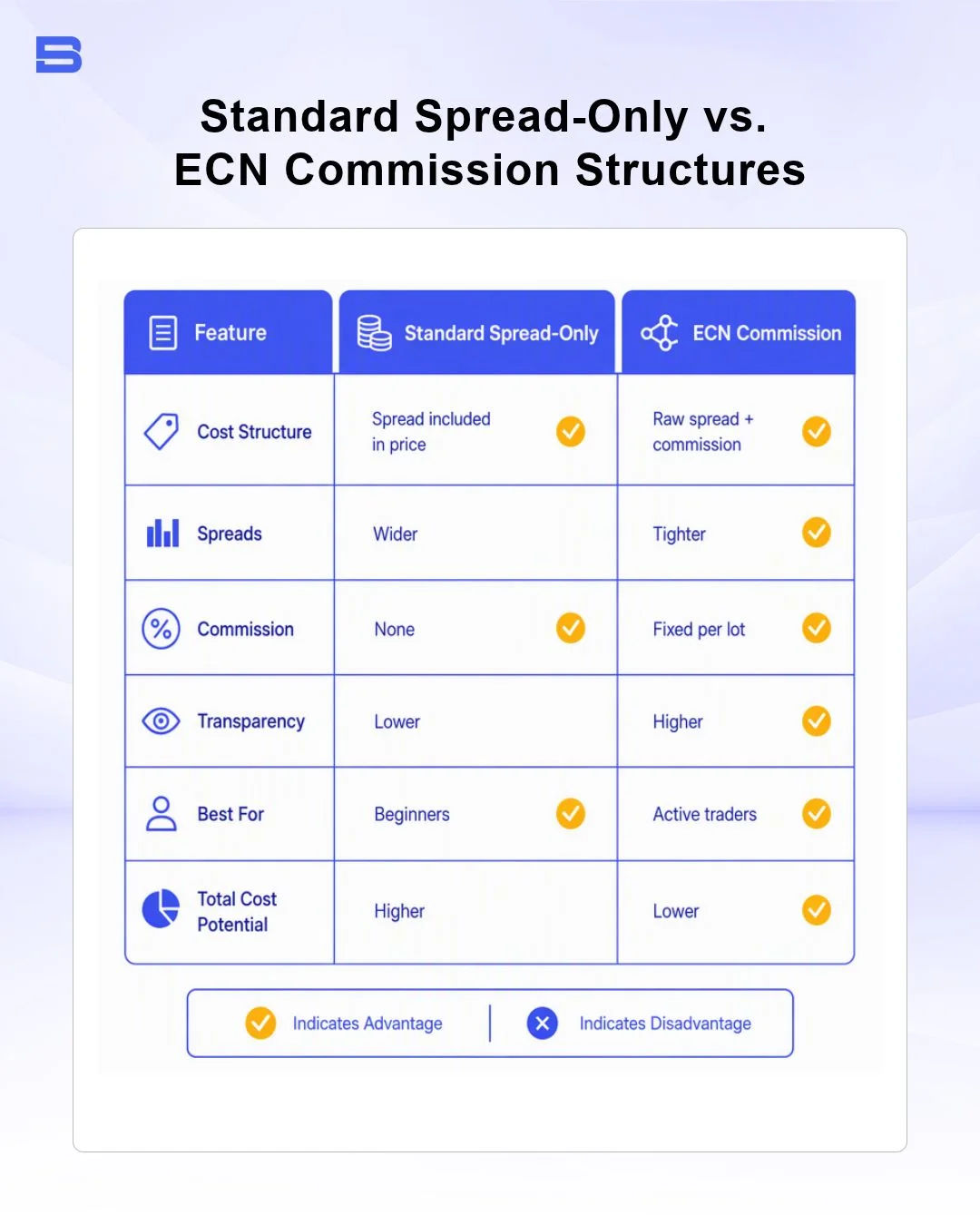
Among the common forex account types, spread-only accounts are often suited to beginners and retail position traders who prefer straightforward pricing without separate commission fees. Instead, brokers incorporate their charges into the bid-ask spread, which is the difference between the buying and selling prices.
While this all-inclusive pricing keeps calculations simple, it is essential to understand how contract sizes and order routing differ between standard and micro-tier setups.
Cent & Micro Accounts: A Lower-Risk Way to Practice in Live Markets
Cent and Micro accounts serve as the primary bridge between a risk-free demo account and full-scale retail live trading. Instead of trading standard lots where 1.0 lot equals 100,000 units of the base currency, Cent accounts display your balance in cents (e.g., a $10 deposit shows as 1,000 cents).
Among the different forex account types, micro accounts allow traders to open positions as small as 0.01 lots (typically 1,000 currency units), making it easier to manage risk with limited capital. For example, a 10-pip move in EUR/USD is worth approximately $1 for a 0.01-lot position, rather than $10 for a 0.1-lot position.
This lower entry requirement allows beginners to test strategies, assess execution quality under live market conditions, and develop emotional discipline while limiting potential losses.
Standard Accounts: Traditional Spread-Based Execution
Standard accounts represent the baseline retail setup. You trade standard contract sizes (1.0 lot = 100,000 units), with spreads typically starting around 1.0 to 1.5 pips on major currency pairs like EUR/USD.
Many standard accounts operate under a Market Maker (B-Book) model. Under B-Book execution, the broker acts as the direct counterparty to your trade rather than passing your order to external financial institutions. While this setup ensures instant order filling, it creates an inherent conflict of interest because the broker profits when a trader loses.
When comparing forex account types, traders should understand that market makers manage risk by hedging their overall exposure. However, execution delays and slippage may still occur during volatile economic news releases, potentially affecting trade entry and exit prices.
ECN & STP Accounts: Direct Execution & Raw Spreads
For active day traders, scalpers, and automated EA users, traditional spread-only pricing often proves too expensive due to wider bid-ask markups. Direct market execution setups—Electronic Communication Network (ECN) and Straight-Through Processing (STP)—route your trade orders directly to primary liquidity pools without market-maker intervention.
ECN accounts connect market participants directly to a network of tier-1 liquidity providers, such as commercial banks and institutional prime brokers. Spreads on an ECN account are "raw," frequently dropping to 0.0 pips on liquid pairs like EUR/USD. In exchange for raw interbank pricing, brokers charge a fixed, transparent round-turn commission (typically $3.00 to $7.00 per standard lot traded).
Among the common forex account types, Straight Through Processing (STP) accounts route orders to external liquidity providers through an A-Book execution model. Brokers may charge a separate commission or apply a small markup to the raw spread.
In a true A-Book model, the broker acts as an intermediary and earns revenue from trading volume, which can reduce direct conflicts of interest associated with taking the opposite side of client trades.
Margin vs. Leverage Mechanics in Forex Accounts
Regardless of whether you select a Standard or raw ECN account, trading forex relies heavily on margin mechanics. Leverage allows you to control a large market position with a fraction of the total capital deposited. For example, a 100:1 leverage ratio requires a 1% margin deposit to open a trade.
While high leverage reduces required margin, it acts as a double-edged sword: leverage amplifies both potential profits and potential losses equally. A sudden 1% price move against a maximum-leveraged position can trigger an immediate margin call or stop-out, wiping out account equity. Financial regulators like the Monetary Authority of Singapore (MAS) impose strict leverage limits on retail accounts specifically to help protect traders from outsized losses.
PAMM & Managed Accounts: Hands-Off Capital Allocation
Traders who lack time or experience often explore PAMM (Percent Allocation Management Module) accounts. Under a PAMM setup, an experienced master trader manages a pooled fund comprising capital from multiple individual investors.
Profits and losses are automatically distributed across investors in proportion to their percentage share of the pool, while the master trader collects an agreed performance fee (e.g., 20% of net profits). Often promoted through an introducing broker, PAMM accounts offer hands-off exposure but carry significant risk. Investors retain no control over individual order execution, leaving their capital fully exposed to the master trader's risk management decisions and drawdowns.
Islamic (Swap-Free) Accounts: Shariah-Compliant Trading
In Islamic finance, earning or paying interest (Riba) is strictly prohibited. Standard forex accounts charge or pay overnight interest fees—known as swaps or rollover fees—when a position remains open past the market close (22:00 GMT). Swaps occur due to interest rate differentials between the two currencies in a pair.
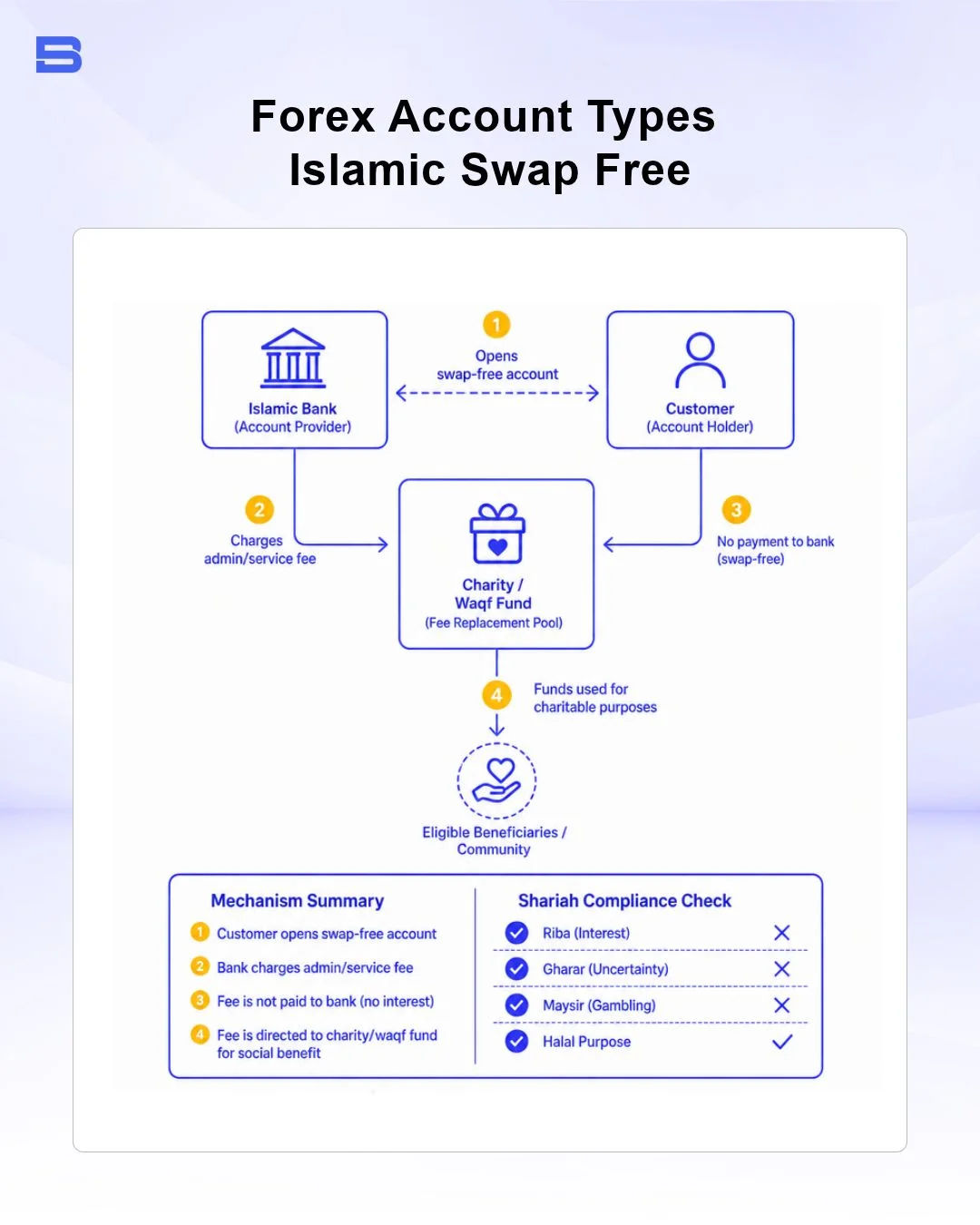
To accommodate Muslim traders, reputable international brokers offer Islamic (Swap-Free) accounts. These accounts eliminate overnight rollover interest, ensuring strict Shariah compliance.
However, brokers still incur costs to maintain open positions overnight. To compensate, brokers replace swaps with administration fees or carry charges after a designated grace period (typically 3 to 7 nights).
Traders in Southeast Asia should ensure their chosen broker complies with regulatory guidelines set by institutions like the Securities Commission Malaysia (SC) to ensure fee structures remain transparent and free of hidden costs.
Spread-Only vs. Commission-Based Pricing Models
To select the most cost-effective account structure, you must weigh fixed trading fees against variable spread behavior across different market conditions.
Spread-only accounts offer predictable cost structures for traders holding positions over days or weeks, as wider spreads impact long-term targets far less than daily commission volume. Conversely, short-term day traders holding positions for minutes or hours benefit significantly from raw pips on ECN setups, where tighter bid-ask spreads dramatically lower transaction drag over dozens of trades.
Conclusion
No single forex account type is objectively superior; the right choice depends entirely on your trading frequency, capital size, and strategy. Beginners and low-frequency swing traders often benefit from the simplicity of Standard or Cent spread-only accounts.
High-volume day traders and automated system users will generally achieve better net returns on direct-execution ECN accounts by minimizing spread drag. Always verify a broker's regulatory standing and transparent execution disclosure before funding your account.
Disclaimer: The content on this page is intended for educational and informational purposes only. It does not constitute financial, investment, tax, or legal advice, and should not be interpreted as a recommendation to buy, sell, or hold any financial instrument or asset. Trading and investing involve significant risk, including the possible loss of your entire capital. Products such as forex, CFDs, and cryptocurrencies carry additional risks due to leverage, high volatility, and limited regulatory protection in some jurisdictions. Past performance of any financial instrument does not guarantee future results. Any market views, forecasts, or opinions expressed are those of the author at the time of writing and may not reflect current market conditions. Platform features, fees, and regulatory status are subject to change — always verify information directly with the relevant provider or regulator before making any financial decision. BrokerSpecs may receive compensation from third parties featured on this site. Always conduct your own due diligence and consider seeking advice from a licensed financial professional before investing. Portions of this article were prepared with the assistance of AI tools and reviewed by our editorial team before publication.