



Related Tags
You log into your brokerage account, intending to stick to your routine, but your feed is flooded with screenshots of explosive triple-digit gains from a speculative breakout stock. Moments later, you catch yourself doubling your standard position size on a similar setup, convinced that rapid windfalls are simply the current reality of the market. Your brain has just substituted statistical probability with an emotionally charged, easily recalled mental image.
What Is the Availability Heuristic Bias in Trading?
The availability heuristic bias is a cognitive shortcut where traders assess an event's likelihood based on how easily recent, dramatic examples come to mind. Instead of calculating statistical base rates or historical expectancy, your brain relies on cognitive ease, mistakenly treating memorable events as frequent occurrences.
In financial markets, this shortcut distorts rational decision-making. Financial market standards outlined by organizations like the CFA Institute emphasize that disciplined analysis requires objective statistical evaluation rather than subjective recollection. When active market participants face volatile swings or rapid information flow, the brain naturally takes the path of least cognitive resistance, reaching for vivid narratives rather than doing tedious quantitative legwork.
How Availability Bias in Trading Distorts Probability Assessment
Your memory does not function like a systematic database. It prioritizes vividness, emotional intensity, and narrative flair over statistical reality.
When evaluating risk before placing a trade, you do not recall hundreds of average historical outcomes. Instead, you recall the outlier event that triggered an intense emotional spike, whether that was a windfall or a portfolio drop. Consequently, if a specific outcome comes to mind with minimal friction, your subconscious mind falsely assigns it a significantly higher probability of recurring.
Why Your Brain Relies on Cognitive Bias in Trading Under Market Stress
Human brains evolved to prioritize immediate survival signals over slow statistical processing. In prehistoric environments, assuming that a rustling bush was a predator based on a vivid past encounter kept our ancestors alive, even if nine times out of ten it was just the wind.
Fast-forward to modern live-market conditions, and that survival wiring backfires. Facing live financial exposure introduces acute cognitive fatigue, prompting the brain to deploy cognitive bias in trading as a quick energy-saving reflex. When you stare at flashing numbers and fluctuating balance totals, your working memory shrinks, prompting you to abandon probability analysis in favor of vivid mental shortcuts.
Real-World Availability Heuristic Examples in Everyday Trading
Retail market environments are filled with vivid stimuli that actively feed this distortion. Two scenarios regularly impact everyday trading routines:
- Chasing Speculative Momentum After Social Proof: You observe peers on social trading forums posting profits from a volatile micro-cap stock. The effect of colorful screenshots and triumphant narratives makes speculative windfalls seem common, driving you to jump in right before liquidity dries up.
- Panic-Selling During Broad Market Drawdowns: A sharp pullback triggers headlines warning of an imminent crash. Rather than reviewing your long-term fundamental thesis or consulting historical broad-market recovery rates, the vivid imagery of past market panics prompts you to liquidate solid holdings at an unfavorable market bottom.
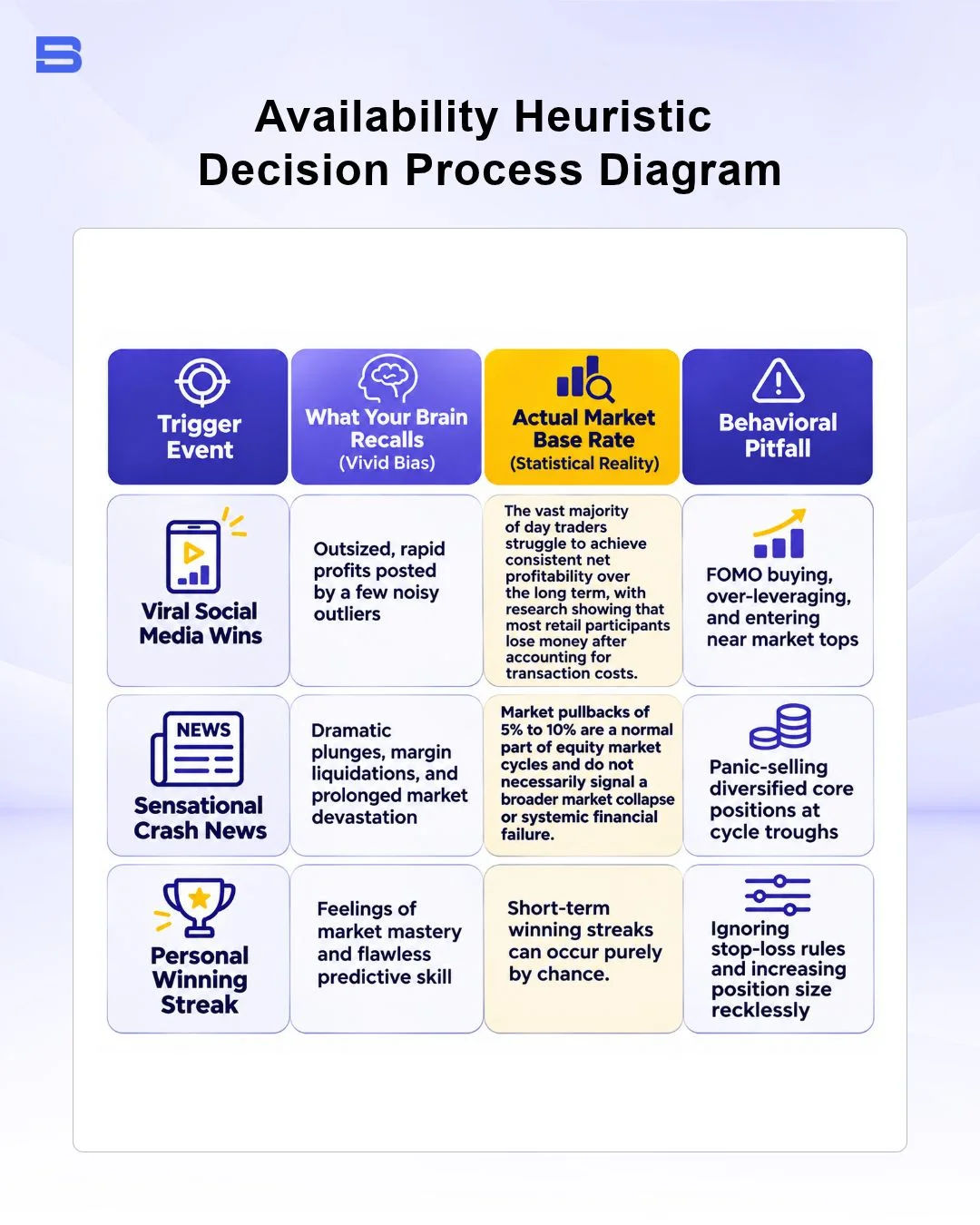
Here's how vivid emotional memories compare with the actual statistical market reality retail traders face:
How Does the Availability Heuristic Affect Decision Making and Risk Management?
This cognitive bias actively degrades your execution by distorting your baseline perception of danger. Regulatory agencies like the Securities Commission Malaysia (SC) frequently remind retail investors that emotional overreaction and misjudging probability are primary contributors to avoidable retail capital erosion.
When vivid memories replace data, you drift into serious risk management errors that can erase months of gains. Consider a trader who achieves three consecutive winning trades using standard position sizing. The vivid satisfaction of those immediate wins overshadows the historical reality that their trading edge only yields a 50% win rate over hundreds of executions.
Overwhelmed by the mental availability of those wins, the trader increases their position to an aggressive 10:1 leveraged exposure on the very next setup. Leverage amplifies returns when the market moves favorably, but it accelerates capital destruction just as swiftly when the position turns against you.
A minor 3% adverse price move against an over-leveraged position can wipe out weeks of disciplined progress, whereas maintaining a consistent 1% account risk model limits the downside to a manageable drawdown.
Availability Heuristic vs Recency Bias: What Is the Difference?
While closely related, the cognitive bias and recency bias stem from distinct psychological mechanisms.
Recency bias is strictly chronologically driven; it assigns greater importance to whatever happened most recently, simply because it took place yesterday or earlier today. In contrast, the cognitive bias is governed by emotional salience and vividness. An event that occurred five years ago, such as an unexpected flash crash or a breakout gain, can dominate your current market outlook far more aggressively than yesterday's unremarkable trading session simply because the memory remains emotionally striking.
Practical Rules for Overcoming Availability Bias in Your Strategy
Neutralizing subconscious cognitive distortion requires replacing intuitive reactions with mechanical, rule-based systems. Investor education resources from the US Securities and Exchange Commission (SEC) consistently advise market participants to ground investment choices in empirical records rather than subjective impressions.
Adopt these systematic controls to protect your capital from memory distortion:
Adopt these systematic controls to protect your capital from memory distortion:
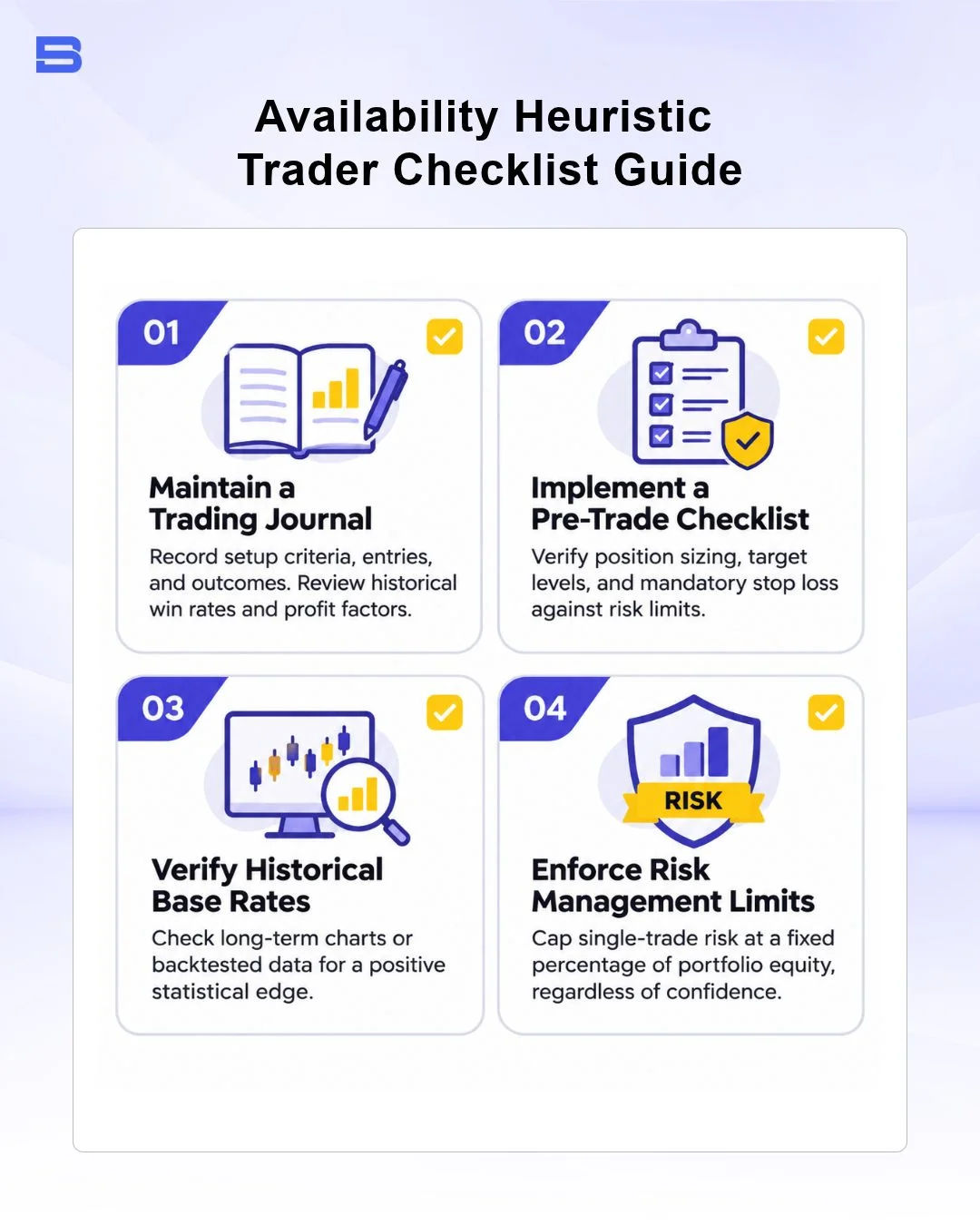
- Maintain a Detailed Trading Journal: Documenting the statistical setup, entry criteria, and quantitative outcome of every position forces you to view your strategy through historical win rates and profit factors rather than emotional memories.
- Implement a Pre-Trade Checklist: Create an objective checklist covering strict position sizing, predefined target levels, and a mandatory stop loss before order submission, ensuring trade parameters align with your established risk limits.
- Verify Base Rates Before Capital Deployment: When a trade feels compelling due to a recent market narrative, deliberately consult long-term historical charts or backtested data to determine whether the setup genuinely carries a positive statistical edge.
- Enforce Structured Risk Management Limits: Cap single-trade risk at a fixed percentage of total portfolio equity, preventing subjective confidence or recent emotional wins from dictating your exposure.
The Bottom Line
The availability heuristic can quietly influence trading decisions by causing investors to rely on recent market events, memorable experiences, or emotionally charged information rather than objective evidence. Recognizing this cognitive bias helps traders avoid overreacting to short-term price movements, misjudging market risks, and making impulsive decisions. By maintaining a structured trading plan, reviewing historical data, and applying consistent risk management rules, traders can make more rational decisions and improve their long-term trading discipline.
Disclaimer: The content on this page is intended for educational and informational purposes only. It does not constitute financial, investment, tax, or legal advice, and should not be interpreted as a recommendation to buy, sell, or hold any financial instrument or asset. Trading and investing involve significant risk, including the possible loss of your entire capital. Products such as forex, CFDs, and cryptocurrencies carry additional risks due to leverage, high volatility, and limited regulatory protection in some jurisdictions. Past performance of any financial instrument does not guarantee future results. Any market views, forecasts, or opinions expressed are those of the author at the time of writing and may not reflect current market conditions. Platform features, fees, and regulatory status are subject to change — always verify information directly with the relevant provider or regulator before making any financial decision. BrokerSpecs may receive compensation from third parties featured on this site. Always conduct your own due diligence and consider seeking advice from a licensed financial professional before investing. Portions of this article were prepared with the assistance of AI tools and reviewed by our editorial team before publication.