



Related Tags
You wake up, glance at your brokerage app, and see a blue-chip tech stock down 12% before the opening bell rings. No geopolitical crisis hit overnight, and no executive abruptly resigned. Instead, the company simply released its latest quarterly report, and the market reacted with sharp volatility.
That concentrated flurry of financial disclosures occurs four times every single year. For beginners and experienced market participants alike, learning to navigate this period is essential for understanding what truly drives company valuations.
What Is Earnings Season and Why Does It Matter?
Earnings season is the quarterly window when publicly listed corporations release their recent financial results, including revenue, net profit, and forward guidance. Under rules enforced by the US Securities and Exchange Commission (SEC), US-listed public companies must file Form 10-Q for each of the first three quarters and an audited Form 10-K annually that covers the full year, including the fourth quarter.
These disclosures eliminate guesswork by laying out verified operational performance. Investors parse the income statement to examine top-line sales growth and the cash flow statement to evaluate operational sustainability.
Because corporate value ultimately reflects a firm’s long-term earning power, these updates force market participants to recalibrate their financial expectations in real time.
When Is Earnings Season? (Quarterly Dates and Schedule)
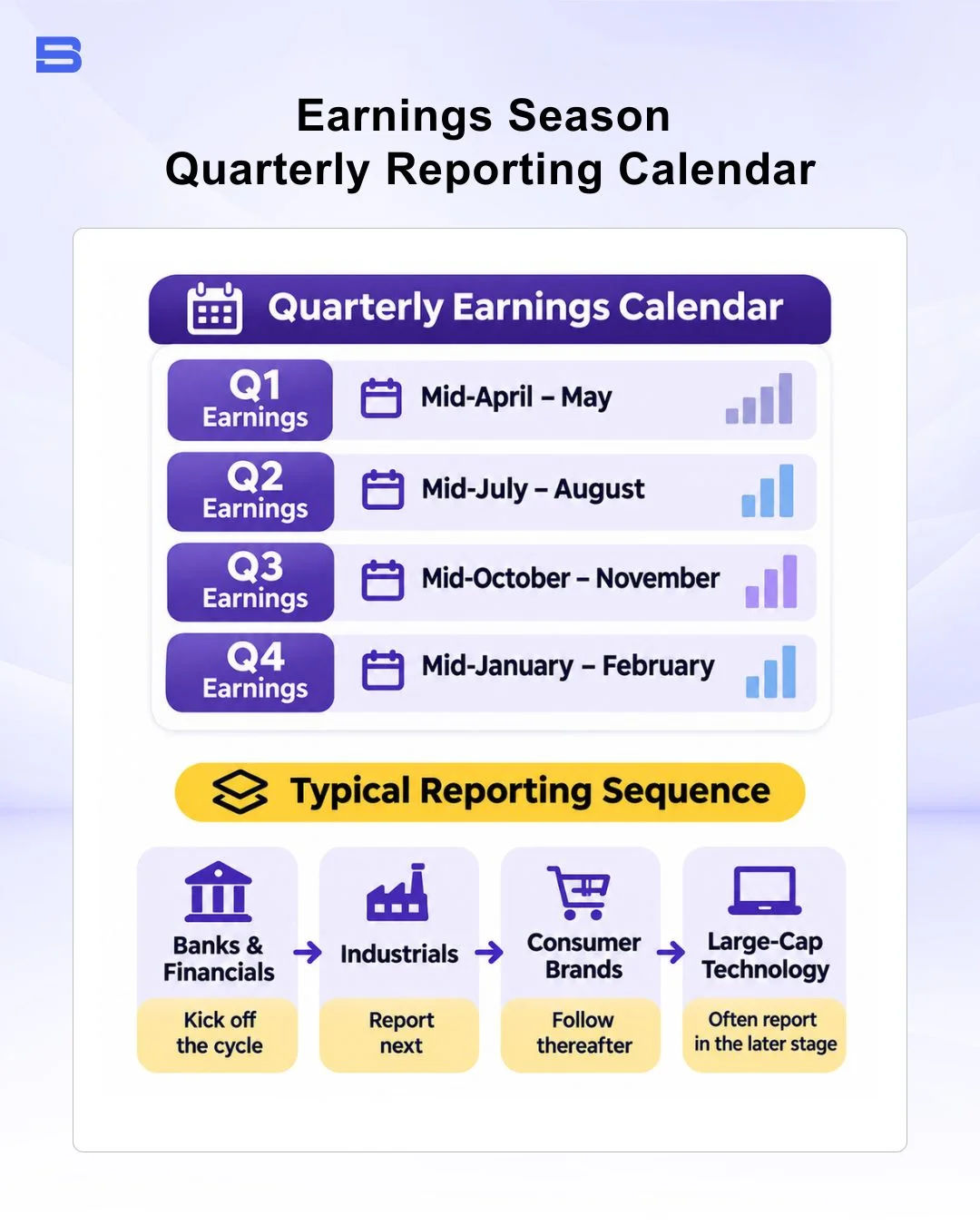
Earnings season occurs four times a year, typically kicking off a couple of weeks after each calendar quarter concludes:
- Q1 Earnings: Mid-April through May
- Q2 Earnings: Mid-July through August
- Q3 Earnings: Mid-October through November
- Q4 Earnings: Mid-January through February
The reporting sequence usually follows an established pattern. Major global banks and financial institutions traditionally kick off the cycle, followed by industrial giants, consumer brands, and large-cap technology companies.
As of this article’s publication, the US Securities and Exchange Commission (SEC) requires larger companies (measured by the market value of shares held by the public) to file Form 10-Q within 40 days after quarter end, and smaller companies within 45 days.
Key Financial Metrics to Track: Earnings Per Share and Beyond
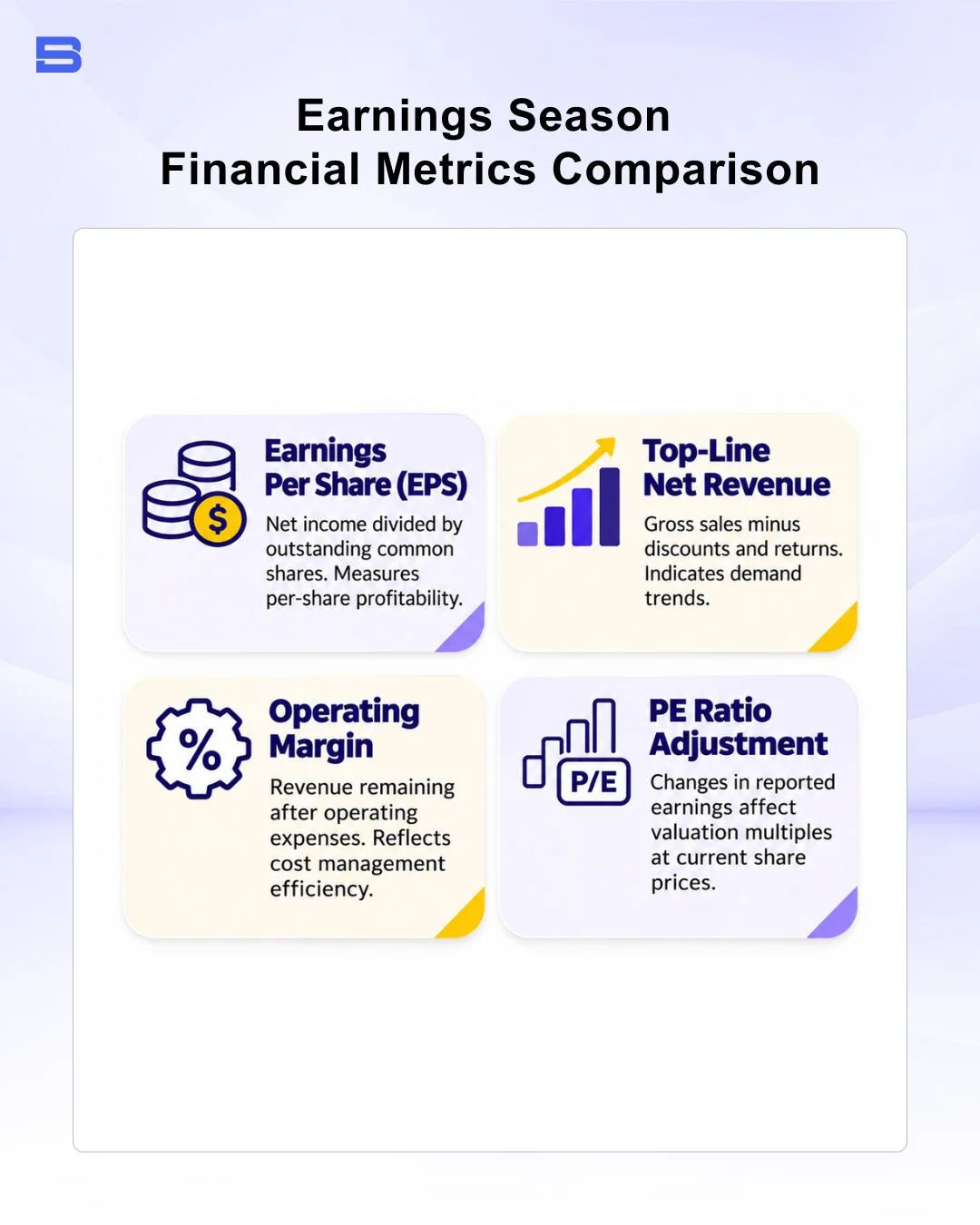
When earnings releases drop, market commentary often fixates on headlines, but seasoned analysts look deeper into core accounting figures. Evaluating an update involves checking several foundational numbers to determine whether operational performance is genuine.
- Earnings Per Share (EPS): Total net income divided by outstanding common shares, reflecting per-share profitability.
- Top-Line Net Revenue: Total gross sales minus discounts and returns, showing whether demand is expanding.
- Operating Margin: The share of revenue left after paying operating expenses, showing cost management efficiency.
- PE Ratio Adjustment: Shifts in reported earnings directly change valuation multiples against current share prices.
A company might generate impressive headline net profits through one-off asset sales, yet its underlying core business could be slowing down. Verifying the health of the balance sheet ensures that reported profits translate into solid assets rather than deteriorating working capital.
How Earnings Season Impacts Stock Prices and Volatility
Stock prices rarely move in a vacuum during earnings windows. They move based on how reality compares to expectations. Institutional analysts build detailed models forecasting revenue and margins months in advance.
When official disclosures deviate from these consensus forecasts, sharp repricing can occur within seconds.
Consensus Estimates vs. Earnings Surprises
A consensus estimate represents the average forecast compiled across major Wall Street analysts. If a company beats that consensus, it produces a positive earnings surprise, whereas missing estimates results in a negative surprise.
Consider this practical scenario: Company ABC is expected to report an EPS of $1.00 on $10 billion in revenue. It officially posts an EPS of $1.15 and revenue of $10.4 billion, beating expectations across the board. Yet, within 10 minutes of trading, the stock drops 6%.
How does that happen? The answer almost always lies in management’s forward-looking commentary.
Why Corporate Guidance Moves Markets More Than Historical Numbers
Historical earnings reports show what happened in the past, but equity valuations reflect discounted cash flows that will be earned in the future. During earnings calls, executive leadership issues earnings guidance, offering revenue and margin projections for upcoming quarters.
If Company ABC beats trailing quarterly figures but cautions that supply-chain costs or weakening customer demand will drag down next quarter’s profit by 15%, analysts slash their future models immediately. Forward expectations often outweigh backward-looking metrics, which may trigger institutional selling even after a past beat.
How to Navigate Earnings Season: Practical Strategies for Investors
Navigating earnings season requires balancing potential profit opportunities against downside risks. While catching a post-earnings surge can produce gains, holding speculative positions into an unannounced report carries substantial risk of overnight gap-downs (opening prices far below the previous close) that can bypass standard stop-loss orders (preset instructions to sell at a chosen price).
For long-term investors, earnings releases serve as quarterly health checkups to determine whether the company’s investment thesis remains intact. Short-term traders, by contrast, frequently struggle with post-market liquidity traps, where wider bid-ask spreads (the gap between the highest buy price and the lowest sell price) dramatically increase slippage (the difference between the expected price and the price actually received).
As the Financial Industry Regulatory Authority (FINRA) regularly notes in its investor guidance, extended-hours trading involves distinct risks, including lower liquidity and higher price volatility.
Options traders face another quiet pitfall known as implied volatility (IV) crush. Heading into an announcement, heightened uncertainty inflates option premiums. Once the numbers are published, implied volatility collapses rapidly, erasing the value of out-of-the-money options (options that would not be profitable to exercise right now) even if the underlying stock moves in the expected direction.
Practicing prudent position sizing and resisting the urge to gamble on binary outcomes can help manage risk, although no approach removes the possibility of loss.
Final Thoughts on Earnings Season
Earnings season provides a clear window into corporate health, cutting through market speculation with verified financial realities. While the resulting price swings can seem chaotic, approaching disclosures with a structured focus on operational margins, cash flow, and sensible forward guidance helps you build lasting conviction across market cycles.
Disclaimer: The content on this page is intended for educational and informational purposes only. It does not constitute financial, investment, tax, or legal advice, and should not be interpreted as a recommendation to buy, sell, or hold any financial instrument or asset. Trading and investing involve significant risk, including the possible loss of your entire capital. Products such as forex, CFDs, and cryptocurrencies carry additional risks due to leverage, high volatility, and limited regulatory protection in some jurisdictions. Past performance of any financial instrument does not guarantee future results. Any market views, forecasts, or opinions expressed are those of the author at the time of writing and may not reflect current market conditions. Platform features, fees, and regulatory status are subject to change — always verify information directly with the relevant provider or regulator before making any financial decision. BrokerSpecs may receive compensation from third parties featured on this site. Always conduct your own due diligence and consider seeking advice from a licensed financial professional before investing. Portions of this article were prepared with the assistance of AI tools and reviewed by our editorial team before publication.