



Related Tags
Imagine checking your trading terminal on an ordinary Thursday morning, expecting a quiet session with tight spreads and steady price action. Within seconds, an unscheduled central bank announcement triggers a sharp price gap that leaps straight over your stop-loss order. Financial professionals call this kind of sudden, extreme shock a black swan event.
What Is a Black Swan Event and the Black Swan Theory?
A black swan event is a rare, unpredictable market shock that carries severe consequences and appears obvious only in hindsight. Former options trader and risk scholar Nassim Nicholas Taleb popularized the black swan theory in his 2007 book The Black Swan.
The metaphor comes from an old European belief that all swans were white because no one had ever seen another color. When Dutch explorers encountered black swans in Australia in 1697, a single observation overturned centuries of assumed certainty. In financial markets, the term describes rare outliers that break standard forecasting models and catch the vast majority of participants off guard.
The Three Defining Traits of a Black Swan Event
According to Taleb’s framework, a true black swan event must meet three strict criteria. First, it is an extreme outlier that lies outside regular expectations because nothing in past data convincingly points to its possibility.
Second, the event produces an extreme, widespread impact across economies, asset classes, or entire financial systems. Third, despite its outlier status, human nature leads observers to invent explanations afterward, creating hindsight bias that makes the shock seem predictable after the fact.
Notable Black Swan Event Examples in Financial Markets
Reviewing historical black swan event examples helps illustrate how quickly market conditions can shift when an unexpected catalyst hits.
- The 2008 Global Financial Crisis: The collapse of Lehman Brothers in September 2008 froze global interbank lending and triggered a severe worldwide recession, with the S&P 500 falling by roughly half or more between its October 2007 peak and its March 2009 trough. Data tracked by the International Monetary Fund (IMF) highlights how defaults in complex mortgage securities cascaded rapidly into global banking stress.
- The 2015 Swiss Franc Unpegging: On January 15, 2015, the Swiss National Bank unexpectedly scrapped its three-year currency cap of 1.2000 francs per euro without warning. According to analysis from the Bank for International Settlements (BIS), EUR/CHF plunged roughly 30% within minutes as liquidity evaporated, leaving retail traders and several brokerage firms with heavy losses.
- The March 2020 COVID-19 Market Crash: Global lockdowns halted economic activity almost overnight, sending major stock indices into a rapid bear-market drop while the VIX volatility index spiked far above its typical range.
Each of these episodes caught standard risk models off guard because historical price data offered no reliable blueprint for the speed of the sell-off.
Black Swan vs. Grey Rhino: Why Not Every Crash Is a Black Swan
Traders often label every sharp market drop a black swan, yet risk analysts separate true surprises from visible threats using the black swan vs grey rhino framework. Policy analyst Michele Wucker coined the term "grey rhino" to describe high-probability, high-impact threats that are widely visible beforehand but ignored until they charge.
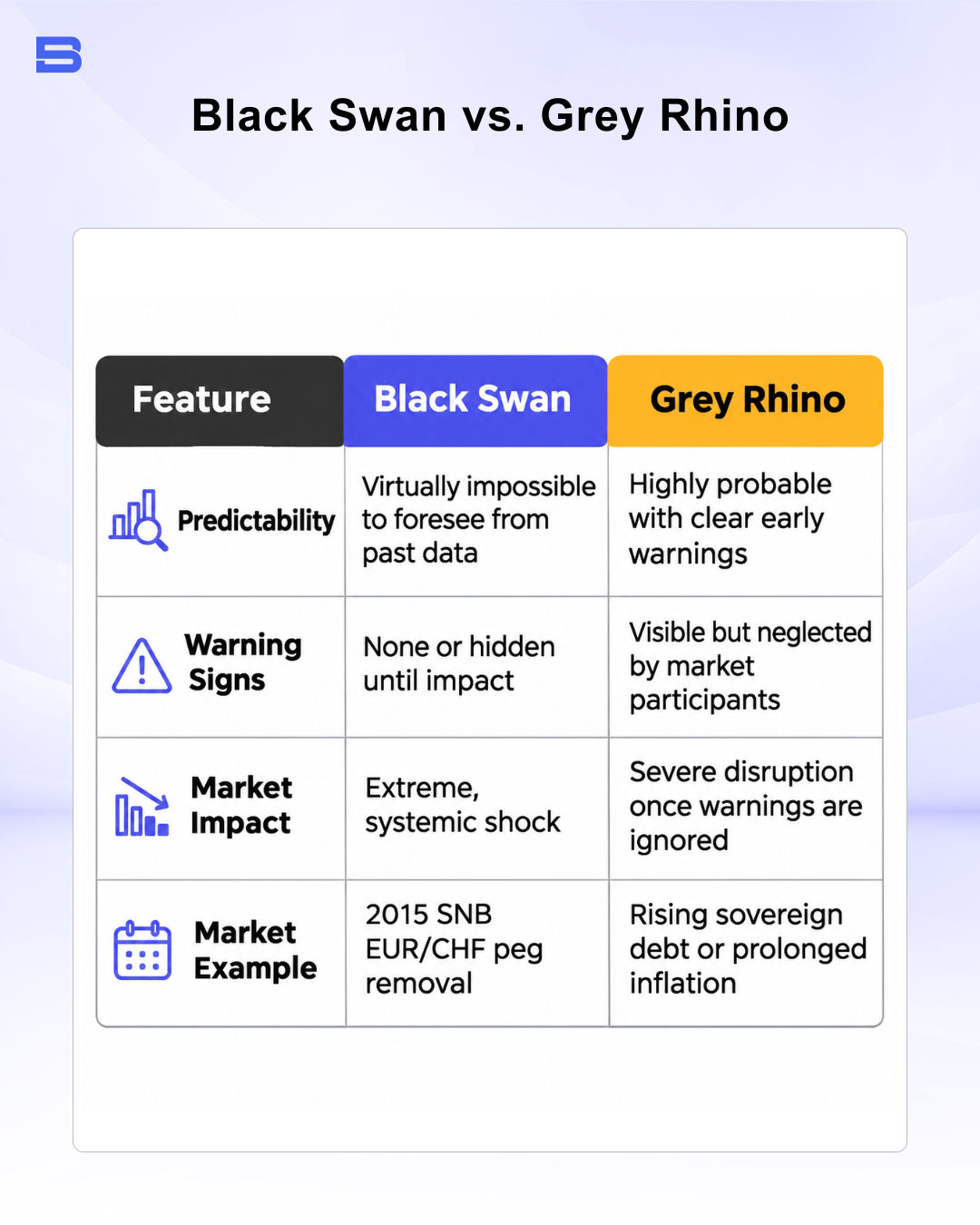
Recognizing this distinction keeps you from treating preventable portfolio risks as unavoidable acts of fate.
Can a Black Swan Event Be Positive?
A positive black swan event occurs when an unforeseen breakthrough creates substantial upside rather than a market collapse. The rapid commercial adoption of the internet in the 1990s is a classic example, transforming global commerce. Even so, traders generally focus on negative shocks first because a single unhedged downside tail event can permanently wipe out an account before future opportunities arrive.
How a Black Swan Event Affects Trading Accounts and Tail Risk
In finance, tail risk refers to the probability that an asset moves far beyond three standard deviations from its average return, sitting at the extreme outer edges of a bell curve. When a black swan strikes, extreme market volatility causes liquidity providers to pull their quotes, widening bid-ask spreads dramatically.
To see how this affects an individual account, consider a trader with a $5,000 balance who buys 0.5 standard lots (50,000 units) of EUR/CHF at 1.2010 using 20:1 leverage. The trader places a standard stop-loss order at 1.1960, aiming to cap the loss at 50 pips, or roughly $250 (5% of account equity at approximately $5 per pip).
Leverage magnifies potential profits when price moves in your favor, but it accelerates losses at the exact same speed when a sudden shock hits. If an unexpected central bank policy change gaps EUR/CHF down 1,500 pips to 1.0510 with no buyers at intermediate prices, slippage forces the order to fill near 1.0510 instead of 1.1960. That 1,500-pip drop produces a $7,500 loss, wiping out the entire $5,000 balance and triggering an immediate margin call or negative equity.
How Traders and Investors Manage Black Swan Risk
You cannot predict when the next black swan will arrive, so effective risk management focuses on surviving the shock rather than forecasting it. Taleb describes systems that gain from disorder as antifragile, and the safeguards below focus on the more modest goal of keeping your account robust enough to survive a shock.
Traders and investors commonly apply four practical safeguards to limit tail-risk damage:
- Keep Leverage Low: Reducing effective leverage leaves a larger free-margin buffer, helping your account absorb sudden price spikes without forced liquidation.
- Cap Position Sizing: Risking a small percentage of capital per trade, such as 1% to 2%, prevents a single gapping position from threatening your entire account.
- Diversify Across Uncorrelated Assets: True portfolio diversification spreads capital across distinct asset classes like cash, government bonds, equities, and commodities so one market shock cannot sink everything at once.
- Enforce Drawdown Limits and Stress Tests: Setting a maximum portfolio drawdown threshold and stress-testing holdings against past crises, as recommended by the CFA Institute, helps keep exposure aligned with your personal risk tolerance.
Together, these habits may help keep rare market outliers as survivable setbacks rather than account-ending events, although no safeguard removes tail risk entirely.
Build Your Account to Survive the Unexpected
A black swan event is an unavoidable feature of modern financial markets, reminding every participant that past stability never guarantees future calm. By keeping leverage conservative, sizing positions carefully, and diversifying across asset classes, you can protect your capital when the unexpected happens.
Disclaimer: The content on this page is intended for educational and informational purposes only. It does not constitute financial, investment, tax, or legal advice, and should not be interpreted as a recommendation to buy, sell, or hold any financial instrument or asset. Trading and investing involve significant risk, including the possible loss of your entire capital. Products such as forex, CFDs, and cryptocurrencies carry additional risks due to leverage, high volatility, and limited regulatory protection in some jurisdictions. Past performance of any financial instrument does not guarantee future results. Any market views, forecasts, or opinions expressed are those of the author at the time of writing and may not reflect current market conditions. Platform features, fees, and regulatory status are subject to change — always verify information directly with the relevant provider or regulator before making any financial decision. BrokerSpecs may receive compensation from third parties featured on this site. Always conduct your own due diligence and consider seeking advice from a licensed financial professional before investing. Portions of this article were prepared with the assistance of AI tools and reviewed by our editorial team before publication.