



Related Tags
It is 3:45 PM in New York, fifteen minutes before the closing bell, and there is no Federal Reserve announcement or earnings release on the wire. Yet volume across U.S. stocks and index benchmarks suddenly surges, pushing intraday swings wider by the minute.
If you have watched calm afternoon sessions turn turbulent on a Friday near quarter-end, you have likely seen triple witching in action. Understanding this recurring expiration event helps you separate mechanical order flow from genuine market fundamentals.
What Is Triple Witching and How Does It Work?
Triple witching is the simultaneous quarterly expiration of stock options, stock index futures, and stock index options on a single trading day. This convergence happens four times a year and forces institutional desks, market makers, and hedge funds to close, exercise, or roll over large derivatives books before contracts lapse.
Rolling a position means closing an expiring contract and simultaneously opening an identical contract for the next quarter, generating heavy two-way order flow through a central clearing house. Because dealers also unwind hedges on underlying shares as options expire, equity volumes often climb sharply without fresh economic news. Recognizing this mechanical rebalancing keeps you from mistaking settlement noise for a durable trend breakout.
Triple Witching vs. Quadruple Witching: Why the Terms Overlap
You will still hear commentators call these dates quadruple witching, a label from when single-stock futures traded alongside the other three contract types. Single-stock futures obligated traders to exchange individual company shares on a set future date, adding a fourth expiration leg.
However, OneChicago, the sole U.S. exchange listing single-stock futures, closed trading operations in September 2020. With only three derivative categories expiring together in U.S. markets today, triple witching is the accurate modern term, though both labels still appear interchangeably on market calendars.
The Three Contracts That Expire on Triple Witching Day
Each triple witching session brings together three equity derivatives with distinct settlement rules that shape intraday price action.
- Individual stock options grant the right, without the obligation, to buy or sell 100 shares of a company at a set strike price before expiration. In options trading, in-the-money equity options generally settle into physical shares after Friday's close, prompting dealers to adjust share hedges through the afternoon.
- Stock index futures are binding agreements to buy or sell the cash value of a benchmark index on a scheduled future date, and major U.S. futures contracts settle in cash rather than physical shares.
- Stock index options also track an entire benchmark and settle in cash. Standard quarterly index options on Cboe typically use AM settlement, calculating final value from a Special Opening Quotation based on Friday morning's opening component prices, whereas weekly and month-end index options use PM settlement at the 4:00 PM ET close.
Triple Witching Dates 2026 and 2027 Calendar
Triple witching normally falls on the third Friday of March, June, September, and December. When a U.S. federal market holiday lands on that Friday, exchanges move expiration forward to the preceding Thursday.
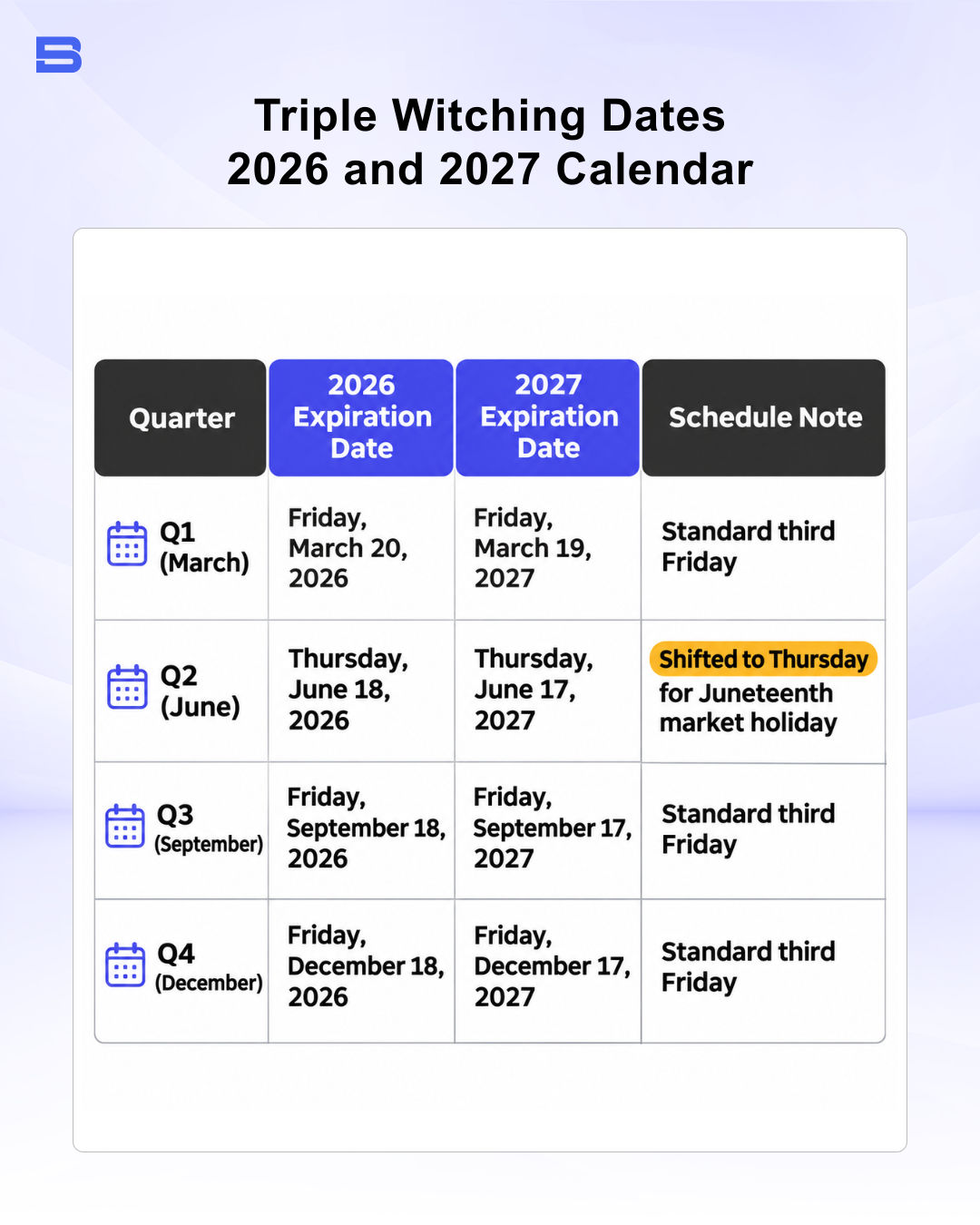
Notice the June shift in both years, as U.S. equity and options markets close for the Juneteenth holiday on Friday, June 19, 2026, and Friday, June 18, 2027. Marking these Thursday dates in advance keeps you from expecting expiration liquidity on a closed market day.
How Triple Witching Affects Market Volume and Volatility
Triple witching sessions rarely move at a steady pace from open to close. Instead, market volatility clusters around two windows: the 9:30 AM ET opening auction when AM-settled index contracts price, and the final hour before the 4:00 PM ET close.
For traders in Malaysia and Singapore, those windows fall at 9:30 PM and 3:00 AM to 4:00 AM MYT/SGT during U.S. daylight saving time, or one hour later during U.S. standard time. Resting orders left unattended overnight in Southeast Asia face sudden liquidity shifts during these hours.
Raw historical charts on June and September expiration days can also mislead you if you overlook quarterly distributions. Several major S&P 500 exchange-traded funds go ex-dividend on the third Friday of March, June, September, and December, creating a mechanical downward price adjustment at the open rather than bearish selling.
How the Witching Hour Drives Volume and Intraday Volatility
The final sixty minutes of the U.S. session, from 3:00 PM to 4:00 PM ET, is known as the witching hour. Market-on-close imbalances, index rebalancing orders, and expiring option hedges collide during this window.
Dealers who sold options near heavily traded strike prices often buy or sell underlying shares rapidly to stay hedged, creating pin risk that can pull prices toward key strikes before stalling once contracts expire at 4:00 PM ET.
Managing Execution Risk Around Triple Witching
Higher quarterly volume creates a double-edged environment for active traders. On the upside, deep institutional participation can tighten bid-ask spreads in benchmark index futures and liquid stocks during core hours, helping orders fill cleanly.
On the downside, rapid order cancellations near the open and close can widen spreads abruptly and trigger slippage, filling orders at worse prices than requested. Tight market stop-losses during these bursts expose your account to whipsaws driven by settlement flows rather than fundamentals.
Consider a $10,000 position on an S&P 500 index CFD with 10:1 leverage ($1,000 margin), where each 1-point index move equals $20. Leverage magnifies gains when the market moves in your favor, but it accelerates capital losses just as quickly when prices move against you. Suppose you buy at 5,800 at 3:40 PM ET with a tight 15-point stop-loss at 5,785, aiming to cap your loss at $300, or 30% of your margin.
If a closing-auction imbalance briefly pushes the index down 22 points to 5,778 before rebounding, a market stop may slip and fill at 5,778. That 7-point slippage turns a planned $300 loss into a $440 loss, wiping out 44% of your margin in minutes.
To manage this execution risk, you may consider limit orders, wider stops, or waiting until after the closing auction settles, while verifying that any intermediary you use for foreign derivatives is regulated by authorities such as the Securities Commission Malaysia (SC).
Treat Expiration Days as Mechanical, Not Fundamental
Triple witching is a predictable quarterly milestone driven by institutional hedging, contract rolling, and derivatives settlement rather than shifting company fundamentals. Recognizing the opening and closing auctions as mechanical liquidity events helps you stay disciplined when intraday charts turn erratic.
By tracking the 2026 and 2027 dates, accounting for June holiday shifts, and sizing positions for wider swings, you can navigate expiration days without letting short-term noise derail your plan.
Disclaimer: The content on this page is intended for educational and informational purposes only. It does not constitute financial, investment, tax, or legal advice, and should not be interpreted as a recommendation to buy, sell, or hold any financial instrument or asset. Trading and investing involve significant risk, including the possible loss of your entire capital. Products such as forex, CFDs, and cryptocurrencies carry additional risks due to leverage, high volatility, and limited regulatory protection in some jurisdictions. Past performance of any financial instrument does not guarantee future results. Any market views, forecasts, or opinions expressed are those of the author at the time of writing and may not reflect current market conditions. Platform features, fees, and regulatory status are subject to change — always verify information directly with the relevant provider or regulator before making any financial decision. BrokerSpecs may receive compensation from third parties featured on this site. Always conduct your own due diligence and consider seeking advice from a licensed financial professional before investing. Portions of this article were prepared with the assistance of AI tools and reviewed by our editorial team before publication.