



Related Tags
At 12:00 PM in Kuala Lumpur, institutional trading desks watch the economic calendar as the Department of Statistics Malaysia (DOSM) releases its monthly external trade figures. Within seconds, automated algorithms react to the net export headline, nudging USD/MYR exchange rates and repositioning equity portfolios. For macro investors and currency traders, tracking the trade balance is essential for understanding real-world capital flows before they hit the market.
Understanding the Malaysia Trade Balance: Core Definitions and Concepts
The Malaysia trade balance represents the net difference between the total monetary value of goods exported from the country and the value of goods imported over a specific period. When Malaysia sells more physical merchandise overseas than it buys from abroad, the country achieves a trade surplus. Conversely, when the nation's total import expenditure exceeds its export revenue, it records a trade deficit.
A sustained surplus means net foreign currency enters the country, which commercial banks convert into the domestic currency to settle trade obligations. A widening deficit forces businesses to sell the local currency to buy foreign exchange, potentially depleting foreign reserves and weakening domestic exchange rates. Tracking the Malaysia trade balance gives you clear visibility into the cross-border cash flows that determine long-term currency strength.
Malaysia Trade Surplus vs. Trade Deficit: What the Difference Means
A trade surplus typically signals strong international demand for domestic goods, reinforcing corporate profits in key manufacturing and commodity industries. A trade deficit indicates that local consumption and industrial investments are absorbing more foreign manufactured items and raw supplies than domestic output can counterbalance. While persistent surpluses strengthen the external financial position, sharp shifts into deficit can introduce currency depreciation and volatility into domestic asset classes.
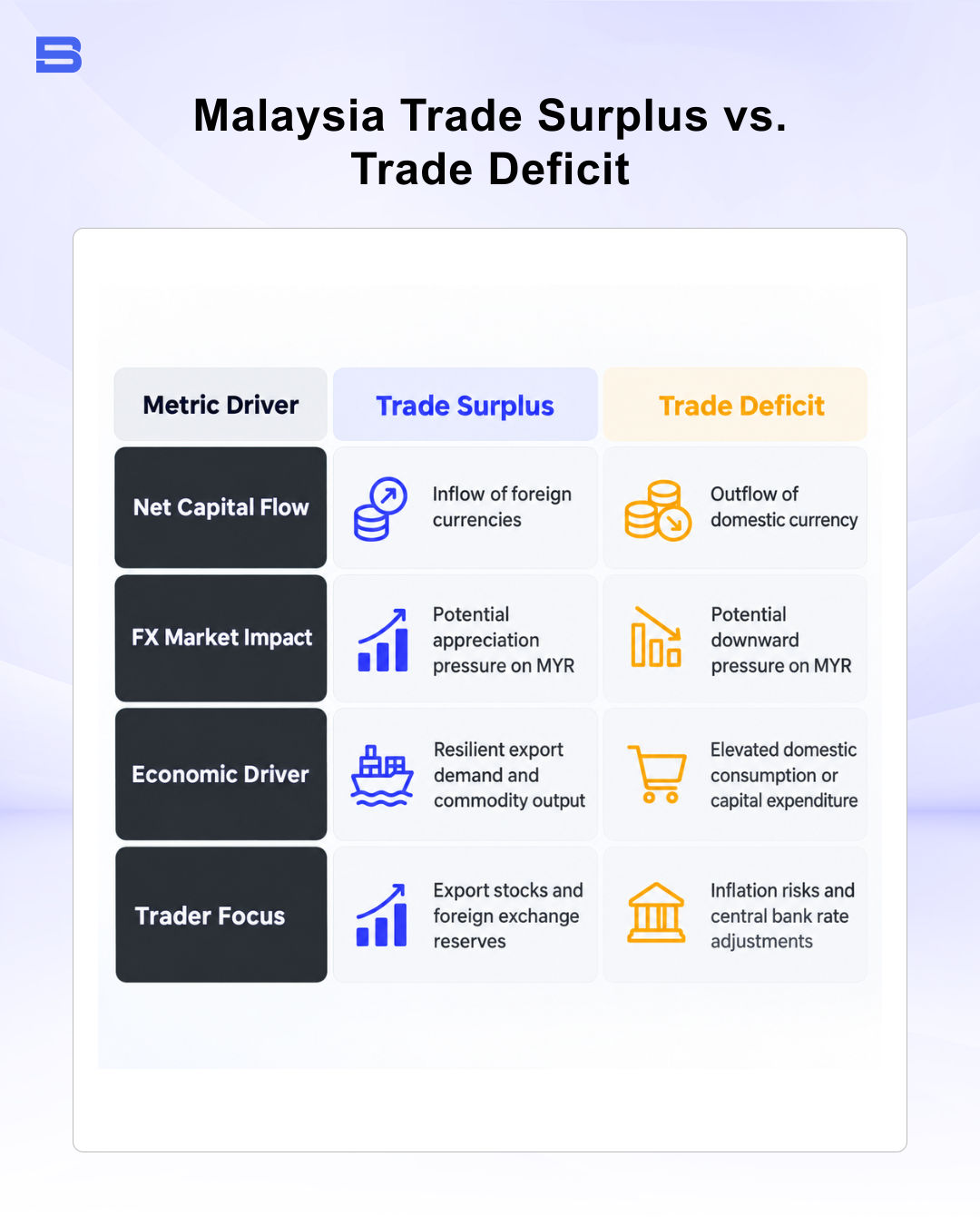
Understanding the fundamental distinction between these two trade environments helps you position your portfolio appropriately. Shifts between surplus and deficit can influence which stock sectors attract investors and how bond markets price in the outlook.
Key Components of Malaysia External Trade Statistics: Exports vs. Imports
Malaysia operates as an open, trade-reliant economy, where external trade makes up a large share of national output. When you examine the components of Malaysia's external trade statistics, exports are predominantly driven by electrical and electronic (E&E) products, followed by petroleum products, liquefied natural gas, and crude palm oil. Understanding the breadth of Malaysia exports allows you to identify which specific industrial sub-sectors are capturing global market share.
On the import side, goods are categorized into intermediate goods, capital goods, and consumption goods. Intermediate goods like semiconductors and industrial components represent the largest share of imports, serving as vital inputs for downstream manufacturing. A surge in intermediate imports often indicates that local factories are gearing up for expanded future production, whereas elevated consumption imports point directly to active domestic retail demand.
Major Trading Partners Driving Malaysia's Trade
Malaysia maintains expansive bilateral trade relationships with global economic giants, led by China, Singapore, and the United States. High concentration among these three trading partners leaves local export revenues exposed to shifting international tariff policies and global consumer demand cycles. A demand slowdown in the United States or an industrial slowdown in China can rapidly compress export margins and trim trade balance gains.
How to Read the Trade Balance Malaysia Report and Key Metrics
To extract actionable insights from the trade balance Malaysia report, you must look past the single headline figure published by the Department of Statistics Malaysia (DOSM). Focus first on total exports versus re-exports, which clarifies how much revenue originates from domestic value-added production rather than basic transit logistics. A rising headline surplus powered purely by re-exports indicates weaker domestic production momentum than the gross figures suggest. For example, the Department of Statistics Malaysia (DOSM) reported a trade balance of RM33.7 billion for September 2026, which gives you a concrete baseline to compare against the next release.
Next, evaluate the composition of incoming imports to gauge underlying industrial health. A temporary drop in the trade surplus caused by an influx of capital goods like heavy machinery is generally positive for medium-term economic expansion. Conversely, a shrinking surplus driven by escalating consumption imports without matching export volume expansion signals a less sustainable external balance.
| Import Category | Typical Examples | What a Rise Usually Signals |
|---|---|---|
| Intermediate goods | Semiconductors, industrial components | Factories may be preparing for higher future production |
| Capital goods | Heavy machinery | Investment in capacity, which is generally positive for medium-term growth |
| Consumption goods | Household and retail products | Active domestic demand, but less sustainable if exports do not keep pace |
What the Malaysia Balance of Trade Signals About Economic Health
The broader Malaysia balance of trade can serve as one useful indicator of national macroeconomic stability and competitiveness, alongside GDP, inflation, and capital-flow data. Sustained surpluses can help build foreign exchange reserves, which may help the sovereign balance sheet withstand global monetary tightening and emerging market capital flight. This structural stability provides a solid anchor for baseline projections of Malaysia GDP.
However, relying heavily on a trade surplus driven by volatile raw commodity exports introduces external vulnerability. Sudden drops in global crude oil or palm oil prices can swiftly contract net export earnings, even if manufacturing export volumes remain consistent. Astute traders separate structural manufacturing trade growth from temporary commodity price spikes when determining whether economic momentum is sustainable.
How Trade Balance Affects the Ringgit and Financial Markets
The Malaysia trade balance influences the foreign exchange market through continuous commercial currency transactions. When international buyers purchase Malaysian manufactured goods, they settle invoices using foreign currency that domestic exporters convert into the Malaysian Ringgit (MYR). This commercial conversion creates organic demand for the local currency in the global forex market, providing fundamental support against major currency pairs like USD/MYR.
When net trade revenues expand consistently, Bank Negara Malaysia (BNM) gains greater flexibility in managing domestic monetary conditions. Sustained trade health reduces the urgency to defend the currency through rapid hikes in Malaysia's Overnight Policy Rate (OPR), while steady foreign capital inflows help stabilize the local benchmark Malaysia bond yield. Conversely, a sharp contraction in net trade can heighten imported price pressures and influence the broader Malaysia inflation rate.
Consider a practical scenario where Malaysia records a monthly trade surplus expansion of RM5 billion, driven by stronger electronics demand abroad. Exporters might convert roughly US$1.1 billion into MYR (at an illustrative rate of about RM4.5 per US dollar) to fund local operations, tax liabilities, and payroll obligations. In theory, this kind of conversion can add buy orders for MYR against USD, which may put modest downward pressure on USD/MYR, although other factors such as interest rate differentials and global risk sentiment often outweigh it.
While a stronger trade surplus supports the local currency, rapid exchange rate appreciation can eventually compress profit margins for price-sensitive exporters. You must weigh the benefits of currency stability against the potential headwinds facing export-dependent equities on Bursa Malaysia.
Turning Trade Balance Data Into Ringgit and Equity Decisions
Monitoring the Malaysia trade balance each month delivers critical visibility into underlying currency demand, industrial production cycles, and macroeconomic health. By analyzing import categories alongside headline surplus numbers, you can anticipate foreign exchange shifts and make grounded, disciplined decisions across currency and equity markets.
Disclaimer: The content on this page is intended for educational and informational purposes only. It does not constitute financial, investment, tax, or legal advice, and should not be interpreted as a recommendation to buy, sell, or hold any financial instrument or asset. Trading and investing involve significant risk, including the possible loss of your entire capital. Products such as forex, CFDs, and cryptocurrencies carry additional risks due to leverage, high volatility, and limited regulatory protection in some jurisdictions. Past performance of any financial instrument does not guarantee future results. Any market views, forecasts, or opinions expressed are those of the author at the time of writing and may not reflect current market conditions. Platform features, fees, and regulatory status are subject to change — always verify information directly with the relevant provider or regulator before making any financial decision. BrokerSpecs may receive compensation from third parties featured on this site. Always conduct your own due diligence and consider seeking advice from a licensed financial professional before investing. Portions of this article were prepared with the assistance of AI tools and reviewed by our editorial team before publication.