



Related Tags
It is 11:00 AM in Kuala Lumpur, and institutional dealing desks are watching their terminal feeds as the latest trade release crosses the wire. A sudden shift in outbound shipments can alter monthly economic projections and reshape commercial foreign exchange flows within minutes. Understanding the momentum behind Malaysia's GDP starts with tracking the performance of Malaysia exports on the global stage.
Understanding Malaysia Exports: Structural Trends and Market Significance
Malaysia operates as one of the most trade-dependent economies in Southeast Asia, with total external trade consistently exceeding its annual domestic output. Official releases published monthly by the Department of Statistics Malaysia (DOSM) show that outbound trade forms the core backbone of national income generation.
A sustained expansion in export volumes expands industrial production, supports capital reinvestment, and raises broader national living standards alongside Malaysia's GDP per capita.
This elevated openness to global commerce exposes the domestic economy to external demand cycles. When major manufacturing centers in North America, East Asia, and Europe enter contractionary phases, export orders fall rapidly. Currency traders monitor these trade reports not merely as historical performance records, but as high-frequency barometers of upcoming economic momentum.
What Are the Key Drivers Behind Malaysia's Main Exports?
The resilience of outbound shipments relies on a balanced division between advanced industrial manufacturing and natural resource extraction. This structural mix protects the broader economy against localized sector shocks, ensuring steady foreign currency revenue throughout the business cycle.
Evaluating the health of these revenue streams requires examining how diverse sectors respond to global shifts:
- High-Tech Manufacturing Resilience: Advanced technology products create durable supply chain relationships, though volumes depend heavily on consumer electronics replacement cycles.
- Capital Goods Reinvestment: Industrial machinery and equipment shipments generate stable margins, yet they face headwinds during global monetary tightening phases.
- Commodity Price Sensitivity: Energy and agricultural shipments offer strong windfalls during supply shortages, but they remain vulnerable to rapid global price corrections.
The Dominance of Malaysia's E&E Exports in Global Supply Chains
Electrical and electronic goods represent the single largest share of national merchandise shipments, historically accounting for roughly 40% of total export receipts.
Malaysia serves as a critical global hub for semiconductor assembly, packaging, and testing operations. When international technology conglomerates increase capital expenditure, regional manufacturing facilities see direct order increases.
Traders track monthly purchasing managers' reports and PMI data worldwide to anticipate shipping volumes in this sector. A synchronized decline in global semiconductor demand can compress national manufacturing revenue within a single quarter.
Malaysia's Commodity Exports: Palm Oil and Liquefied Natural Gas Dynamics
Resource-based products provide essential diversification away from purely industrial manufacturing cycles. Crude palm oil (CPO) and liquefied natural gas (LNG) generate substantial recurring trade receipts that fluctuate based on global commodity benchmarks. Long-term energy supply agreements with North Asian industrial consumers help stabilize baseline LNG cash flows during broader market downturns.
Agricultural output introduces distinct supply-side risks that traders must track. Adverse regional weather patterns can reduce harvest yields, while sudden shifts in international renewable fuel mandates alter baseline demand.
Major Trading Partners: Evaluating Malaysia's Top Export Destinations
National export earnings depend heavily on trade ties with a concentrated group of bilateral partners. Singapore, China, and the United States together absorb over 40% of all outbound merchandise shipments.
Economic reports from the International Monetary Fund (IMF) indicate that structural shifts within these three destination markets dictate regional export momentum.
A localized slowdown in any major partner creates asymmetric risks for domestic producers. Increased trade barriers or evolving industrial tariffs can redirect established shipping lanes and compress profit margins across local supply chains. Macroeconomic traders continually assess bilateral trade balances to identify potential foreign exchange risks before policy revisions materialize.
How Export Data Feeds into the Malaysia Trade Balance
Gross export receipts represent only half of the trade equation; they must be evaluated against inbound imports of intermediate and capital goods. The net trade balance reflects the surplus cash entering the economy after domestic industries pay for foreign production inputs. While rising consumer imports indicate domestic demand strength, an unexpected surge in intermediate imports can compress the net surplus.
A narrowing monthly trade surplus frequently prompts foreign exchange analysts to revise their currency projections. Persistently compressed trade margins can reduce national reserve accumulation and alter domestic price stability alongside the prevailing Malaysia's inflation rate.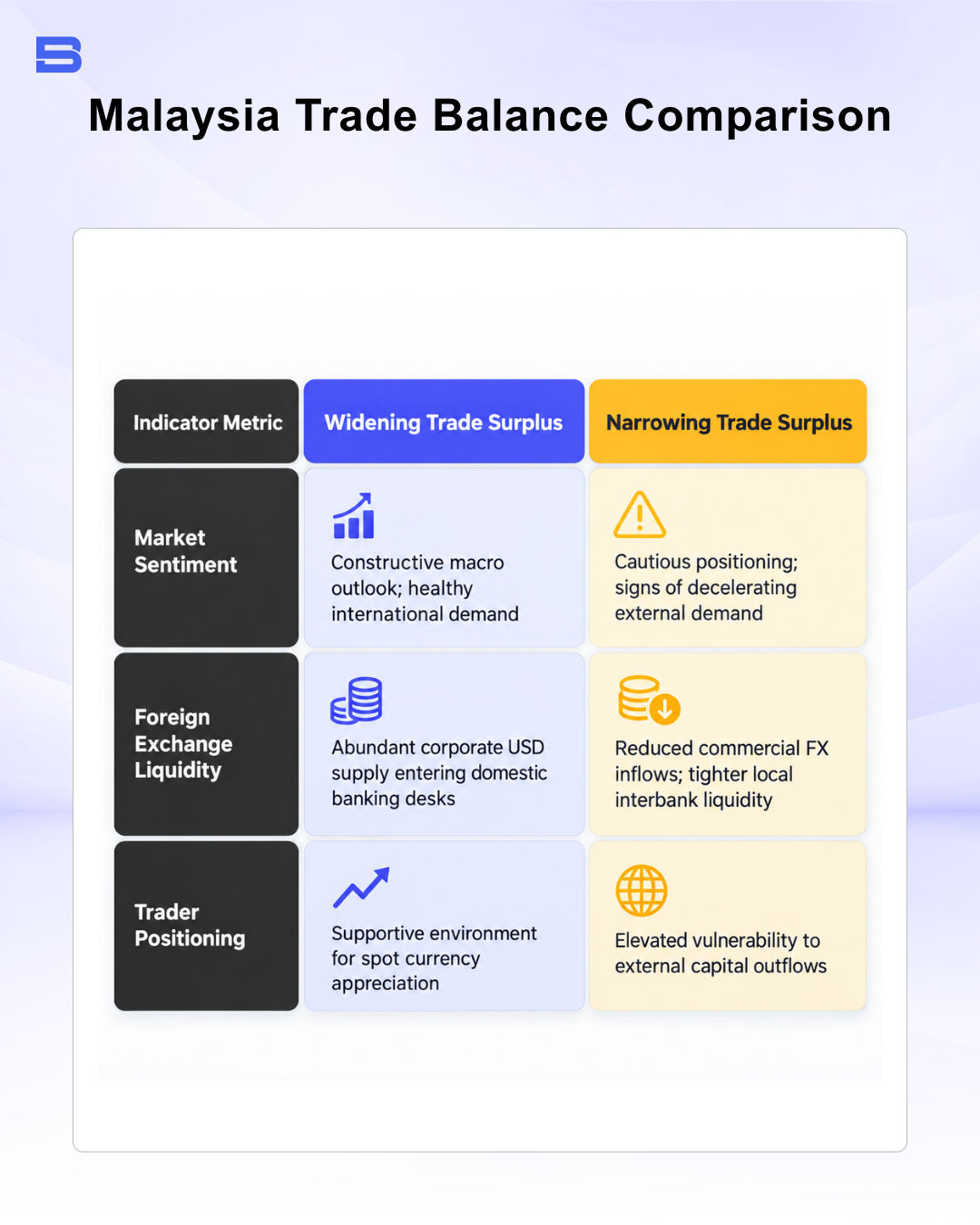
The Transmission Channel: How Do Exports Affect the Ringgit?
When domestic exporters conclude sales overseas, they receive payments primarily in foreign denominations such as the US Dollar. Under foreign exchange administration guidelines established by Bank Negara Malaysia (BNM), commercial enterprises regularly convert portions of these foreign currency balances into the domestic unit to meet local operating costs, tax commitments, and payroll obligations.
This steady conversion activity creates direct, real-money buying pressure for the Malaysian Ringgit within the interbank market.
Consider an industrial exporter executing a scheduled conversion of USD 25 million after receiving quarterly trade payments. At a prevailing interbank spot exchange rate of 4.4000, selling the foreign currency proceeds generates a demand for RM 110,000,000. If that conversion occurs at an alternative spot rate of 4.3000, the foreign currency tranche yields RM 107,500,000, representing an effective RM 2,500,000 variance in local corporate purchasing power.
When dozens of exporters execute similar commercial transactions simultaneously following a strong trade report, the resulting liquidity wave can move spot exchange rates across the global forex market.
These underlying trade balances also influence central bank monetary considerations. A healthy export surplus supports macroeconomic stability, allowing policymakers flexibility when calibrating the benchmark overnight policy rate (OPR) against global interest rate differentials.
Why Tracking Malaysia's Exports Matters for Currency Traders
Active macroeconomic participants use monthly external trade figures to position around short-term exchange rate expectations. When reported exports exceed median economic consensus forecasts, the resulting surprise often prompts dealers to mark up the Ringgit against major currency crosses. Conversely, sharp contractions in outbound shipments can trigger rapid speculative sell-offs as market participants anticipate reduced commercial dollar conversion flows.
Calendar traders must manage risk carefully around these monthly macroeconomic releases. Economic data surprises can produce sudden price gaps and temporary spread widening on domestic currency pairs, increasing execution slippage for unhedged accounts. Disciplined market participants avoid chasing initial volatility spikes, waiting instead for post-release market depth to stabilize before deploying capital.
Using Export Data to Read Ringgit Flows
Outbound merchandise shipments serve as a primary engine of economic expansion and foreign exchange stability. Tracking changes in key manufacturing segments and major trade partnerships provides currency traders with the clarity needed to navigate shifting market conditions.
Disclaimer: The content on this page is intended for educational and informational purposes only. It does not constitute financial, investment, tax, or legal advice, and should not be interpreted as a recommendation to buy, sell, or hold any financial instrument or asset. Trading and investing involve significant risk, including the possible loss of your entire capital. Products such as forex, CFDs, and cryptocurrencies carry additional risks due to leverage, high volatility, and limited regulatory protection in some jurisdictions. Past performance of any financial instrument does not guarantee future results. Any market views, forecasts, or opinions expressed are those of the author at the time of writing and may not reflect current market conditions. Platform features, fees, and regulatory status are subject to change — always verify information directly with the relevant provider or regulator before making any financial decision. BrokerSpecs may receive compensation from third parties featured on this site. Always conduct your own due diligence and consider seeking advice from a licensed financial professional before investing. Portions of this article were prepared with the assistance of AI tools and reviewed by our editorial team before publication.