



Related Tags
It is 14:14 Central European Time on an ECB announcement Thursday, and currency charts across Frankfurt, London, and New York are frozen in tight consolidation. One minute later, the headline drops, and the euro spikes 45 pips before sharply reversing as algorithms digest the benchmark statement.
Understanding the European Central Bank (ECB) interest rate framework is essential if you trade European currencies, sovereign debt, or index derivatives. These policy decisions establish the cost of money across the 21 member states of the Eurozone, shaping global liquidity and currency valuations. This guide explains how Europe’s three-tier rate corridor operates, how policy shifts move the euro, and how you can manage volatility during major releases.
What Is the ECB Interest Rate and How Does It Work?
The ECB interest rate represents the target borrowing cost set by the European Central Bank to maintain price stability across the Eurozone. Under its official mandate, the central bank aims to keep headline inflation at a symmetric 2% target over the medium term. When consumer prices surge above this threshold, the bank increases rates to temper economic demand, whereas sluggish inflation or economic contraction prompts rate reductions to stimulate commercial borrowing.
Commercial banks use these central bank benchmarks to determine their own lending and deposit rates for businesses and retail consumers. As borrowing costs rise, corporate expansion cools, consumer mortgage demand slows, and overall spending moderates. Conversely, lower interest rates cheapen credit, encouraging commercial investment while reducing the return on cash savings.
For participants in the global forex market, central bank adjustments shift capital flows across international borders. Global institutions reallocate capital toward currencies offering higher real yields, directly driving supply and demand for the euro. Tracking these policy shifts provides crucial context for evaluating European economic health and positioning across currency pairs alongside broader economic indicators.
What Are the Three Key ECB Interest Rates?
Unlike central banks that operate around a single headline figure, the European Central Bank manages monetary policy through three distinct interest rates. Together, these tools form an operational corridor that steers short-term money market conditions and establishes interbank lending parameters across the continent.
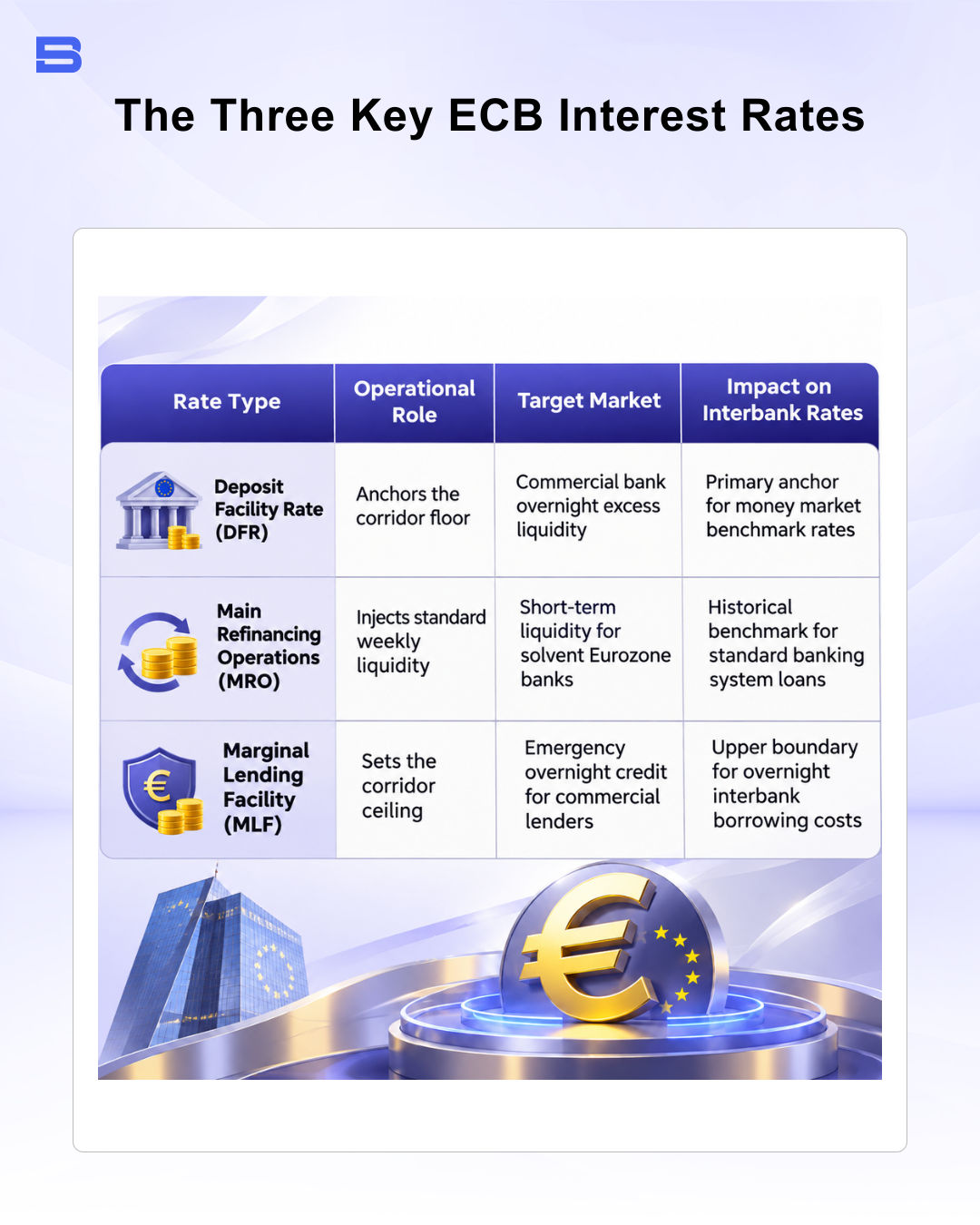
Deposit Facility Rate: The Core Policy Anchor
The ECB deposit facility rate defines the interest commercial lenders earn when parking surplus liquidity overnight at the central bank. Over the past decade, structurally abundant liquidity across the European banking system has transformed the deposit facility into the de facto policy anchor for Eurozone money markets. Benchmark financing rates such as the Euro Short-Term Rate (€STR) track this rate closely, making it the primary driver of sovereign bond yields and foreign exchange valuation.
Main Refinancing Operations (MRO)
The main refinancing operations rate represents the cost for commercial banks to borrow collateralized liquidity from the central bank on a one-week basis. Through regular weekly auctions, commercial banks pledge eligible securities to secure working capital. While historically serving as the headline ECB interest rate, the MRO rate now primarily establishes a fixed spread above the deposit floor to regulate liquidity auctions.
Marginal Lending Facility (MLF)
The marginal lending facility offers emergency overnight collateralized credit to commercial financial institutions. Because it represents the most expensive source of emergency central bank funding, it forms the absolute ceiling of the official interest rate corridor. Banks turn to this facility only when market counterparty liquidity dries up, ensuring overnight interbank rates do not spike above this defined upper band.
How the ECB Governing Council Decides Policy Rates
Rate decisions rest with the ECB Governing Council, the primary decision-making body comprising the six members of the Executive Board and the governors of the 21 Eurozone national central banks. The council meets every six weeks at ECB headquarters in Frankfurt to review monetary policy, assess labor statistics, and evaluate financial conditions.
Four times per year, these policy meetings align with the release of ECB staff macroeconomic projections, providing multi-year forecasts for inflation and gross domestic product growth. When actual inflation persists above projections, the council typically adopts a hawkish stance to curb credit expansion. When growth contracts, the rhetoric shifts dovish, laying the groundwork for rate accommodation.
Timing plays a significant tactical role for currency traders during announcement days. The policy decision statement is published at 14:15 Central European Time, followed by the President’s press conference at 14:45 CET. While the initial statement triggers instantaneous headline algorithm reactions, the subsequent press conference delivers the nuanced forward guidance that often drives sustained multi-day trends.
Traders planning ahead often search for one answer: when is the next ECB interest rate decision? The ECB publishes its monetary policy meeting calendar in advance, so you can mark each date before positioning.
How the ECB Interest Rate Affects the Euro and FX Pairs
Monetary policy adjustments shift the yield spread between the Eurozone and international economies, directly impacting cross-border capital flows. How the ECB interest rate affects the euro comes down to real yield differentials and cross-border capital flows. Higher policy rates attract foreign institutional capital into European sovereign bonds, boosting spot demand for the euro, while lower rates incentivize capital to seek yields elsewhere.
Because the euro makes up a large share of the DXY US Dollar Index, shifts in European rates may generate significant ripple effects across global currency benchmarks. An aggressive tightening stance in Frankfurt often creates downward pressure on the US dollar basket, while dovish cuts tend to trigger broader dollar appreciation.
Consider a practical trading scenario on EUR/USD ahead of a monetary policy meeting:
- Initial Conditions: EUR/USD trades at 1.0850 with an average institutional bid-ask spread of 0.8 pips.
- Unexpected Catalyst: The ECB cuts the benchmark rate by 25 basis points, whereas the market broadly expected an unchanged policy hold.
- Price Reaction: EUR/USD plunges 65 pips to 1.0785 over the next 15 minutes as yields contract.
- Liquidity Impact: Market makers widen spreads to 3.5 pips during the immediate release window to mitigate inventory imbalance.
Trading a standard lot of €100,000 (about $108,500 notional value at 1.0850) produces a gain or loss of $10 per pip on EUR/USD. In this scenario, a 65-pip move represents a $650 swing in gross position value. With retail margin requirements of 30:1, securing this standard lot requires approximately $3,616 in margin capital. That same $650 swing translates to an 18% fluctuation against your margin equity within minutes.
Macro Policy Divergence: ECB vs. Federal Reserve and BOJ
Sustained foreign exchange trends rarely develop from one central bank’s decisions in isolation. Instead, trends emerge from monetary policy divergence, which measures the gap in interest rate trajectories between two economic regions. Comparing the ECB’s rate path against decisions from the Federal Reserve and the Bank of Japan (BOJ) allows you to anticipate medium-term capital reallocations.
When expectations for a Federal Reserve interest rate cut accelerate while the ECB remains on hold due to persistent regional services inflation, the transatlantic yield spread narrows. This dynamic tends to support EUR/USD over multiple quarters. Conversely, when the BOJ interest rate shifts away from negative or near-zero levels, capital flows out of global carry trades, creating volatile shifts in cross pairs such as EUR/JPY.
Before positioning around macroeconomic divergence, consider three core factors:
- Government Yield Differentials: Track the yield spread between 10-year German Bunds and 10-year US Treasuries to gauge sovereign debt incentives.
- Relative Inflation Momentum: Compare European Harmonised Index of Consumer Prices (HICP) data against reports like the US CPI to identify which central bank faces greater tightening pressure.
- Central Bank Forward Guidance: Evaluate calendar expectations around future gatherings, such as the scheduled Federal Open Market Committee (FOMC) meeting, to avoid entering positions right before opposing monetary policy announcements.
Managing Execution Risk and Volatility Around ECB Decision Days
Trading around central bank announcements presents severe operational challenges that require disciplined risk parameters. During the 14:15 CET release window, top-of-book interbank liquidity drops rapidly as institutional automated quote engines withdraw spreads. This thinning order book regularly triggers severe slippage, where market orders fill dozens of pips beyond your specified price screen.
Leverage amplifies your returns when currency pairs move favorably, but it accelerates capital losses just as quickly when unexpected rate shifts trigger rapid price reversals. Attempting to trade the initial announcement headline with unhedged high-leverage orders can lead to account liquidation before the subsequent press conference even begins.
To protect your capital, calibrate stop-loss orders to account for widened spreads rather than standard intraday ranges. Many professional traders refrain from opening new market orders during the initial 10-minute release window, choosing instead to wait for liquidity to normalize once the press conference concludes.
Navigating European Central Bank Policy
The ECB interest rate framework serves as a vital macroeconomic pillar for currency valuation and global liquidity flows. Navigating these major news catalysts requires an understanding of the three-tier corridor, careful tracking of central bank forward guidance, and disciplined position sizing. By analyzing yield divergence and avoiding aggressive market orders during peak announcement volatility, you can integrate European central bank policy into your broader trading strategy while aiming to keep portfolio risk within limits you set.
Disclaimer: The content on this page is intended for educational and informational purposes only. It does not constitute financial, investment, tax, or legal advice, and should not be interpreted as a recommendation to buy, sell, or hold any financial instrument or asset. Trading and investing involve significant risk, including the possible loss of your entire capital. Products such as forex, CFDs, and cryptocurrencies carry additional risks due to leverage, high volatility, and limited regulatory protection in some jurisdictions. Past performance of any financial instrument does not guarantee future results. Any market views, forecasts, or opinions expressed are those of the author at the time of writing and may not reflect current market conditions. Platform features, fees, and regulatory status are subject to change — always verify information directly with the relevant provider or regulator before making any financial decision. BrokerSpecs may receive compensation from third parties featured on this site. Always conduct your own due diligence and consider seeking advice from a licensed financial professional before investing. Portions of this article were prepared with the assistance of AI tools and reviewed by our editorial team before publication.