


Related Tags
You open your trading platform during a high-impact US economic release, watching EUR/USD plunge, USD/JPY rally, and gold sell off simultaneously across your monitors. Individual currency pairs only show bilateral performance, making it difficult to tell whether foreign currencies are weakening or the greenback is experiencing broad institutional demand. Navigating the global forex market requires a reliable macro compass, and this is where the US Dollar Index provides a single aggregate measure of dollar health.
What Is the DXY Dollar Index and How Does It Work?
The DXY dollar index is a geometrically weighted benchmark measuring the value of the United States dollar against a basket of six major global currencies. Established in 1973 following the collapse of the Bretton Woods system, the index was created to track how the dollar floats after decoupling from the gold standard. Global institutions and central banks monitored by the International Monetary Fund (IMF) rely on this benchmark to evaluate US currency performance against major commercial partners.
Direct Definition and Base Value 100 Mechanics
The index operates around an arbitrary base value established at 100.00 in March 1973. Values above 100.00 indicate dollar appreciation relative to the basket since inception, while readings below 100.00 reflect overall depreciation.
To understand how this translates in practice, consider a numerical comparison between different market regimes. If the DXY trades at 105.50, the US dollar has appreciated 5.50% against the weighted basket relative to its baseline. Conversely, a drop to 94.00 indicates the greenback has lost 6.00% of its relative purchasing power against those same currencies.
Reading Example:
- DXY at 100.00 = Parity with 1973 baseline
- DXY at 105.50 = +5.50% basket appreciation
- DXY at 94.00 = −6.00% basket depreciation
This percentage interpretation allows you to strip away single-currency anomalies. You can quickly see whether a pair move is driven by domestic factors or broad dollar repositioning.
The DXY Currency Basket and Weighting Breakdown
The DXY derives its value from six currencies representing key industrial economies. Because the basket composition reflects historical trade agreements from the 1970s, the weighting remains heavily concentrated in European currencies.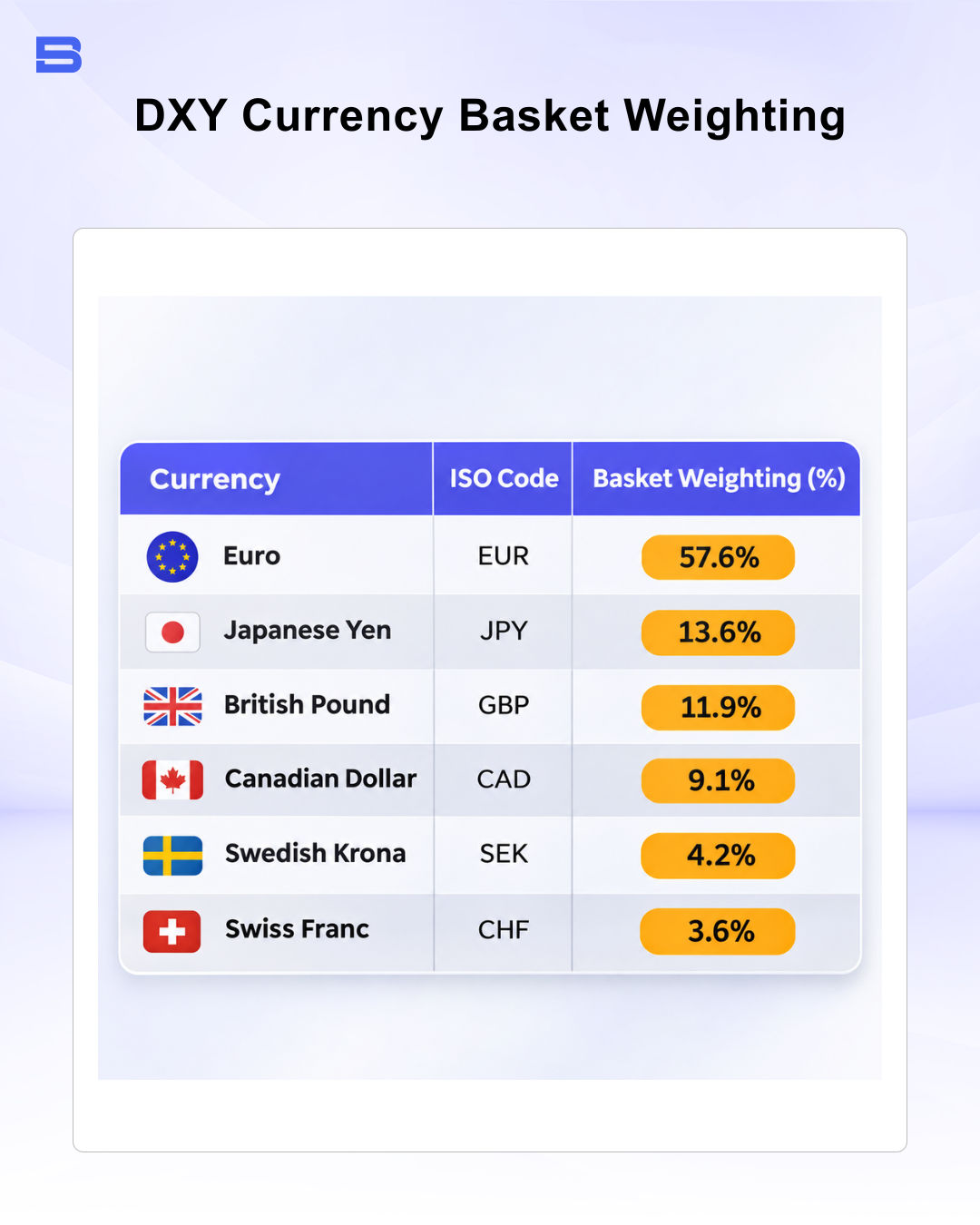
DXY Calculation Formula and Mathematical Weighting
The index uses a geometric weighted average rather than a simple arithmetic sum. This mathematical structure prevents any single massive exchange rate fluctuation from distorting the overall index calculation.
The formula multiplies each currency exchange rate raised to its respective weight exponent, scaled by an initial constant. Currencies quoted with the US dollar as the base currency carry positive exponents in the calculation. Conversely, European-style pairs quoted with the US dollar as the quote currency use negative exponents to maintain proper directional alignment.
DXY Structural Limitations in Modern Macroeconomics
While the DXY remains the market standard, its composition has faced criticism for failing to reflect modern trade flows. Research from the Bank for International Settlements (BIS) emphasizes that US trade dynamics have shifted dramatically toward Asia and Latin America over the past five decades.
European currencies account for 77.3% of the entire index weighting when combining the Euro, Pound, Krona, and Franc. This heavy concentration turns the index into an inverse proxy for European economic strength rather than a balanced global indicator.
Furthermore, major modern trading partners like China and Mexico are completely absent from the basket. The Chinese Renminbi and Mexican Peso represent substantial shares of bilateral US trade volume today. As a result, the index can overlook structural macroeconomic shifts in Pacific and North American trade corridors.
Key Factors Affecting DXY: Fed Policy, Yields, and Macro Sentiment
Macroeconomic fundamentals exert continuous pressure on the index. The primary engine behind medium-term dollar trends is central bank monetary policy and cross-border capital allocation.
Interest Rate Differentials and Central Bank Divergence
Capital flows toward economies offering higher risk-adjusted yields on fixed-income assets. When the U.S. Federal Reserve maintains higher benchmark interest rates than its peers, foreign capital enters dollar-denominated assets to capture superior returns.
Signals regarding Federal Reserve rate cuts triggered by easing US CPI inflation figures tend to weaken the index. Conversely, hawkish monetary shifts relative to ECB interest rate decisions or BOJ interest rate decisions widen yield spreads and bolster dollar demand.
Global Risk Dynamics: The Dollar Smile Theory
The dollar exhibits unique behavioral characteristics across different global economic regimes. This dynamic is commonly explained through the Dollar Smile framework, developed by macroeconomist Stephen Jen.
The left side of the smile occurs during periods of severe global risk aversion or financial distress. Investors liquidate risk assets and seek safety in US Treasury markets, driving the index higher regardless of domestic US performance.
The right side represents periods where the US economy strongly outperforms the rest of the world. Robust GDP expansion and elevated interest rates attract foreign direct investment and equity inflows, driving up the index value.
The bottom trough of the smile reflects synchronized global economic expansion. When international economies grow steadily, capital leaves the defensive dollar to seek higher cyclical returns in emerging and export-oriented markets.
How to Trade DXY and Use It as a Trading Compass
Traders approach the index through two distinct methods: direct market execution and portfolio risk filtering. Understanding both applications prevents costly directional errors across correlated currency trades.
Direct Trading: DXY Futures and CFDs
You can trade the index directly through regulated futures contracts listed on the Intercontinental Exchange under ticker symbol DX. Institutional funds use these futures contracts to hedge multi-billion-dollar foreign exchange exposures without trading six separate currency pairs.
Retail traders frequently trade the index using contracts for difference provided by online brokerages. While CFDs offer lower initial capital requirements, leverage amplifies both gains and losses equally. Holding leveraged positions overnight incurs financing fees, which can erode returns if positions remain open during consolidation phases.
Intermarket Analysis: DXY and Gold Correlation
The index functions as an inverse indicator for several major financial assets. Because the Euro makes up 57.6% of the basket, the daily chart of DXY often mirrors EUR/USD upside down.
Commodities priced globally in dollars, such as gold and crude oil, typically carry an inverse correlation to the index. When the dollar index strengthens, commodities become more expensive for buyers holding foreign currencies, dampening global demand and softening commodity prices.
However, market correlations can decouple during periods of extreme liquidity stress. During acute market shocks, traders may liquidate profitable gold positions to cover margin calls elsewhere, causing gold and the dollar index to move together temporarily.
Evaluating the index also prevents unintentional portfolio concentration. Consider a scenario where you open long trades on USD/CAD, USD/CHF, and short EUR/USD at the same time.
While these trades appear across three different currency pairs, your risk is heavily concentrated in a single aggregate dollar move. If an unexpected US economic data release causes the dollar index to drop, all three positions will move against you simultaneously, compounding your losses.
Risk Audit Example:
- Position 1: Long USD/CAD
- Position 2: Long USD/CHF
- Position 3: Short EUR/USD
- Portfolio Reality: Triple dollar exposure rather than genuine cross-pair diversification.
Auditing the overall index trend before taking multi-pair setups helps you maintain appropriate net exposure to the greenback.
Using the Dollar Index as a Macro Compass
The DXY dollar index remains an indispensable compass for assessing aggregate dollar strength across global financial markets. Tracking basket mechanics and central bank divergences allows you to manage intermarket correlations and protect your capital from hidden portfolio exposure.
Disclaimer: The content on this page is intended for educational and informational purposes only. It does not constitute financial, investment, tax, or legal advice, and should not be interpreted as a recommendation to buy, sell, or hold any financial instrument or asset. Trading and investing involve significant risk, including the possible loss of your entire capital. Products such as forex, CFDs, and cryptocurrencies carry additional risks due to leverage, high volatility, and limited regulatory protection in some jurisdictions. Past performance of any financial instrument does not guarantee future results. Any market views, forecasts, or opinions expressed are those of the author at the time of writing and may not reflect current market conditions. Platform features, fees, and regulatory status are subject to change — always verify information directly with the relevant provider or regulator before making any financial decision. BrokerSpecs may receive compensation from third parties featured on this site. Always conduct your own due diligence and consider seeking advice from a licensed financial professional before investing. Portions of this article were prepared with the assistance of AI tools and reviewed by our editorial team before publication.