



Related Tags
It is 10:00 AM in Singapore and Kuala Lumpur, and currency order books are thinning rapidly. Traders watching AUD/USD and copper futures brace as the clock ticks down toward Beijing’s economic data release. A single decimal deviation here can trigger sharp market moves across global desks before Western exchanges even open.
As the world’s second-largest economy, China acts as the primary engine of global commodity demand and regional supply chains. Navigating a China GDP release requires looking past the headline rate into sector composition, market expectations, and liquidity risks.
Decoding China GDP Growth: How National Output Is Measured
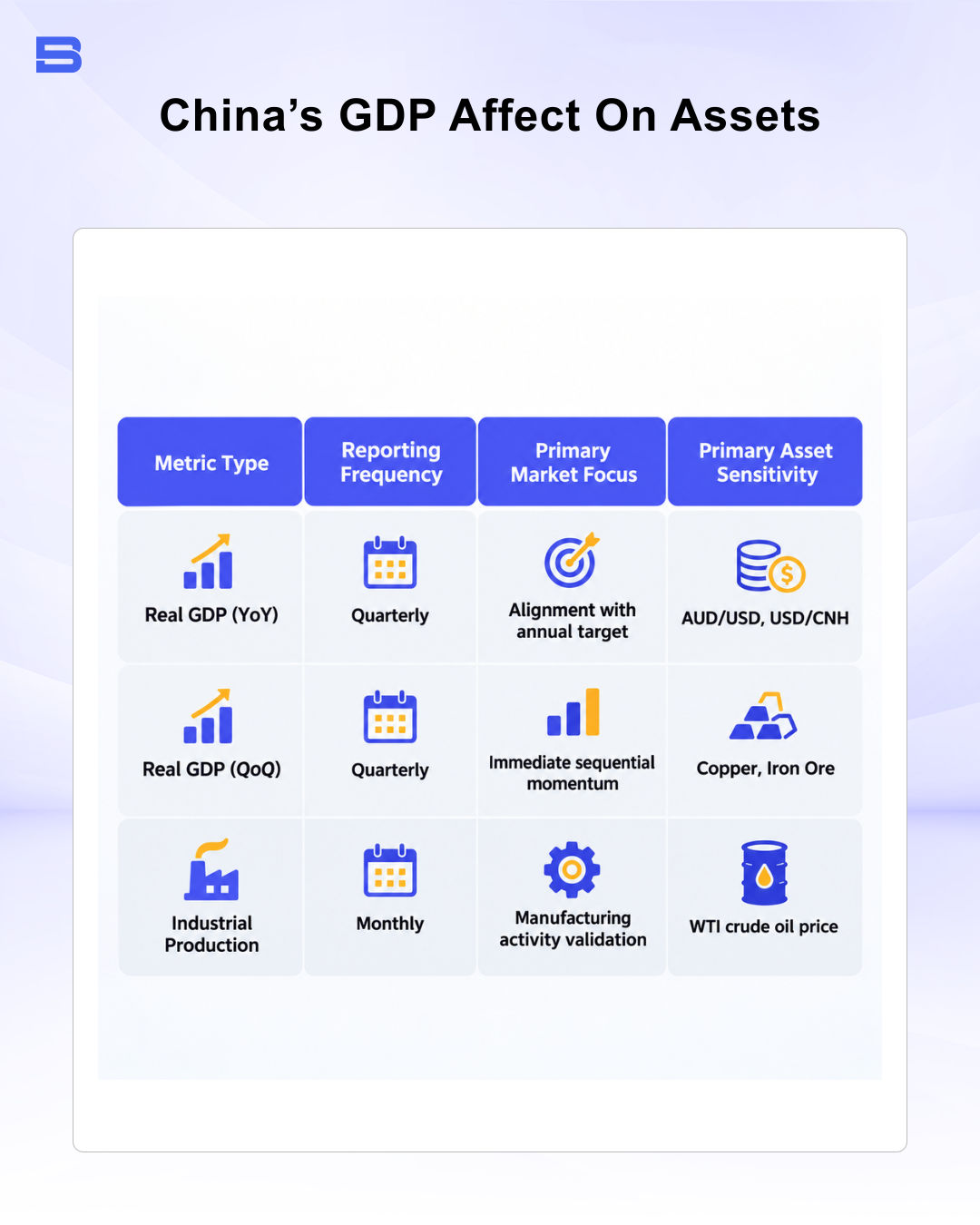
Official national accounts are compiled by the National Bureau of Statistics of China (NBS) and published quarterly. The bureau reports two primary China GDP growth figures: quarter-on-quarter (QoQ) expansion and year-on-year (YoY) growth. While QoQ figures capture short-term sequential momentum, institutional desks prioritize the YoY percentage to assess whether the economy is tracking toward Beijing’s annual target.
Multilateral institutions like the International Monetary Fund (IMF) cross-reference these official figures against independent high-frequency indicators. Annual targets are heavily steered through fiscal and monetary stimulus, meaning a sharp miss often triggers swift policy interventions by the People’s Bank of China (PBOC).
Understanding China GDP: Core Components and Economic Drivers
National output is measured through expenditure and production models, divided among fixed-asset investment, domestic retail consumption, and net exports. In recent years, structural policies have redirected credit toward advanced manufacturing, clean technology, and domestic consumer spending.
Evaluating which sector generated the reported growth reveals whether a market reaction will sustain itself. For instance, consider a quarter where headline expansion prints at 5.2% YoY, but domestic retail sales grow by only 2.1% while net exports surge by 12%. Because export growth depends on consumer demand in Europe and the United States, macro desks view export-heavy prints as vulnerable to global economic slowdowns.
Trading China GDP Releases: Consensus vs. Reality
Financial markets price in macroeconomic projections weeks before the NBS briefing. Consensus surveys compiled by major financial terminals establish a baseline expectation for headline growth. When an official print matches the median forecast precisely, initial volatility often collapses into a quiet "sell the news" pullback.
The largest market deviations occur when the headline figure diverges sharply from consensus expectations. Consider a scenario where consensus forecasts quarterly growth at 5.0% YoY, but the print arrives at 4.6%. Algorithmic execution systems may sell risk-sensitive assets within milliseconds, which can push AUD/USD lower and lift USD/CNH as capital hedges against slowing Asian demand.
Traders who chase the initial breakout candle frequently encounter severe liquidity pockets. Aggressive market orders can suffer substantial execution slippage during the release.
Illustrative scenarios only (consensus 5.0% YoY):
| Scenario | Possible market reaction |
|---|---|
| Print below consensus (4.6%) | AUD/USD may fall and USD/CNH may rise |
| Print in line with consensus (5.0%) | Initial volatility may fade into a pullback |
| Print above consensus (5.4%) | AUD/USD and copper may find buying interest |
Cross-Asset Transmission Channels
Currency Pairs Affected by China GDP: AUD/USD and USD/CNH
The Australian Dollar serves as the primary liquid proxy for Chinese economic performance in the global forex market. Australia exports massive volumes of iron ore, coal, and liquefied natural gas to mainland ports. When China GDP growth figures disappoint, AUD/USD frequently drops faster and further than regional Asian currencies.
Meanwhile, the offshore Yuan (USD/CNH) reflects international investor sentiment toward mainland monetary stability. While the onshore Yuan (USD/CNY) trades within a daily central parity band set by the PBOC, USD/CNH trades freely around the clock and absorbs macroeconomic shocks directly.
Impact on Commodity Markets: Industrial Metals and Energy
Industrial metal contracts react to China GDP and production figures faster than most sovereign debt markets. Copper prices serve as a widely watched barometer of physical economic activity. An upside GDP surprise powered by fixed manufacturing investment can trigger buying across global copper contracts.
Energy benchmarks like WTI crude oil contracts also track Chinese demand forecasts closely. Regional manufacturing hubs feel these fluctuations through bilateral trade flows, altering domestic production readings such as Malaysia’s Purchasing Managers’ Index (PMI).
Reading Beyond Official Figures: Alternative Verification Metrics
Institutional desks rarely rely on the headline GDP print alone. Many market participants examine the Li Keqiang Index, an alternative proxy composed of three concrete indicators: rail freight volume, electricity consumption, and commercial bank loan disbursements. These metrics provide a tangible benchmark to verify the official GDP of China reported by the NBS.
Macro analysts also cross-check private survey data like the RatingDog China General Manufacturing PMI (formerly the Caixin PMI) alongside domestic port throughput and customs clearance statistics. When headline GDP reports steady acceleration while commercial electricity consumption remains stagnant, institutional desks approach market breakouts with caution. Tracking complementary data may help you filter out some false breakouts triggered by initial algorithmic momentum.
Execution Pitfalls: Volatility, Slippage, and Data Revision Risk
Trading around scheduled data releases introduces specific operational risks that can quickly erode trading capital. During the 10:00 AM SGT/MYT release window, institutional market makers often widen spreads to protect against directional imbalances. Leverage amplifies your returns when you anticipate a breakout correctly, but it accelerates losses just as quickly when spreads widen and orders fill at unfavorable prices.
A prudent practice is to let the initial 15-minute price discovery candle close before entering a position. This brief pause allows liquidity to replenish and gives you time to verify whether underlying components support the headline move.
Long-term investors also evaluate the sustainability of reported output by monitoring China’s debt-to-GDP ratio alongside domestic productivity trends in China’s GDP per capita. Data revisions can alter prior quarterly benchmarks in subsequent quarters, changing the broader economic trajectory.
Trading China GDP Release With Discipline
China’s gross domestic product announcement functions as a major market-moving event for global currencies, industrial commodities, and regional equities. Navigating this release successfully requires analyzing underlying sector contributions, comparing results against consensus expectations, and managing execution volatility. Maintaining disciplined position sizing and waiting for clear market confirmation can help you approach these volatile events with greater confidence.
Disclaimer: The content on this page is intended for educational and informational purposes only. It does not constitute financial, investment, tax, or legal advice, and should not be interpreted as a recommendation to buy, sell, or hold any financial instrument or asset. Trading and investing involve significant risk, including the possible loss of your entire capital. Products such as forex, CFDs, and cryptocurrencies carry additional risks due to leverage, high volatility, and limited regulatory protection in some jurisdictions. Past performance of any financial instrument does not guarantee future results. Any market views, forecasts, or opinions expressed are those of the author at the time of writing and may not reflect current market conditions. Platform features, fees, and regulatory status are subject to change — always verify information directly with the relevant provider or regulator before making any financial decision. BrokerSpecs may receive compensation from third parties featured on this site. Always conduct your own due diligence and consider seeking advice from a licensed financial professional before investing. Portions of this article were prepared with the assistance of AI tools and reviewed by our editorial team before publication.