



Related Tags
Traders watch the countdown tick toward midday on the Tokyo desk, where currency charts are pinned flat in tense anticipation. A single sentence from the Bank of Japan (BOJ) can snap USD/JPY across 200 pips within seconds.
For decades, Japan maintained rock-bottom borrowing costs, anchoring global capital flows as the world’s primary low-yield funding currency. Today, policy shifts from Tokyo send direct shockwaves through global equities, sovereign debt, and foreign exchange markets.
Understanding how the BOJ interest rate is adjusted helps you navigate sudden market swings rather than getting caught off guard by unexpected policy shifts.
What Is the BOJ Interest Rate Benchmark?
The BOJ interest rate benchmark is the uncollateralized overnight call rate, which represents the interest rate commercial banks charge each other for overnight loans without collateral.
Commercial banks hold excess funds in current accounts at the central bank, creating an operational lending corridor. When the policy board adjusts its target range, commercial banks pass those borrowing costs down through interbank lending, corporate credit, and retail financing.
The rate functions alongside the complementary deposit facility, which establishes the baseline return institutions earn on excess reserves. This multi-tiered liquidity framework allows Tokyo policymakers to control short-term funding liquidity across the broader financial system.
From Yield Curve Control to Rate Normalization
Before it ended its negative rate policy, the central bank relied on a −0.1% policy rate alongside Yield Curve Control to artificially pin 10-year Japanese government bond yields near zero. This historic policy stance distorted domestic debt markets and forced Japanese institutions to seek returns in foreign sovereign bonds.
Transitioning away from negative rates marks a major structural shift toward monetary normalization. As domestic yields climb, the economic incentive for large overseas capital allocation may begin to reverse.
Key Drivers: Shunto Wage Negotiations and Sustainable Inflation
Tokyo policymakers do not adjust borrowing costs based solely on headline price spikes. The central bank focuses specifically on demand-driven inflation supported by steady domestic wage gains, distinguishing sustainable trends from temporary import cost surges.
Global macro traders monitor US CPI reports to track foreign policy trajectories, but Japan prioritizes the spring Shunto wage negotiations. Substantial pay increases negotiated between major corporations and labor unions provide the domestic purchasing power necessary to sustain core inflation near the official 2% target.
Without confirmed wage expansion, higher interest rates risk stifling domestic consumption before sustainable economic momentum takes root.
How the BOJ Interest Rate Decision Moves Global Markets
A policy announcement from Tokyo reaches far beyond domestic Japanese borders. When the board updates its rate guidance, shifts in capital flows can quickly affect equity valuations, bond spreads, and currency pairs across the global forex market.
What time is the BOJ interest rate decision announced? The Bank of Japan does not set a fixed time, but the statement typically arrives around midday Tokyo time on the second day of the meeting, and a later release may signal a policy change.
Currency traders frequently discover that a rate hike does not guarantee yen appreciation. If central bank commentary sounds dovish or signals an extended pause, markets often dump the yen immediately after an announcement because wider foreign yield advantages remain intact.
Tracking how the DXY US Dollar Index behaves during these announcements helps you gauge whether Tokyo decisions are reshaping broader dollar strength or simply driving isolated yen volatility.
Yield Differentials: Comparing the BOJ and Federal Reserve
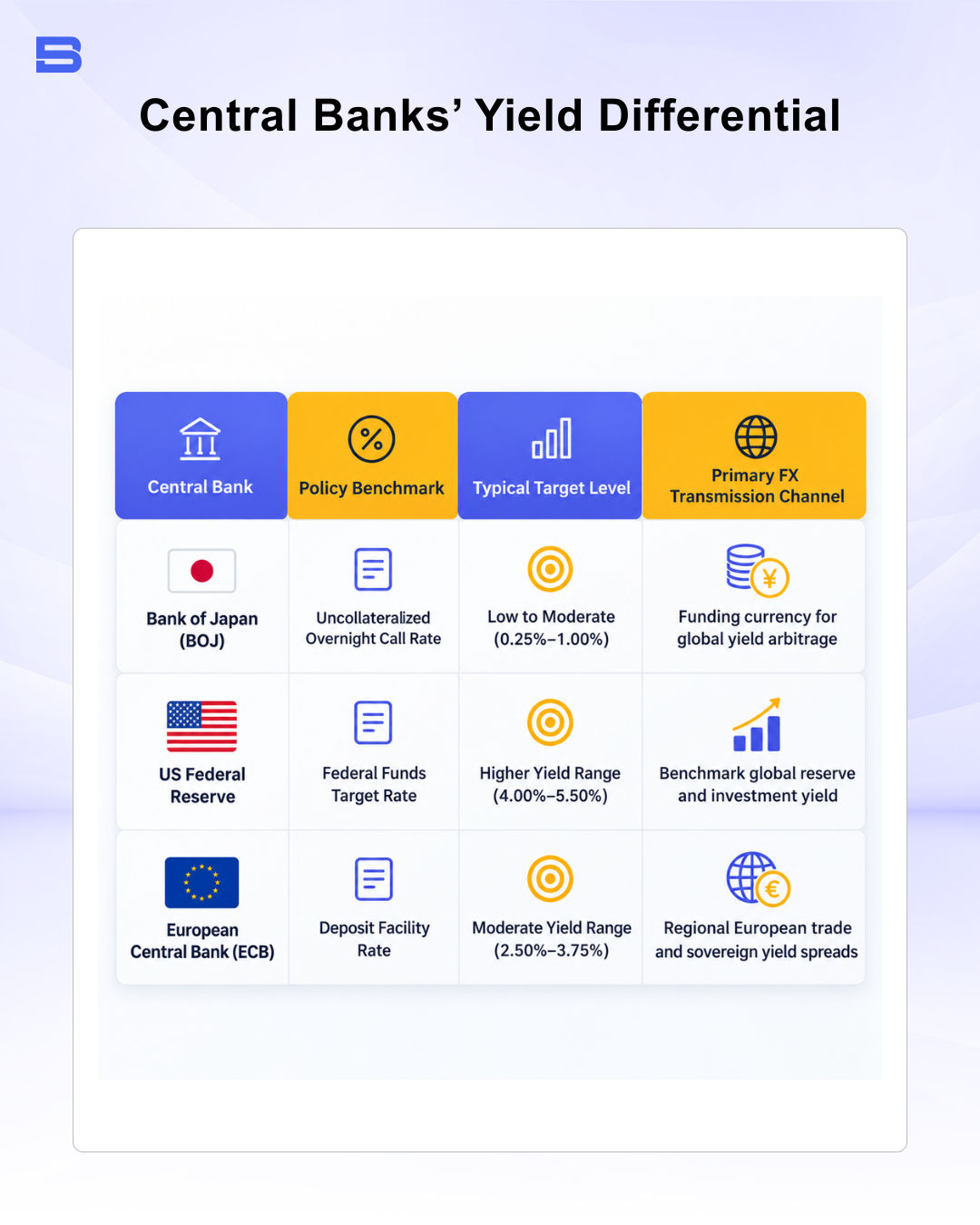
Exchange rates reflect rate differentials, the relative interest rate gap between two sovereign currencies. Even when Tokyo raises borrowing costs, a large spread against US benchmark rates may continue to exert downward pressure on the Japanese currency.
Market pricing shifts rapidly when the outlook for Federal Reserve interest rate cuts aligns with a changing FOMC meeting calendar and diverging European Central Bank (ECB) interest rate policies.
Impact on JGB Yields and Global Liquidity
Higher policy rates push Japanese Government Bond (JGB) yields upward, making domestic debt competitive again for local institutional investors. Japanese life insurers and pension funds hold sizable foreign asset portfolios, particularly in US Treasuries and European bonds.
When domestic yields offer attractive, currency-risk-free returns at home, institutional investors may repatriate capital back into Japan. This institutional flow can drain offshore liquidity and may place upward pressure on foreign government bond yields.
The Yen Carry Trade: Mechanics, Yield Gaps, and Unwind Risks
For decades, the yen carry trade served as a widely used strategy in foreign exchange. Traders borrow yen at minimal interest rates, convert the funds into higher-yielding foreign currencies, and collect the positive interest rate spread.
While positive daily swap payments provide a steady stream of yield, this strategy carries severe currency risk. Because you are shorting the funding currency, sharp yen appreciation can erase months of accrued interest payments in a matter of hours.
Consider a practical scenario where a trader borrows ¥15,000,000 at an annual interest rate of 0.50% and converts the capital at 150.00 USD/JPY to acquire $100,000 in US short-term notes yielding 5.00%. Over one full year, the gross yield differential is 4.50%, generating a net interest gain of $4,500, or roughly ¥675,000.
If an unexpected rate hike strengthens the yen by 5% and drops USD/JPY to 142.50, the $100,000 principal converts back into only ¥14,250,000, creating an immediate capital loss of ¥750,000. That single currency adjustment completely wipes out the entire ¥675,000 annual yield carry, leaving the trader with a net loss of ¥75,000 before factoring in trading commissions.
When multiple global funds attempt to exit leveraged positions simultaneously, margin calls can trigger a rapid unwinding loop. Cross-border bank lending data monitored by the Bank for International Settlements (BIS) suggests that rapid carry unwinds can coincide with spikes in the VIX index and sell-offs across international equity markets.
Reading Beyond the Headline Rate Hike
Navigating the BOJ interest rate decision requires looking beyond simple rate hike headlines. The real drivers of market momentum are the underlying yield differentials against foreign benchmarks and the policy board’s forward guidance.
By analyzing wage dynamics, monitoring carry trade positioning, and managing currency volatility, you can protect your portfolio from sharp liquidity contractions while identifying calculated opportunities across global markets.
Disclaimer: The content on this page is intended for educational and informational purposes only. It does not constitute financial, investment, tax, or legal advice, and should not be interpreted as a recommendation to buy, sell, or hold any financial instrument or asset. Trading and investing involve significant risk, including the possible loss of your entire capital. Products such as forex, CFDs, and cryptocurrencies carry additional risks due to leverage, high volatility, and limited regulatory protection in some jurisdictions. Past performance of any financial instrument does not guarantee future results. Any market views, forecasts, or opinions expressed are those of the author at the time of writing and may not reflect current market conditions. Platform features, fees, and regulatory status are subject to change — always verify information directly with the relevant provider or regulator before making any financial decision. BrokerSpecs may receive compensation from third parties featured on this site. Always conduct your own due diligence and consider seeking advice from a licensed financial professional before investing. Portions of this article were prepared with the assistance of AI tools and reviewed by our editorial team before publication.