



Related Tags
You wake up to check your portfolio and notice the Ringgit sliding lower while local equities open under pressure. If you search for headlines, financial commentators often point to an obscure data shift that happened hours before equity trading began: domestic bond yields ticked upward. Understanding how a Malaysia bond yield moves helps you anticipate shifts across currency valuations, borrowing costs, and institutional capital allocations before they filter into retail markets.
What Is the 10 Year Malaysia Government Bond Yield and Why Is It the Benchmark?
A Malaysia bond yield represents the annualized rate of return you earn by lending capital to the federal government through sovereign debt securities.
When institutional managers assess domestic fixed-income assets, the 10-year maturity serves as the primary risk-free reference point for pricing domestic credit. Because the federal government issues debt backed by its taxing authority and monetary sovereignty, sovereign defaults are historically treated as minimal compared to private corporate credit.
The 10-year benchmark yield can shift noticeably as inflation expectations and growth trajectories change, so check the latest level before drawing conclusions. When investors price corporate debentures, they add a credit spread on top of this 10-year baseline rate, while retail loans such as mortgages usually follow bank base rates linked to the central bank’s policy rate. Tracking this single benchmark helps you gauge the foundational cost of capital across the broader Malaysian economy.
Malaysian Government Securities (MGS) vs. MGII
In Malaysia, sovereign debt primarily trades through two distinct structures: conventional Malaysian Government Securities (MGS) and Malaysian Government Investment Issues (MGII). While both carry sovereign backing, MGII are structured as Islamic sukuk based on Shariah principles such as Murabahah to facilitate non-interest-bearing institutional participation.
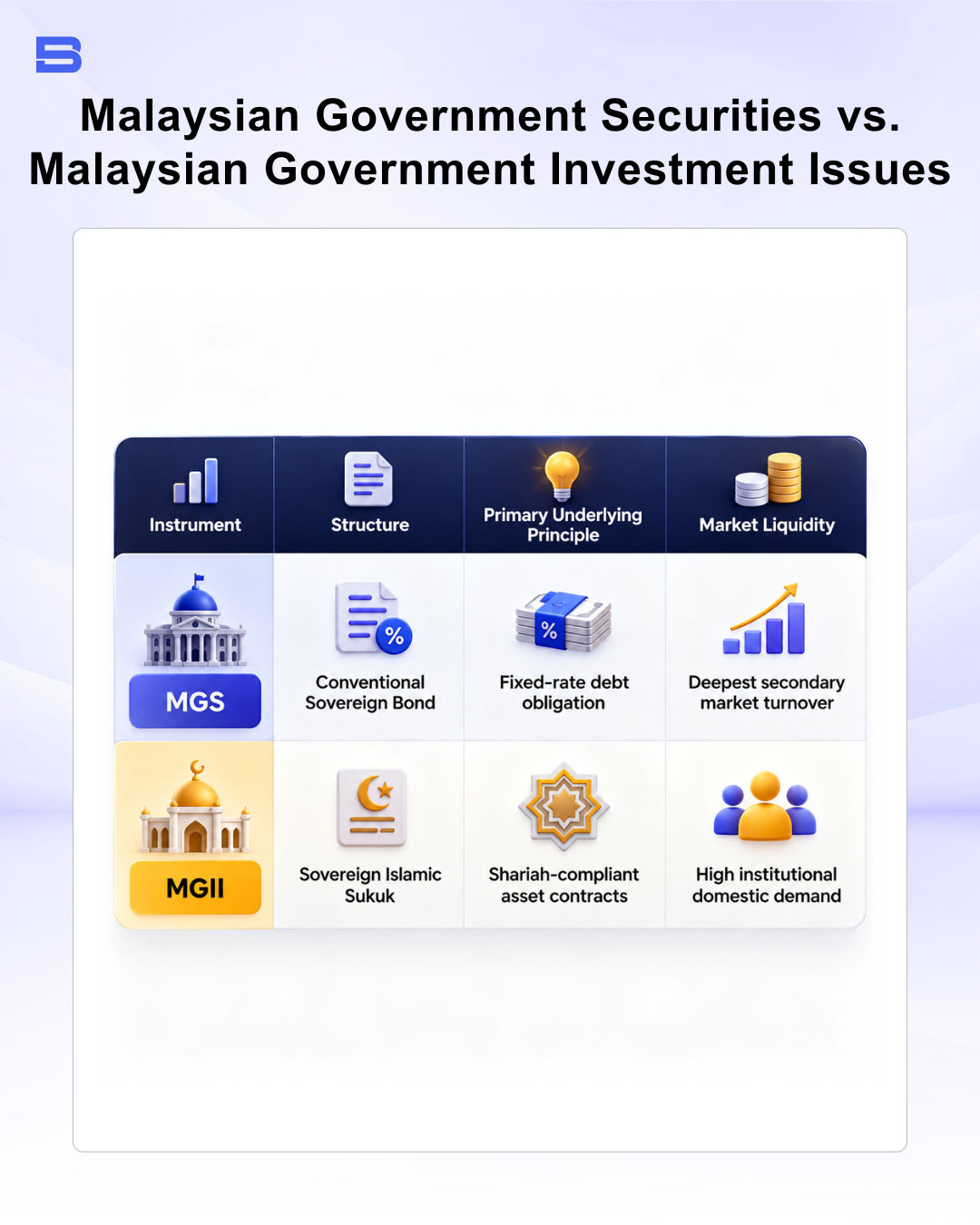
Foreign fund managers actively trade both instruments, though conventional MGS issues historically maintain slightly tighter bid-ask spreads in offshore liquid markets.
How Malaysia Government Bond Yield Moves: The Price-Yield Relationship
To analyze debt markets effectively, you must understand that bond prices and yields move in opposite directions. When a government bond is issued, its coupon payment remains fixed throughout its lifespan, but trading demand in secondary markets causes its cash purchase price to fluctuate daily.
Consider a practical worked scenario. Suppose you purchase a 10-year MGS note with a face value of RM10,000 paying a fixed annual coupon of 4.00%, or RM400 per year. If prevailing market yields subsequently rise to 4.50% due to tighter monetary conditions, newly issued government debt offers a superior payout to investors.
To sell your 4.00% bond on the secondary market, you must discount its trading price to approximately RM9,600. That RM400 capital discount compensates the buyer, bringing their effective yield to maturity up to the market rate of 4.50%. Conversely, if market yields drop toward 3.50%, your fixed RM400 payout becomes more valuable, allowing you to sell the bond at a premium above par value.
Capital losses can occur if you liquidate fixed-income holdings before maturity during an aggressive rate-hiking cycle. While holding sovereign debt until its maturity date returns the full principal value, intermediate market volatility can erode liquid capital if unexpected withdrawals force an early sale.
What Does a Rising Malaysia Bond Yield Signal for the Economy?
When government borrowing costs rise across several tenors, the move rarely occurs in isolation. A rising yield often signals that markets anticipate stronger economic expansion, measured by accelerating Malaysia GDP figures that encourage business investment and capital expenditure. Higher yields reflect healthy credit demand as corporations and consumers compete for capital across productive sectors.
However, surging yields can also signal mounting Malaysia inflation rate pressures. When raw materials, consumer goods, and wages trend higher, fixed bond coupons lose purchasing power, prompting institutional lenders to demand higher annual yields to offset inflation risk. If inflationary pressures persist, markets quickly price in prospective interest rate hikes by Bank Negara Malaysia (BNM) to its overnight policy rate (OPR) corridor.
Rising sovereign yields present a classic trade-off for investors. Higher yields reward conservative savers and institutional bond funds with attractive cash flows, but elevated sovereign borrowing rates raise capital costs for listed firms, which can compress equity market valuation multiples.
The Malaysia-US Yield Spread and Ringgit Valuation
Global fixed-income capital continually evaluates the spread between the 10-year MGS yield and the 10-year US Treasury yield. Because the US Dollar serves as the primary global reserve currency, institutional managers require an attractive yield premium to hold emerging market sovereign debt.
When the Malaysia-US yield spread narrows or turns negative, foreign institutional investors may reallocate capital into US assets, placing downward pressure on the Ringgit. Conversely, a wide yield buffer may encourage steady debt inflows and support domestic liquidity alongside strong Malaysia trade balance data and sustained Malaysian export receipts.
Foreign investors hold a meaningful share of outstanding MGS debt, and that share can change over time. Sudden global risk shocks can trigger rapid capital outflows in the global forex market, which suggests that sovereign yields may act as a monetary buffer for the local currency.
Reading the Malaysia Yield Curve: Normal, Flat, and Inverted
The sovereign yield curve plots the annual returns of government debt across varying maturities, spanning three-year notes up to 30-year long bonds. Examining the curve’s slope reveals how bond traders view economic health and credit availability over different time horizons.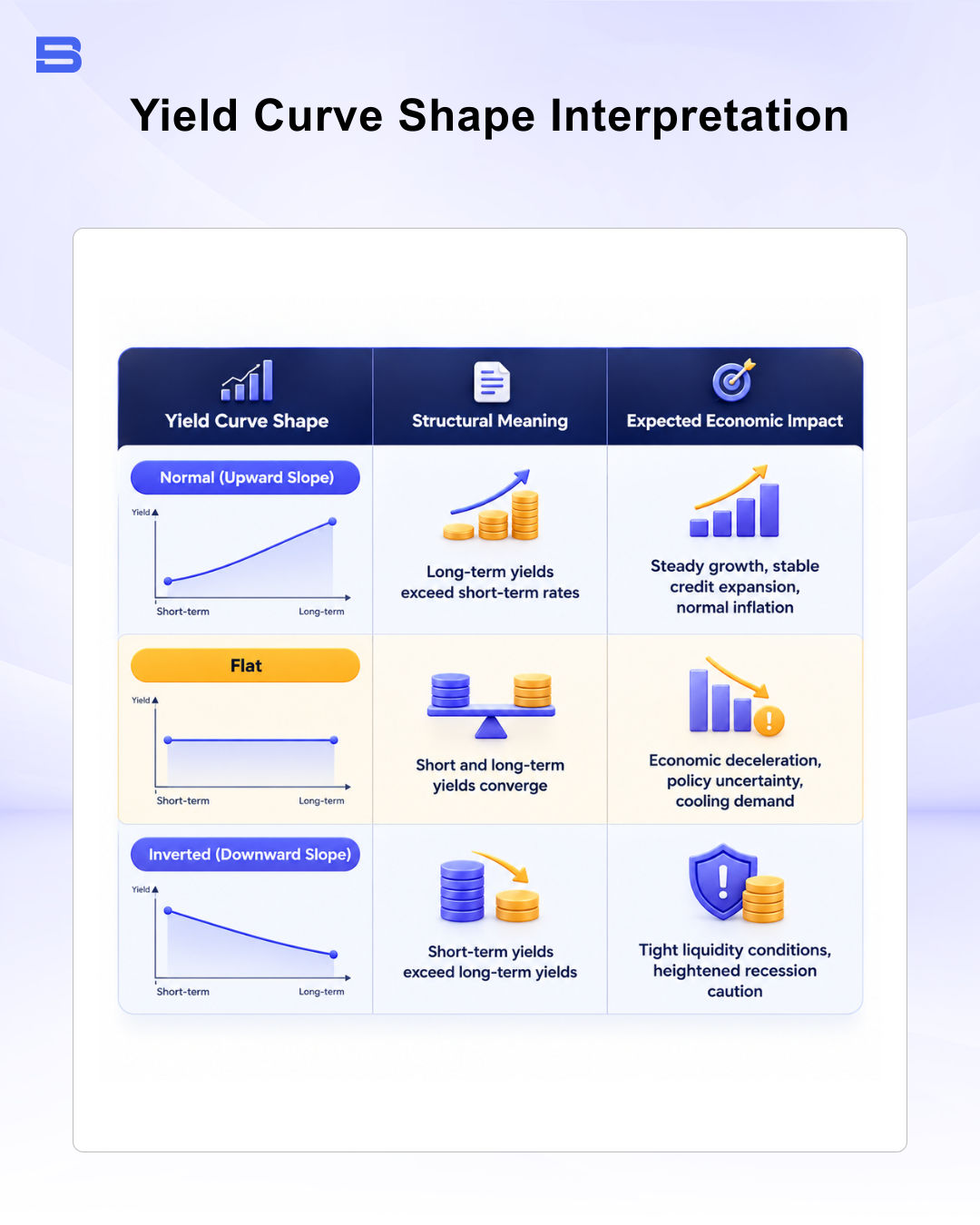
A normal curve reflects healthy risk compensation, as locking capital into 20-year or 30-year paper warrants a term premium over holding short-dated treasury bills. If economic headwinds tighten the supply of cash in the financial system, curve flattening alerts equity traders that corporate earnings growth may moderate in upcoming quarters.
An inverted curve, where short-term yields sit above long-term yields, may signal that markets expect slower growth or future rate cuts, though it does not guarantee a downturn.
| Curve shape | Short-term vs long-term yields | Typical reading |
|---|---|---|
| Normal | Long-term yields above short-term yields | Healthy risk compensation |
| Flat | Little gap between short-term and long-term yields | Corporate earnings growth may moderate |
| Inverted | Short-term yields above long-term yields | Markets may expect slower growth |
Practical Takeaways for Traders and Investors
Sovereign bond yields can provide a useful, real-time barometer of domestic liquidity, inflation expectations, and institutional sentiment. Rather than tracking equity prices or foreign exchange in isolation, observing Malaysia bond yield movements allows you to align your trading positioning with broader macroeconomic trends.
Disclaimer: The content on this page is intended for educational and informational purposes only. It does not constitute financial, investment, tax, or legal advice, and should not be interpreted as a recommendation to buy, sell, or hold any financial instrument or asset. Trading and investing involve significant risk, including the possible loss of your entire capital. Products such as forex, CFDs, and cryptocurrencies carry additional risks due to leverage, high volatility, and limited regulatory protection in some jurisdictions. Past performance of any financial instrument does not guarantee future results. Any market views, forecasts, or opinions expressed are those of the author at the time of writing and may not reflect current market conditions. Platform features, fees, and regulatory status are subject to change — always verify information directly with the relevant provider or regulator before making any financial decision. BrokerSpecs may receive compensation from third parties featured on this site. Always conduct your own due diligence and consider seeking advice from a licensed financial professional before investing. Portions of this article were prepared with the assistance of AI tools and reviewed by our editorial team before publication.