



Related Tags
Stand on the Bund in Shanghai, and the skyline displays the scale of the world’s second-largest economy. Travel several hundred miles inland into rural Guizhou or Gansu, however, and you encounter a vastly different financial reality. This stark contrast illustrates why headline national output tells only half the story.
To gauge real consumer purchasing power and long-term market demand, you need to track China GDP per capita rather than aggregate national figures. Per-capita metrics reveal how much productive value actually flows to the average individual, providing global traders with a clearer gauge of domestic consumption, import appetite, and systemic economic resilience.
What Is China GDP Per Capita and How Is It Measured?
China GDP per capita measures the total economic output of China divided by its resident population of approximately 1.4 billion people. The National Bureau of Statistics of China (NBS) calculates this figure by taking the nominal gross domestic product across all provinces and dividing it by the nationwide census population.
While aggregate China GDP consistently ranks second worldwide, dividing that total across 1.4 billion residents tells a different tale. Coastal powerhouse cities like Shenzhen and Shanghai record per-capita output rivaling high-income developed hubs, yet central and western interior regions generate less than half of that output.
This geographic dispersion means aggregate statistics often conceal localized structural weaknesses. For investors evaluating market depth, knowing the average output per citizen gives a more reliable baseline of sustainable consumer demand than aggregate production volumes alone.
China GDP Per Capita: Nominal vs. Purchasing Power Parity (PPP)
The China GDP per capita PPP vs nominal gap shows how economic metrics diverge dramatically depending on whether you evaluate them at current market exchange rates or through local purchasing power. According to World Bank data for 2025, China’s nominal GDP per capita sits near $13,900, which reflects standard foreign exchange conversion against the US dollar. When measured using Purchasing Power Parity (PPP), that figure surges above $25,800.
PPP adjustments account for relative price levels, reflecting the fact that everyday staples, transport, and utilities cost significantly less in domestic Yuan than in Western capitals. An urban professional earning RMB105,000 annually converts to roughly $14,800 in nominal US dollars. Within domestic borders, however, that income yields roughly $25,500 in practical living capacity across rent, groceries, and services.
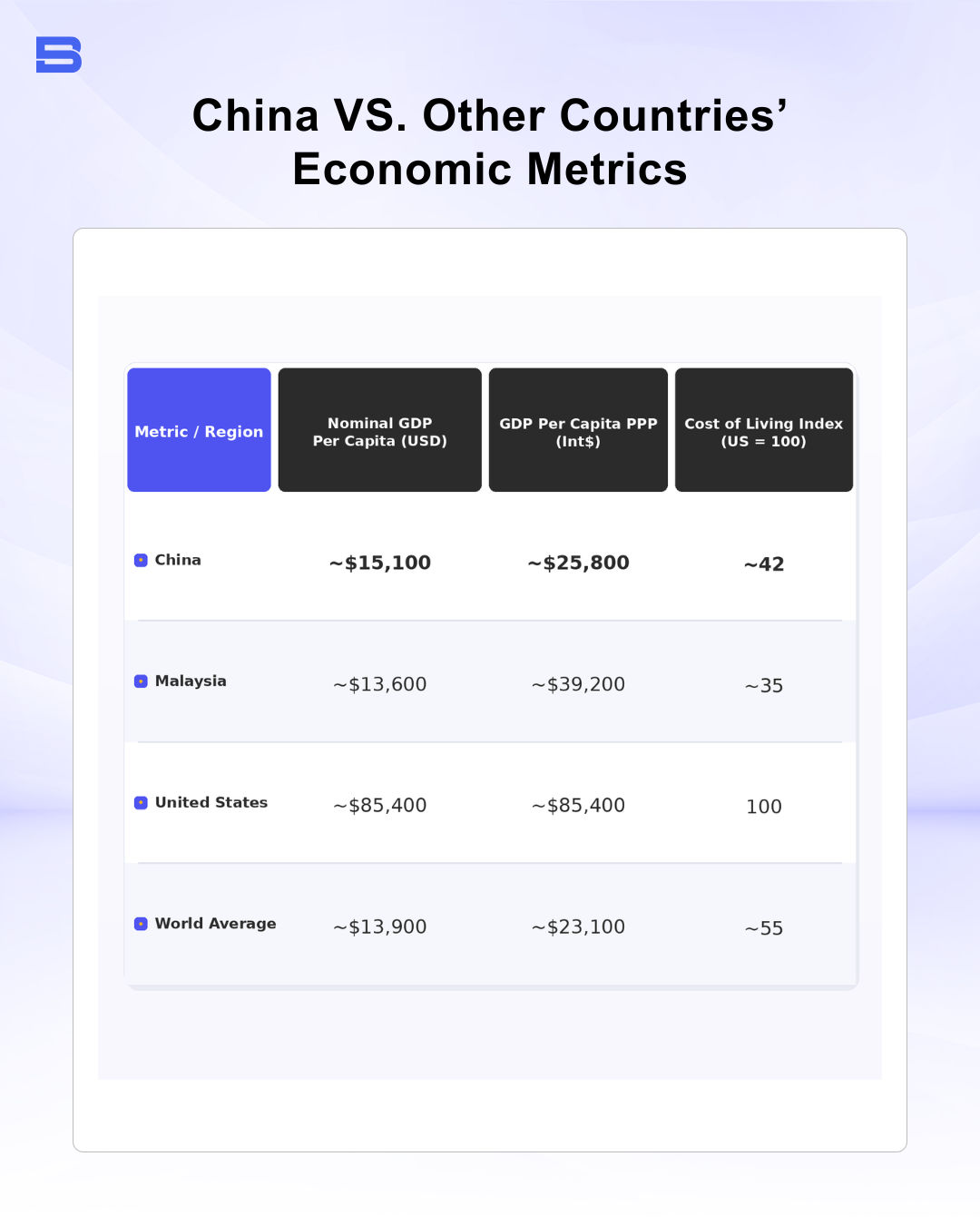
When examining China's position across the Asian continent, its nominal per-capita output sits firmly in the upper-middle bracket. It trails developed Asian economies such as Singapore and Japan, while trading closely alongside regional peers like Malaysia. Data compiled by the International Monetary Fund (IMF) shows that while China's nominal per-capita figure resembles that of emerging peers, its aggregate PPP footprint already rivals established Western markets.
The Middle-Income Trap: Can China Reach High-Income Status?
Escaping the middle-income trap remains the central developmental challenge for Beijing's economic planners. The World Bank sets its high-income threshold at approximately $14,375 in Gross National Income (GNI) per capita, effective July 1, 2026. China currently straddles this exact perimeter, seeking to graduate into high-income status while facing mounting economic friction.
Historic development models demonstrate that many emerging nations stall at this juncture when rising wages erode cheap manufacturing advantages before advanced innovation takes root. China faces this exact dilemma alongside external trade friction and technological export restrictions.
To break through this developmental ceiling, the economy cannot rely indefinitely on state-funded infrastructure or basic assembly lines. Sustained growth may require higher domestic consumption, indigenous high-value technological patents, and expanded service-sector productivity.
Structural Headwinds: Debt, Demographics, and Property Rebalancing
Several powerful headwinds threaten to cap China's per-capita wealth accumulation over the coming decade. Demographics may present one of the most urgent drags, as a shrinking working-age labor force supports a rapidly expanding elderly population. This demographic contraction reduces labor supply while redirecting fiscal resources into pensions and medical healthcare.
Simultaneously, the prolonged consolidation across China's residential property sector has curtailed the primary wealth-generation engine for urban households. Stagnating property valuations may depress consumer confidence among urban households.
Local government balance sheets compound this friction due to legacy financing vehicles that restrict municipal public spending, an issue closely tied to China's debt-to-GDP ratio. Investors holding Chinese assets face periodic valuation adjustments whenever debt-servicing burdens restrain fiscal stimulus or dampen household spending.
Macro Trading Implications: From Household Wealth to Global Assets
Per-capita income trends serve as an essential pulse check for international portfolios and multi-asset positions. Individual disposable wealth determines real absorption capacity for consumer imports, industrial commodities, and regional capital flows.
How Per Capita Wealth Impacts Consumer Demand and Global Trade
China’s expanding middle-class segment drives global corporate revenues across multiple consumer sectors. Shifts in domestic discretionary income can register quickly in overseas leisure travel, automotive manufacturing, and high-end luxury retail.
China consumer spending and market impact are closely linked: when domestic consumer confidence contracts, the fallout can spill across regional supply chains. Southeast Asian consumer exporters and tourism operators may experience swift margin compression whenever mainland travel and imported goods purchases slow down.
Market Transmission: Commodity Demand and Currency Pairs (CNH)
The transition away from heavy infrastructure toward higher-tech domestic consumption redefines global commodity flows. Traditional building commodities like iron ore may face structurally lower baseline demand, while energy inputs remain sensitive to transport mobility and consumer activity.
Energy traders monitoring the WTI crude oil price consistently gauge Chinese consumer fuel demand to estimate marginal consumption shifts. Furthermore, fluctuations in domestic income growth influence the offshore Yuan (USD/CNH). Whenever wage growth moderates and the People's Bank of China lowers policy rates to support domestic demand, currency traders often price in persistent Yuan depreciation pressure against major reserve currencies.
Per Capita Income as the Real Signal for Traders
Tracking China GDP per capita allows you to see past headline aggregate production figures to assess the real health of one of the world’s largest consumer markets. Sustained cross-asset trading opportunities across currencies, commodities, and regional equities will ultimately depend on whether Chinese household wages can continue expanding amidst demographic and structural headwinds.
Disclaimer: The content on this page is intended for educational and informational purposes only. It does not constitute financial, investment, tax, or legal advice, and should not be interpreted as a recommendation to buy, sell, or hold any financial instrument or asset. Trading and investing involve significant risk, including the possible loss of your entire capital. Products such as forex, CFDs, and cryptocurrencies carry additional risks due to leverage, high volatility, and limited regulatory protection in some jurisdictions. Past performance of any financial instrument does not guarantee future results. Any market views, forecasts, or opinions expressed are those of the author at the time of writing and may not reflect current market conditions. Platform features, fees, and regulatory status are subject to change — always verify information directly with the relevant provider or regulator before making any financial decision. BrokerSpecs may receive compensation from third parties featured on this site. Always conduct your own due diligence and consider seeking advice from a licensed financial professional before investing. Portions of this article were prepared with the assistance of AI tools and reviewed by our editorial team before publication.