



Related Tags
You find an online broker with sleek charts, zero commissions, and slick marketing, and you feel ready to deposit your capital. Before you wire your hard-earned savings, an essential question arises: who actually protects your funds if this firm collapses or freezes withdrawals? In Malaysia, that safeguard starts with verifying whether the entity holds a valid capital markets services license.
Understanding this legal credential helps you distinguish between legitimate market intermediaries and unauthorized offshore operations targeting retail traders.
What Is a Capital Markets Services License (CMSL)?
A Capital Markets Services License (CMSL) is a statutory authorization issued by the Securities Commission Malaysia permitting a corporation to conduct regulated financial market activities. Granted under the Capital Markets and Services Act 2007 (CMSA), it serves as the foundational regulatory gateway for entities operating within Malaysian capital markets.
The Securities Commission Malaysia (SC) evaluates every applicant against stringent financial adequacy standards, operational resilience guidelines, and corporate governance benchmarks. For retail investors, a CMSL confirms that a brokerage firm or fund manager operates under formal Malaysian legal jurisdiction rather than an unregulated offshore tax haven.
When you trade with a licensed onshore entity, you trade within an established perimeter of regulatory oversight. Conversely, dealing with unlicensed firms means sacrificing statutory account segregation, independent dispute resolution, and local regulatory recourse.
What Regulated Activities Does a CMSL Cover?
A CMSL is not an open-ended pass for any financial endeavor. Under Schedule 2 of the CMSA 2007, an institution receives authorization only for specific, designated activities:
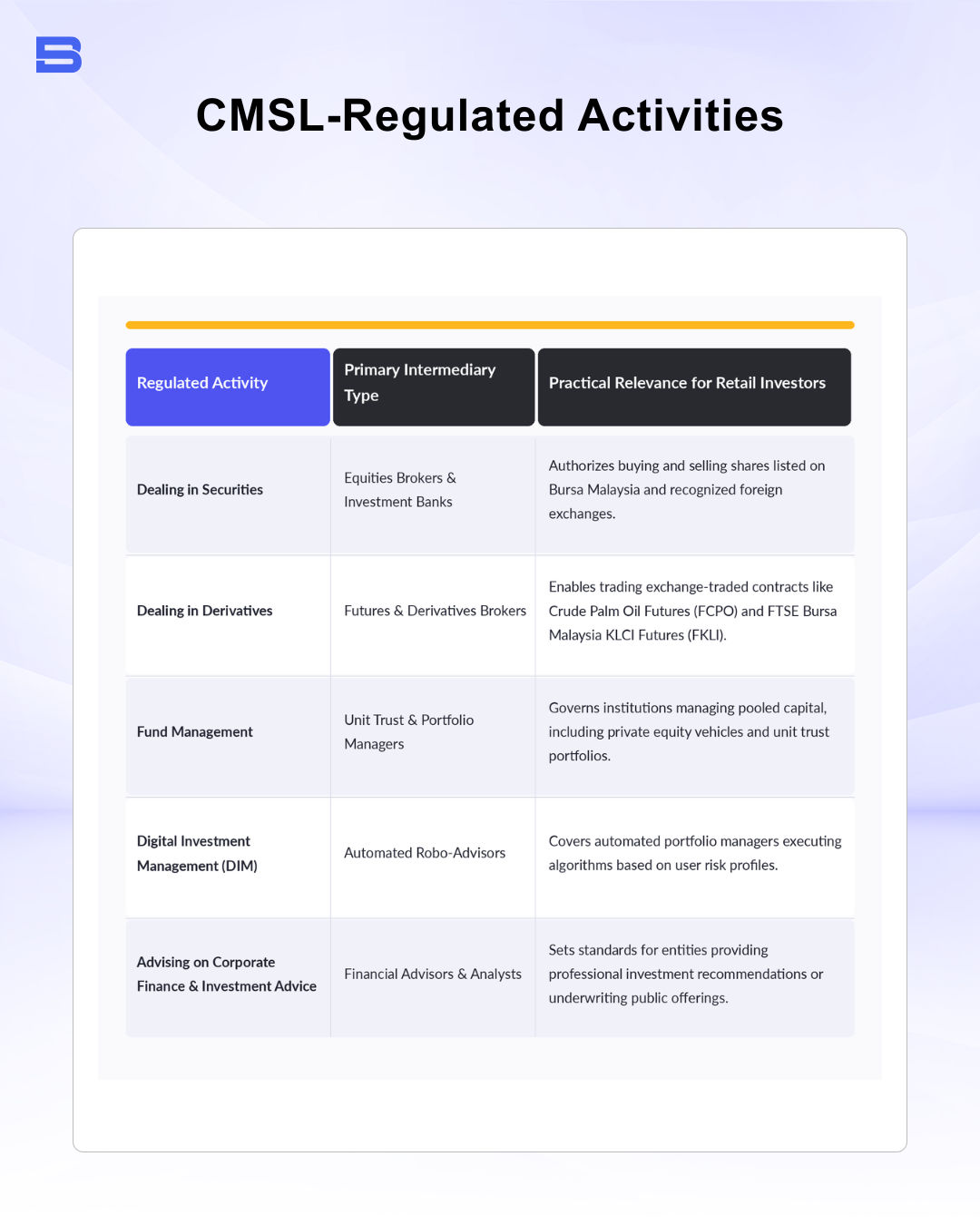
Holding a CMSL for dealing in securities does not grant a broker the authority to offer high-risk over-the-counter products like leveraged retail forex. Intermediaries must maintain dedicated capital reserves and satisfy continuous fit-and-proper tests for their key executive officers. This focused scope ensures that a licensed firm cannot wander into high-risk, unvetted asset classes without explicit regulatory approval.
CMSL vs. CMSRL: What Is the Difference?
While a CMSL is issued exclusively to corporations, individuals working on their behalf must hold a Capital Markets Services Representative's License (CMSRL). This distinction directly shapes how retail traders interact with financial professionals.
A brokerage firm holds the corporate CMSL, while its licensed remisiers, dealer representatives, and fund managers carry individual CMSRLs. To earn and retain a CMSRL, representatives must pass professional examinations administered by the Securities Industry Development Corporation (SIDC) and fulfill mandatory annual continuing professional education requirements.
When you open a brokerage account, you are protected by the firm's corporate framework, but you must also verify that your individual dealer representative holds an active CMSRL. If an unregistered account manager approaches you offering private stock tips or discretionary execution, that individual is operating outside statutory bounds.
What Investor Protections Does a CMSL Actually Provide?
The primary advantage of choosing a CMSL holder is institutional safeguarding. Licensed brokers are required by law to deposit client monies into segregated trust accounts maintained with licensed commercial banks. This keeps your capital strictly insulated from the broker's own working capital and operational liabilities.
Furthermore, retail clients dealing with licensed intermediaries gain automatic access to the Securities Industry Dispute Resolution Center (SIDREC). If a dispute arises over order execution, unauthorized transactions, or misleading conduct, SIDREC provides free mediation and adjudication for monetary claims up to RM250,000.
Licensed market participants also contribute to the Capital Market Compensation Fund, which provides statutory recourse if a participating firm defaults or enters liquidation. However, regulatory licensing establishes operational integrity; it does not protect your portfolio from market volatility, poor execution timing, or adverse price movements in speculative instruments.
How to Verify if a Broker Holds a Valid CMSL
Unscrupulous entities frequently impersonate licensed institutions by fabricating regulatory documentation or forging corporate registration numbers. You should never accept a broker's claim of being regulated at face value; independent verification takes less than two minutes.
To verify an intermediary, follow this three-step process:
- Visit the Official Public Register: Access the Public Register of Licence Holders directly via the official Securities Commission Malaysia portal.
- Search by Exact Legal Entity: Search using the company's full legal name rather than its retail trading brand, checking that its registered address and business number match.
- Cross-Check Permitted Activities: Verify that the entity is authorized for the exact instrument you plan to trade, such as dealing in securities or derivatives.
Be sure to also review the SC Investor Alert List, which flags unauthorized websites, clone entities, and unregistered platforms operating in Malaysia. If a platform claims to be a regulated forex broker in Malaysia, check whether it possesses a genuine CMSL for derivatives or merely uses deceptive regulatory claims.
For cross-border comparisons, Singapore forex brokers must hold a comparable Capital Markets Services license issued by the Monetary Authority of Singapore (MAS), whereas forex brokers in Indonesia operate under Bappebti. Understanding these jurisdictional boundaries within regional trading regulations and broker options prevents costly deposit traps.
Verifying Your CMSL Before You Fund an Account
A Capital Markets Services License is the fundamental trust mark for retail market participants navigating Malaysian finance. It ensures your broker maintains dedicated capital, isolates your funds in statutory trust accounts, and submits to local dispute resolution mechanisms. Checking the public register before funding your account requires minimal effort, but it provides essential security for your trading capital.
Disclaimer: The content on this page is intended for educational and informational purposes only. It does not constitute financial, investment, tax, or legal advice, and should not be interpreted as a recommendation to buy, sell, or hold any financial instrument or asset. Trading and investing involve significant risk, including the possible loss of your entire capital. Products such as forex, CFDs, and cryptocurrencies carry additional risks due to leverage, high volatility, and limited regulatory protection in some jurisdictions. Past performance of any financial instrument does not guarantee future results. Any market views, forecasts, or opinions expressed are those of the author at the time of writing and may not reflect current market conditions. Platform features, fees, and regulatory status are subject to change — always verify information directly with the relevant provider or regulator before making any financial decision. BrokerSpecs may receive compensation from third parties featured on this site. Always conduct your own due diligence and consider seeking advice from a licensed financial professional before investing. Portions of this article were prepared with the assistance of AI tools and reviewed by our editorial team before publication.