


Related Tags
You are eyeing the stock market, eager to build a diversified portfolio, but the sheer volume of individual equities, balance sheets, and sector dynamics feels overwhelming. Buying shares in dozens of separate companies requires significant capital, constant monitoring, and multiple transaction fees.
This is where an Exchange-Traded Fund (ETF) comes in—offering a single trade to access an entire market segment, index, or commodity basket. Search 'what is ETF trading' and you'll find it comes down to buying and selling on an exchange, just like a stock.
What Is an ETF Investment and How Does It Work?
An Exchange-Traded Fund (ETF) is an investment fund traded on public stock exchanges, much like individual shares of stock. An ETF holds a basket of underlying assets—such as stocks, bonds, commodities, or foreign currencies—and tracks an underlying index or sector benchmark.
When you purchase one unit of an ETF, you do not directly own individual shares of the underlying companies. Instead, you buy a proportional interest in the entire pooled basket of assets managed by the fund provider.
Unlike conventional mutual funds or unit trusts—which calculate their Net Asset Value (NAV) once per day after market close—ETFs trade continuously throughout normal market hours at fluctuating intraday market prices.
Real-World Execution Example: Suppose an ETF tracking a local market index holds shares of 30 major public companies. If the individual underlying stock prices rise, the ETF's Net Asset Value increases proportionately. If the ETF trades at $10.00 per unit on the stock exchange, buying 100 units costs $1,000 (excluding trading commissions), instantly giving you exposure across all 30 underlying companies without placing 30 separate buy orders.
ETFs vs. Unit Trusts and Mutual Funds: Key Differences
While both ETFs and unit trusts pool investor capital to acquire a diversified selection of assets, their operational structures, pricing mechanisms, and execution dynamics differ significantly.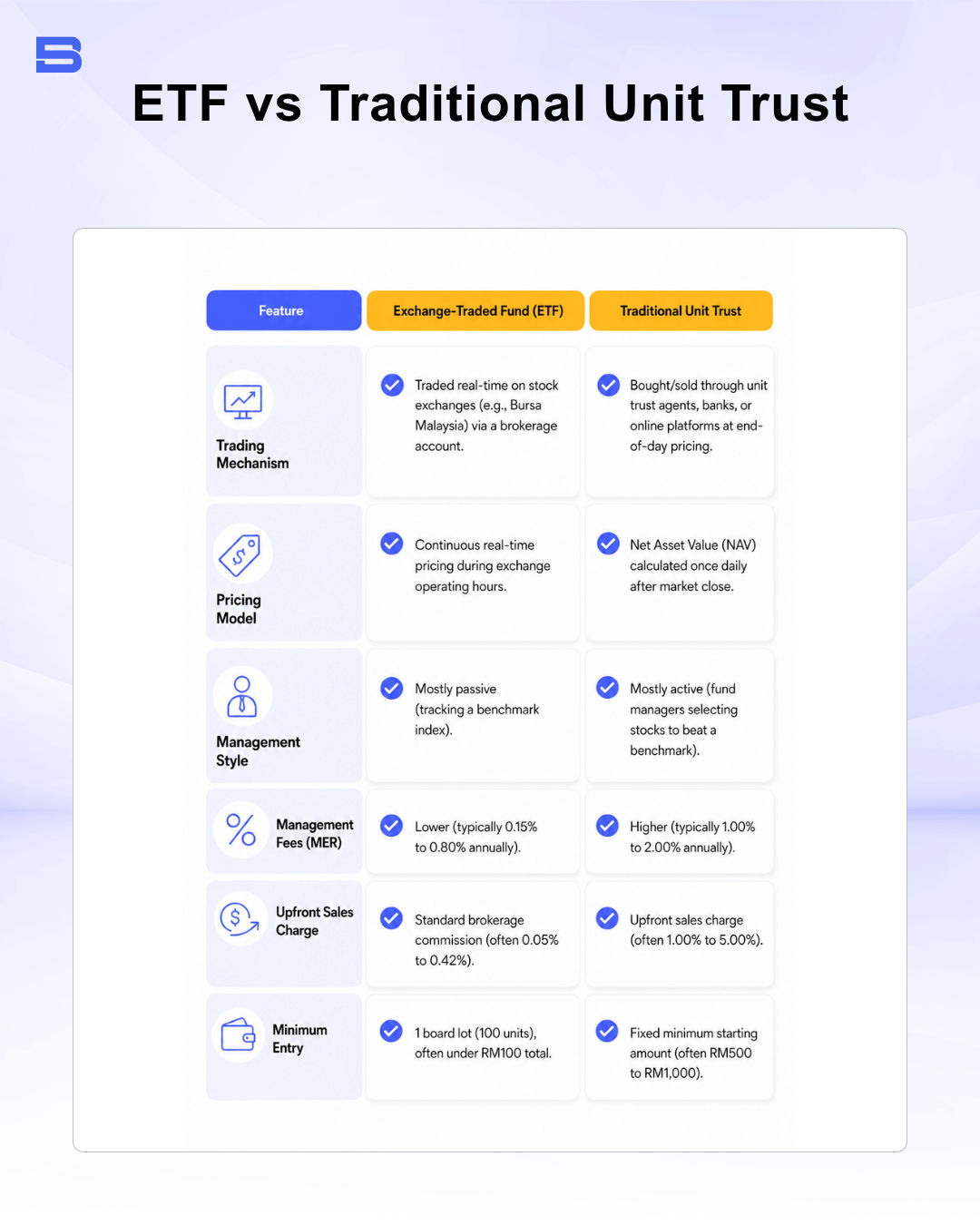
Main Types of ETFs Available to Investors
Understanding what is ETF diversification starts with knowing the major categories available to investors. ETFs cover almost every major asset class and financial market sector, allowing you to tailor portfolio exposure precisely.
- Equity ETFs: Track stock indices such as the S&P 500 or the MSCI World. They offer exposure to large-cap, mid-cap, or dividend-paying companies across specific countries or global markets.
- Bond / Fixed-Income ETFs: Invest in portfolio baskets of government debt securities, sovereign sukuk (government-issued Islamic bonds), or corporate bonds. These funds focus on generating predictable income streams while reducing broad market volatility.
- Commodity ETFs: Track physical commodities like gold, crude oil, or agricultural products. Investing in a commodity ETF allows you to gain price exposure to physical assets without managing physical storage or futures contract delivery logistics.
- Sector and Industry ETFs: Focus on specific economic segments, such as technology, healthcare, clean energy, or real estate. Investors interested in real estate often compare real estate ETFs with direct property vehicles, such as a Real Estate Investment Trust (REIT).
Key Risks and Considerations Before Investing in ETFs
If you're weighing what is ETF risk before investing, start with market volatility and tracking error. While ETFs provide broad diversification, they are exposed to systematic market risks and specific fund mechanics.
- Market Volatility Risk: ETFs do not insulate capital from general market declines. If the underlying asset class or equity market drops, the market price of the ETF falls proportionately.
- Tracking Error: Tracking error measures how closely the ETF’s total return mimics its benchmark index. Management fees, cash drag (the performance loss from holding uninvested cash), and trading costs can cause an ETF’s performance to slightly lag its target index.
- Liquidity and Spread Costs: Broadly traded global ETFs feature tight bid-ask spreads and high volume. However, niche or low-volume regional ETFs may suffer from wide bid-ask spreads, making entry and exit prices less favorable.
Expense Ratios and Fees to Watch
To calculate total investment costs, always evaluate both ongoing operational costs and transaction fees:
- Expense Ratio: The annual fee charged by the fund provider to cover management, administrative, and operational costs. Expressed as a percentage of total assets, low-cost passive index ETFs typically range from 0.03% to 0.50% annually, according to fund providers such as Vanguard and BlackRock, whereas actively managed ETFs may charge higher rates.
- Brokerage Commissions: Standard exchange buying and selling transaction fees charged by your broker when executing trades.
How to Buy ETFs in Malaysia and Global Markets
Once you understand what is ETF pricing, the next step is opening a regulated brokerage account. To begin investing in ETFs, follow these practical steps depending on your targeted geographic markets:
- Select a Regulated Brokerage Account: To purchase ETFs listed on local stock exchanges, open a direct trading account paired with a central depository system account. For global ETFs listed in foreign markets, choose a broker regulated by reputable regulatory bodies, such as the Securities Commission Malaysia (SC) or the US Securities and Exchange Commission (SEC).
- Fund Your Trading Account: Deposit capital into your brokerage trading portal via local bank transfers or supported payment channels.
- Research the Target ETF: Analyze the fund’s underlying holdings, expense ratio, tracking history, and daily liquidity.
- Execute the Order: Enter the fund's ticker symbol into your trading platform, specify the quantity or dollar amount, select a limit or market order, and confirm the trade.
Gain Efficient Market Access With ETFs
ETFs provide a low-cost, transparent, and flexible bridge between individual stock trading and broad index diversification. By pooling assets into a single exchange-traded instrument, you gain efficient market access across equities, bonds, and commodities while maintaining full control over your trade execution and entry costs.
By now you should have a clear answer to what is ETF investing and how it fits into a diversified portfolio.
- What Can You Trade? A Guide to Forex, Stocks, and More
- CFD Trading for Beginners
- What is CFD Trading and How Does It Work?
- Forex vs. Stocks: Which Market Suits You Best?
- How to Diversify a Portfolio Across Asset Classes
- How Dividend Stocks Work: Yields, Risks, and Strategies
- Silver Trading Explained: A Guide for Retail Investors
- Precious Metals Trading: A Complete Guide for Beginners
- Natural Gas Trading: A Guide to the Market
- Structured Warrants Malaysia: How They Work and Risks
- What Is the KLCI Index and How to Trade It
- Gold Investment in Malaysia: A Complete Guide for Beginners
- What Is Kijang Emas and How to Invest in It
- Value Investing Explained: How to Find Undervalued Stocks
- How to Trade Bitcoin Safely: A Complete Market Guide
- Growth Investing Explained: Strategies, Metrics, and Risks
- What Is Digital Gold Malaysia and How to Invest
- Crypto Trading Strategies for Beginners
- Gold vs Bitcoin: Key Differences, Risks, and Strategies
- Sukuk: A Guide for Beginners to Islamic Bonds
- What Is FCPO (Crude Palm Oil Futures) and How to Trade It
- How to Identify and Invest in Shariah-Compliant Stocks
- Timber Investment: Is It Worth It?
- Gold ETF Malaysia: A Guide for Beginners
- What Are Malaysian Government Securities (MGS)?
- Corporate Bonds Malaysia: A Guide for Beginners
- China A-Shares Trading Guide for Malaysian Investors
- What Is a Silver ETF and How to Invest in It?
- How to Trade XRP: A Practical Guide for Retail Investors
- How to Trade Solana (SOL): A Guide for Beginners
- What Are Gold Futures and How Do They Work?
- Money Market Fund in Malaysia: A Guide for Beginners
- Property Investment Malaysia: Direct Real Estate or M-REITs?
- What Is Binance Coin and How Does It Work?
- Green Sukuk: A Guide for Beginners to Islamic ESG Investing
- What Is Shiba Inu (SHIB) and How to Trade It
- What Is USDT? A Complete Guide to Tether for Beginners
- What Is Dogecoin and How to Trade It Safely for Beginners
- Cardano: A Guide for Beginners to Trade This Cryptocurrency
- Polkadot: A Guide to Trading This Cryptocurrency
- Tron: A Guide for Beginners to Trading This Cryptocurrency
- What Is Litecoin (LTC)? A Guide to Trading Digital Silver
- What Is Chainlink (LINK) and How to Trade It
- How to Trade Pepe Coin: Spot, Leverage, and Risk Management
- Near Protocol: A Guide to Trading This Cryptocurrency
- Trading Polygon Crypto: A Practical Guide for Beginners
- Trade Toncoin: Understanding the TON Ecosystem and Risks
- Cosmos Crypto: Ecosystem Architecture, Tokenomics, and Risks
- Stellar Crypto: A Guide to Trading This Cryptocurrency
- Avalanche Crypto Explained: A Practical Guide for Traders
- What Is Worldcoin? How to Trade WLD and Manage Risk
- Aptos: A Guide for Beginners to Trading This Cryptocurrency
- Sui Crypto Explained: Tokenomics and Trading Guide
- Celestia: A Guide to Trading This Cryptocurrency
- Decentraland: A Guide to Trading This Cryptocurrency
- What Is Arbitrum? How to Trade the Leading Layer 2 Network
- Sei Crypto: A Guide to Trading This Cryptocurrency
- What Is Injective Protocol and How to Trade INJ Safely
Disclaimer: The content on this page is intended for educational and informational purposes only. It does not constitute financial, investment, tax, or legal advice, and should not be interpreted as a recommendation to buy, sell, or hold any financial instrument or asset. Trading and investing involve significant risk, including the possible loss of your entire capital. Products such as forex, CFDs, and cryptocurrencies carry additional risks due to leverage, high volatility, and limited regulatory protection in some jurisdictions. Past performance of any financial instrument does not guarantee future results. Any market views, forecasts, or opinions expressed are those of the author at the time of writing and may not reflect current market conditions. Platform features, fees, and regulatory status are subject to change — always verify information directly with the relevant provider or regulator before making any financial decision. BrokerSpecs may receive compensation from third parties featured on this site. Always conduct your own due diligence and consider seeking advice from a licensed financial professional before investing.