



Related Tags
The morning bell rings, economic reports drop, and order books flood with instantaneous buying and selling pressure. Within seconds, price bars print rapidly on your screens as institutional capital and retail participants scramble to capitalize on rapid price movements.
Day trading is the practice of opening and liquidating positions within the absolute confines of a single trading session. Far from a passive investment strategy or a path to quick wealth, intraday trading operates as a high-probability business dependent on strict statistics, rigorous risk execution, and emotional control.
This guide to day trading for beginners breaks down how the strategy works, from core setups to mandatory risk controls.
What Is Day Trading and How Does It Work?
Day trading refers to the execution of financial asset transactions where all positions are fully closed prior to the official market close of the same trading day. The fundamental objective is to capture intra-session price swings while avoiding overnight market exposure.
Unlike long-term investing, which relies on fundamental evaluation over multi-year horizons, intraday operations prioritize short-term price dynamics, order flow (the real-time stream of incoming buy and sell orders), and technical market structure.
Common asset classes for intraday execution include:
- Foreign Exchange (Forex): Highly liquid currency pairs operating 24/5 with continuous price movement.
- Index CFDs & Futures: Derivative contracts tracking equity benchmarks like the S&P 500 or Nasdaq 100.
- Equities: Individual public stocks displaying intraday volume surges and volatility catalyst events.
Intraday liquidity allows traders to enter and exit positions quickly without significantly moving the underlying market price.
Day Trading vs. Position Trading: Understanding Timeframes and Risk
Understanding structural differences across hold timeframes is essential when matching a strategy to your risk profile. While day trading operates across seconds, minutes, or hours, position trading extends across months or years, relying primarily on macroeconomic fundamentals.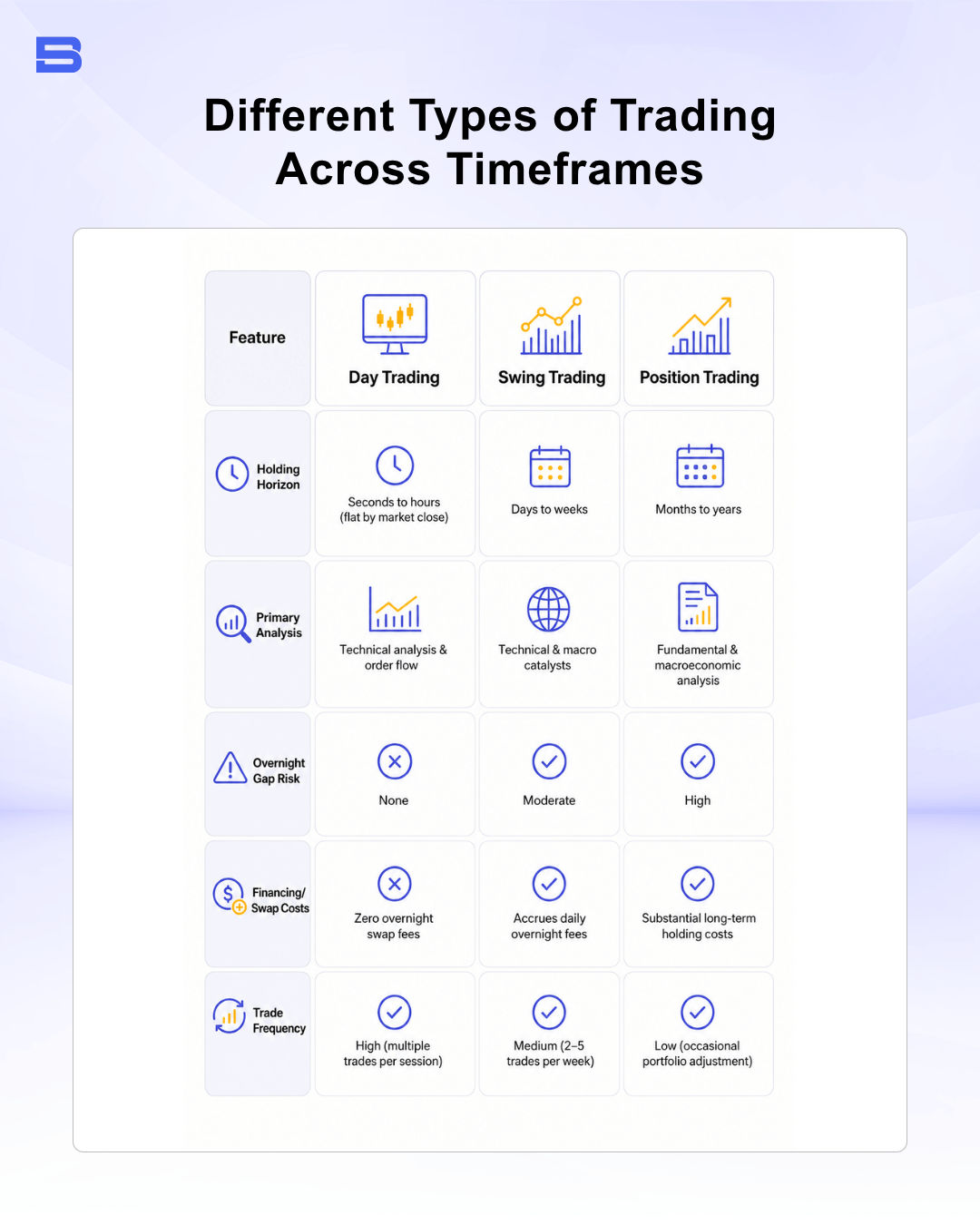
Eliminating overnight exposure frees intraday traders from overnight gap risks caused by earnings announcements, geopolitical headlines, or unexpected foreign exchange shifts that occur while markets are closed.
Core Day Trading Strategies: From Scalping to Trend Following
Successful execution relies on applying structured rules rather than gut feeling. Traders generally fall into three distinct intraday execution categories:
- Scalping: Opening and closing trades within seconds or minutes to capture tiny price increments, often executing dozens of trades per session.
- Momentum Breakout: Entering positions as price aggressively moves past critical consolidation ranges supported by anomalous trading volume.
- Trend Following: Identifying the primary direction of the session and executing entries on corrective pullbacks toward dynamic support levels.
Technical Execution: Using Support and Resistance Levels
Identifying critical price zones is fundamental to intraday entry timing. Technical execution relies on support and resistance zones where supply and demand historically imbalance. When prices approach established intraday support, buying interest typically counters selling volume, providing a logical risk-defined boundary for long positions.
Using Technical Indicators for Intraday Signals
Intraday traders often apply technical indicators to confirm price momentum:
- Moving Average (EMA): Utilizing short-term exponential moving averages (such as the 9 EMA and 20 EMA) helps identify real-time directional momentum and dynamic support.
- Volume Weighted Average Price (VWAP): Calculates the true average price an asset has traded at throughout the day, based on both volume and price. Institutions frequently use VWAP as a benchmark for execution quality.
Selecting Your Execution Setup
Selecting a strategy depends heavily on your personal routine, personality, and capital base. High-frequency strategies like scalping demand undivided screen time and sub-second execution speeds, whereas trend-following strategies allow for structured session planning around key liquidity windows (e.g., market open), the periods when trading volume and price movement are typically highest.
How to Start Day Trading Step-by-Step
Launching an intraday trading business requires establishing proper operational infrastructure:
- Select a Regulated Broker: Partner with a broker subject to strict oversight by regulators such as the Financial Conduct Authority (FCA) or Australian Securities and Investments Commission (ASIC). Evaluate infrastructure factors including platform stability, execution latency, order routing, and competitive bid-ask spreads.
- Set Up a Simulated Execution Environment: Test platform execution, hotkeys, and order types using a demo environment before committing real capital.
- Establish a Quantified Risk Framework: Predefine position sizing, maximum account drawdown limits, and mandatory stop-loss placement rules.
Regulatory Rules and Capital Requirements
Capital rules vary significantly depending on asset class and regulatory jurisdiction. Under US regulations enforced by the US Securities and Exchange Commission (SEC), traders can be designated as pattern day traders if they execute four or more day trades within five business days. Once flagged, they must maintain a minimum account equity of $25,000 in their margin accounts.
Conversely, Forex and CFD trading under Tier-1 financial frameworks often carry alternative account minimums but feature strict leverage caps (limits on how much borrowed capital you can control per dollar of your own) imposed to protect retail participants.
Navigating Intraday Volatility and Market Liquidity
Intraday volatility serves as both an operational necessity and a core risk. Price dispersion is heavily driven by macroeconomic catalysts, such as central bank rate announcements, non-farm payroll reports, and consumer price index disclosures. Sudden spikes in market sentiment can rapidly expand bid-ask spreads.
Executing trades during low liquidity periods or high-impact news drops significantly increases slippage — the variance between your requested execution price and the actual fill price.
Managing volatility requires avoiding order entry immediately surrounding scheduled macroeconomic news releases unless your strategy is explicitly backtested for news-breakout scenarios.
Mandatory Risk Management and Position Sizing
Capital preservation forms the baseline of active trading longevity. Without strict position-sizing rules, leverage amplifies capital loss rapidly. A single standard lot on a heavily leveraged platform can wipe out margin accounts during sudden adverse market moves. Consider a trader operating an account balance of $10,000 who establishes a mandatory strict maximum 1% risk rule per trade ($100 maximum risk).
Maximum Risk Capital = $10,000 × 0.01 = $100
If buying an asset at $50.00 with a technical stop-loss placed at $49.50, the risk per share is $0.50:
Position Size = Maximum Risk Capital ÷ (Entry Price − Stop Loss) = $100 ÷ $0.50 = 200 shares
By using this calculation, even if the price hits your stop-loss, your total loss remains capped at exactly $100 (1% of total account capital). Implementing strict automatic stop-loss orders and establishing a daily maximum drawdown threshold — the largest single-day loss you'll allow before you stop trading — are non-negotiable risk controls required to prevent margin calls.
Consistency With Day Trading
Day trading is a process-oriented discipline centered on risk management, technical execution, and strict capital preservation. Achieving long-term consistency requires viewing market engagement as a strategic business rather than a speculative pursuit.
Focus on mastering execution within a controlled environment, managing position sizing rigorously, and respecting market liquidity before scaling live capital.
- How to Build an Investment Plan That Actually Works for You?
- What Is the MACD Indicator and How to Use It
- What Is a Wedge Pattern in Trading?
- What Is Ichimoku Cloud Strategy? A Complete Trading System
- Mastering Elliott Wave Theory: Rules and Trading Strategies
- News Trading: Strategies, Execution Risks, and Risk Control
- What Is an Iron Condor Options Strategy?
- Backtesting Explained: What It Is and Why It Really Matters
- Grid Trading: Mechanics, Parameters, and Risk Strategies
- What Is Breakout Trading and How Does It Work?
- Mean Reversion: Technical Strategies and Risk Frameworks
- Momentum Trading: Indicators, Strategies, and Risk Control
- Hammer Candlestick: Structure, Meaning, and Strategy
- Doji Candlestick: Types, Signals, and Trading Strategies
- What Is the Sharpe Ratio and How to Calculate It
- What Is VWAP and How Do Traders Use It?
- Trade the Ascending Triangle: A Step-by-Step Practical Guide
- What Is the Stochastic Oscillator and How to Use It
- How to Trade the Descending Triangle Pattern
- High Frequency Trading: Speed, Algorithms, and Market Impact
- What Is Volume Profile and How to Use It in Trading
- What Is a Morning Star Pattern Candlestick?
- Trade with Parabolic SAR: A Practical Analysis Guide
- Evening Star Pattern: Structure, Rules, and Risk Controls
- Kelly Criterion: Formula, Position Sizing, and Risk
- What Is the NYSE Minimum Trading Price? Rules Explained
Disclaimer: The content on this page is intended for educational and informational purposes only. It does not constitute financial, investment, tax, or legal advice, and should not be interpreted as a recommendation to buy, sell, or hold any financial instrument or asset. Trading and investing involve significant risk, including the possible loss of your entire capital. Products such as forex, CFDs, and cryptocurrencies carry additional risks due to leverage, high volatility, and limited regulatory protection in some jurisdictions. Past performance of any financial instrument does not guarantee future results. Any market views, forecasts, or opinions expressed are those of the author at the time of writing and may not reflect current market conditions. Platform features, fees, and regulatory status are subject to change — always verify information directly with the relevant provider or regulator before making any financial decision. BrokerSpecs may receive compensation from third parties featured on this site. Always conduct your own due diligence and consider seeking advice from a licensed financial professional before investing. Portions of this article were prepared with the assistance of AI tools and reviewed by our editorial team before publication.