



Related Tags
Imagine sitting at your trading desk as a central bank press conference begins. Within seconds of the policy statement dropping, bond yields spike, equity futures plummet, and currency exchange rates swing violently across global platforms.
So, what is hawkish and dovish monetary policy, exactly? In short, they describe the two poles a central bank can lean toward: hawkish means favoring higher interest rates to fight inflation, while dovish means favoring rate cuts to support growth.
This sudden market movement rarely happens by chance. Capital markets reprice instantly whenever policymakers signal shifts in their macroeconomic trajectory, making it essential to grasp how monetary tone influences asset pricing.
Understanding whether central bankers lean toward tightening or easing allows you to anticipate market volatility, adjust leverage safely, and align your trading plan with prevailing liquidity conditions.
What Is Monetary Policy Stance?
A central bank monetary policy stance represents the official economic strategy adopted by monetary authorities to regulate money supply, interest rates, and national inflation. Central banks adjust this stance periodically to balance price stability against sustainable economic expansion.
When inflation accelerates beyond official target levels, policymakers implement restrictive measures to cool market activity. Conversely, during economic downturns, central banks transition toward accommodative settings to encourage business investment and household spending.
Maintaining this equilibrium requires continuous evaluation of macroeconomic indicators. If policymakers miscalculate timing, an overly aggressive posture may induce recessionary pressure, whereas excessive stimulus risks unchecked currency devaluation.
Hawkish vs. Dovish Monetary Policy: Key Differences
A monetary stance is broadly categorized as either hawkish or dovish depending on whether policymakers prioritize inflation control or economic growth. A hawkish stance focuses primarily on curbing rising prices by raising borrowing costs and reducing circulating capital.
A dovish stance prioritizes stimulating employment and business expansion through lower interest rates and expanded liquidity. Central banks adjust these positions based on real-time economic indicators like gross domestic product, retail sales, and wage growth.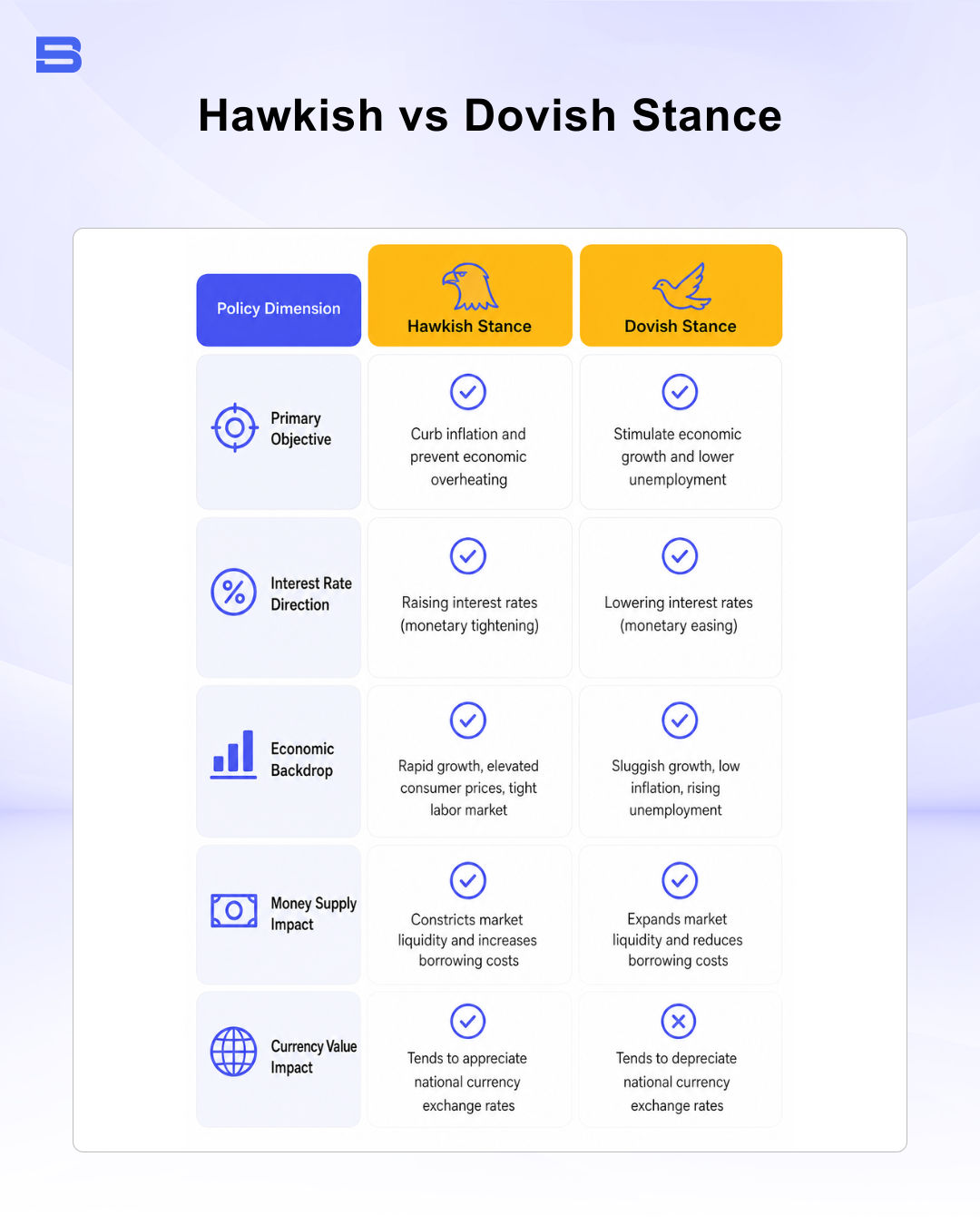
Central Bank Tools: Rates, Quantitative Easing, and Quantitative Tightening
Central banks utilize benchmark interest rates as their primary policy instrument to steer economic conditions. Adjusting short-term target rates directly influences lending terms across commercial banks and mortgage lenders.
Beyond interest rate adjustments, monetary authorities employ balance sheet mechanisms to manage systemic liquidity. Under dovish conditions, quantitative easing involves purchasing government securities to inject liquidity into financial institutions.
During hawkish cycles, central banks execute quantitative tightening by letting bonds mature without reinvestment or selling assets directly. This process absorbs surplus liquidity from the banking system and raises long-term yield curves.
Hawkish vs. Bullish: Understanding the Difference
Traders occasionally confuse policy terminology with price direction. A hawkish stance describes a central bank's policy inclination toward interest rate hikes, whereas a bullish outlook describes an investor's expectation of rising asset prices.
A hawkish policy shift is often bullish for the domestic currency because higher yields attract foreign capital inflows. However, that same hawkish policy can be bearish for stock markets as higher corporate borrowing costs reduce valuation multiples.
How Central Bank Interest Rates and Stances Impact Markets
Modifications to central bank interest rates trigger structural reallocations across global asset classes. Higher base rates raise capital costs for businesses, which may compress corporate profit margins and slow equity market momentum.
For example, if a central bank implements a 25 basis point (0.25%) interest rate hike on a $100,000 variable-rate commercial loan, annual interest obligations increase by $250. This directly reduces net profit margins while increasing sovereign bond yields.
FX markets react swiftly to rate differentials as capital flows toward higher-yielding currencies. However, rate adjustments carry downside risks; unexpected hikes may trigger credit defaults, while aggressive cuts risk accelerating inflationary pressures.
Decoding Central Bank Forward Guidance
Central bankers utilize deliberate phrasing during public addresses to signal prospective policy shifts without causing abrupt market panic. This strategy, known as central bank forward guidance, helps market participants price in rate adjustments gradually.
Keywords such as "vigilant" or "hawkish bias" typically signal upcoming rate hikes, whereas phrases like "patient" or "transitory pressures" indicate an inclination toward steady or lower rates.
Modern monetary committees frequently emphasize a "data-dependent" framework, meaning future rate adjustments depend strictly on upcoming economic releases rather than fixed calendar schedules.
Real-World Example: Federal Reserve (FOMC) Meeting Decisions
The Federal Reserve sets monetary policy for the United States through regular Federal Open Market Committee meetings. Decisions announced by the FOMC directly influence global capital distribution, commodity pricing, and international trade valuations.
During historical inflationary spikes, the Fed has implemented consecutive 50 to 75 basis point rate hikes to restrict monetary growth. Institutional market oversight standards, such as those discussed by the US Securities and Exchange Commission (SEC), emphasize transparency in how these systemic rate changes ripple across public markets.
Regional Impact: Bank Negara Malaysia OPR Decisions
In Southeast Asia, central banks balance domestic growth against international interest rate differentials. Monetary policy in Malaysia centers on the Overnight Policy Rate (OPR) set by monetary authorities.
Adjustments by Bank Negara Malaysia (BNM) regarding the OPR directly influence commercial lending rates, fixed deposit yields, and Ringgit exchange stability. A hawkish adjustment supports currency strength against regional peers, though higher borrowing costs may temper household discretionary consumption.
Economic Data That Drives Shifts: US CPI and Beyond
Central banks do not alter their stance arbitrarily; policy pivots are driven by macroeconomic reporting. Key reports include labor market figures, gross domestic product growth rates, and purchasing manager sentiment indices.
Inflation metrics like US Consumer Price Index (CPI) serve as primary catalysts for policy adjustments. When consumer price data consistently exceeds central bank targets, policymakers face increasing pressure to abandon dovish settings and initiate restrictive measures.
Tracking Economic Policy
Recognizing whether central banks are operating under a hawkish or dovish framework provides a foundational lens for analyzing cross-asset market trends. By tracking economic indicators and official policy statements, you can adjust risk exposure appropriately and align your trading strategies with broader macroeconomic momentum.
Disclaimer: The content on this page is intended for educational and informational purposes only. It does not constitute financial, investment, tax, or legal advice, and should not be interpreted as a recommendation to buy, sell, or hold any financial instrument or asset. Trading and investing involve significant risk, including the possible loss of your entire capital. Products such as forex, CFDs, and cryptocurrencies carry additional risks due to leverage, high volatility, and limited regulatory protection in some jurisdictions. Past performance of any financial instrument does not guarantee future results. Any market views, forecasts, or opinions expressed are those of the author at the time of writing and may not reflect current market conditions. Platform features, fees, and regulatory status are subject to change — always verify information directly with the relevant provider or regulator before making any financial decision. BrokerSpecs may receive compensation from third parties featured on this site. Always conduct your own due diligence and consider seeking advice from a licensed financial professional before investing. Portions of this article were prepared with the assistance of AI tools and reviewed by our editorial team before publication.