



Related Tags
Imagine waking up, reviewing market charts for twenty minutes over coffee, placing an order with defined risk levels, and getting on with your workday. You do not need to stare at flickering candles for eight consecutive hours or react to every minor market blip.
Swing trading offers a balanced path between passive long-term investing and high-frequency day trading. By capturing short- to medium-term price momentum, you build market exposure while maintaining a full-time career. However, capturing these price swings takes strict patience, structured risk controls, and a clear execution plan.
This guide to swing trading for beginners lays out a repeatable, structured framework for entering and exiting the market.
What Is Swing Trading and How Does It Work?
Swing trading is an active investment approach aimed at capturing intermediate price moves in a financial asset over a period of several days to a few weeks. Rather than holding an asset for years to compound growth, a swing trader aims to profit from expected upward or downward market momentum — known as "swings" — within a broader market trend.
To understand how swing trading fits into financial markets, it helps to examine basic operational structure. Understanding how trading works allows you to recognize how price movements build liquidity across underlying spot or derivative markets.
While some individuals trade independent accounts, others eventually explore funded programs like prop trading to access larger trading capital once they demonstrate consistent strategy execution.
When swing trading, your objective is straightforward: locate an asset establishing a clean directional trend, enter during a brief pause or pullback, and exit once momentum shows signs of exhaustion.
Swing Trading vs. Day Trading: Key Differences
Beginners frequently evaluate how to start day trading before realizing that intraday strategies demand constant screen time, rapid execution, and high emotional stamina. Comparing the difference between day trading and swing trading helps clarify which approach fits your schedule.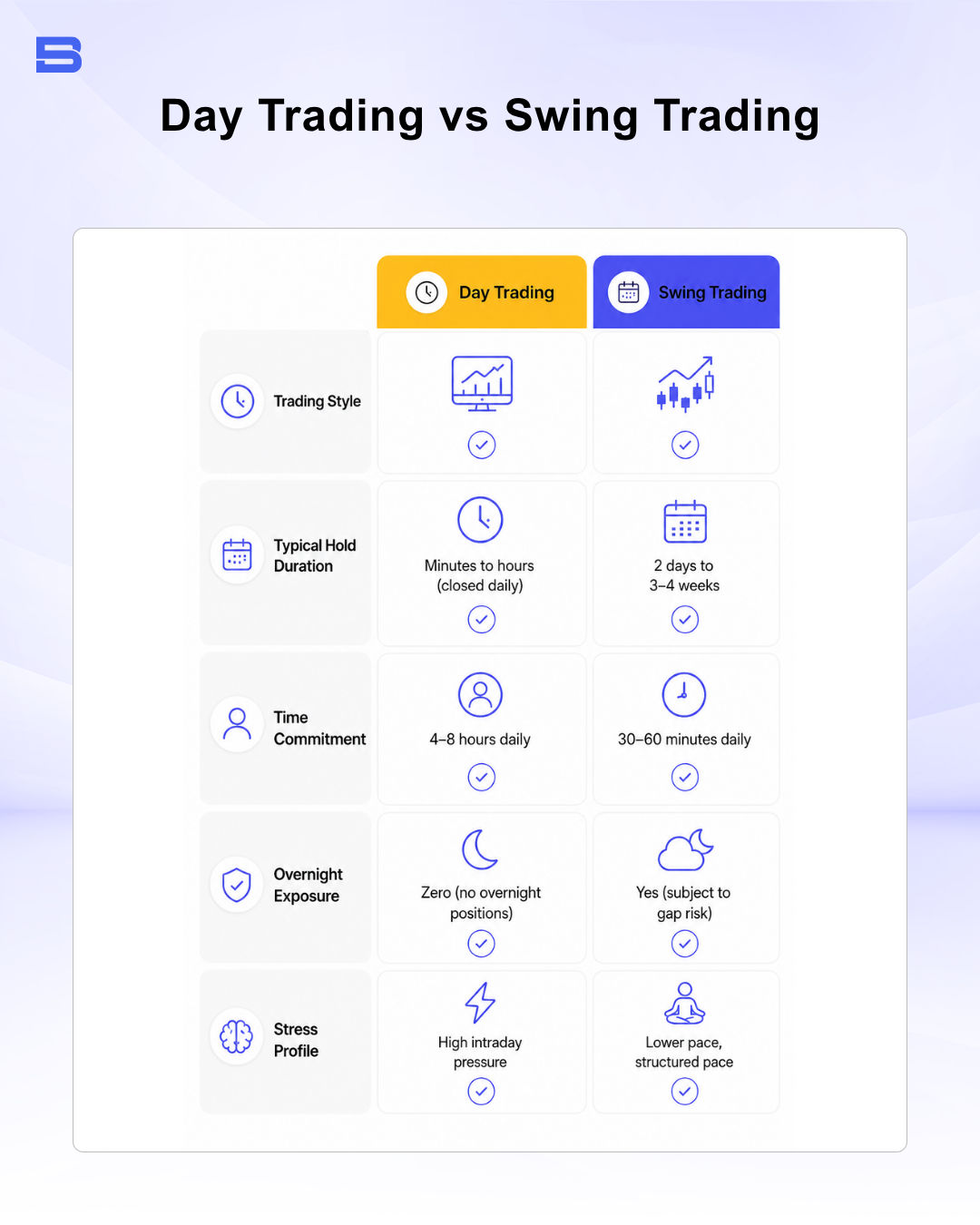 Day traders attempt to profit from tiny intraday fluctuations, closing every single position before market close to avoid unexpected news events. In contrast, swing traders hold positions overnight and over weekends, trading speed for patience and allowing trends room to develop.
Core Swing Trading Strategies for Beginners
Developing a repeatable swing trading strategy provides a structured framework for entering and exiting the market. Rather than guessing price direction, effective strategies rely on clear technical setups across liquid markets like spot trading equities or currency pairs, as well as leveraged derivatives such as futures trading.
Trend-Following and Pullback Entries
A reliable swing trading strategy for beginners centers on buying dips in uptrends or shorting rallies in downtrends. Markets rarely move in a straight line; they advance in waves of higher highs and higher lows.
- Uptrend Entry: Identify an asset making continuous higher highs. Wait for price to pull back toward a key support zone rather than buying at peak levels.
- Downtrend Entry: Identify an asset making lower lows. Wait for price to bounce up into a resistance area before placing a short position.
Technical Analysis Tools for Swing Traders
Reliable swing trading indicators help filter market noise and highlight potential entry points:
- Moving Averages (50-day and 200-day): Moving averages smooth out price data to establish overall trend direction. A rising 50-day moving average indicates medium-term bullish momentum.
- Relative Strength Index (RSI): The RSI measures momentum on a 0–100 scale. Readings below 30 indicate potential oversold conditions (buying opportunities in uptrends), while readings above 70 flag overbought areas.
- Support and Resistance Levels: Historical price levels where buying or selling interest previously paused price movement serve as natural targets for entries and stop-loss placement.
According to technical standards outlined by the CFA Institute, combining multiple non-correlated indicators improves chart analysis efficiency without overloading execution setups.
Step-by-Step Guide to Start Swing Trading
Beginning your trading journey requires a disciplined, step-by-step process:
- Select Liquid Assets: Focus on large-cap stocks, major Exchange-Traded Fund (ETF) products, or highly liquid currency pairs. High liquidity ensures smooth order execution and narrower bid-ask spreads.
- Set Up Charting Software: Use standard charting platforms to plot daily and 4-hour timeframes to analyze broader technical trends.
- Define Clear Entry Rules: Determine exact technical criteria before opening a trade. Never enter a position simply because the price is moving fast.
- Practice on Demo Accounts: Test your methodology using virtual funds to build familiarity with order entry and trade tracking without putting capital at risk.
Managing Risk as a Beginner Swing Trader
Surviving initial learning curves depends entirely on strict risk management. Without risk controls, active participation in market swings can easily degenerate into impulsive speculation — leading traders to question whether trading is gambling or examine if financial structures align with their values, such as evaluating whether trading is haram.
Worked Risk-to-Reward Scenario
Consider a trading account funded with $5,000. To preserve capital, limit your maximum risk on any single trade to 1.5% of your balance ($75).
- Account Balance: $5,000
- Risk per Trade (1.5%): $75 maximum stop-loss allocation
- Entry Target: Stock entry at $50 per share
- Stop-Loss Placement: Placed at $47 per share (risk = $3 per share)
- Position Size: $75 total risk ÷ $3 risk per share = 25 shares total purchase
- Profit Target (1:2 Risk-to-Reward): Placed at $56 per share (reward = $6 per share)
In this scenario, if the stock hits your stop-loss, you lose exactly $75. If the trade hits your target price, you gain $150 ($6 reward × 25 shares). Maintaining a 1:2 risk-to-reward ratio allows your account to grow over time even if only half of your total trades end in profit.
Market Hazards to Monitor
Swing traders face unique risks that day traders avoid:
- Overnight Gap Risk: Earnings reports, geopolitical headlines, or macroeconomic data released while markets are closed can cause asset prices to open significantly lower or higher than the previous day's close, bypassing stop-loss orders.
- Leverage Hazards: Utilizing derivative accounts through margin trading amplifies exposure. While leverage magnifies potential gains when trades move favorably, it accelerates capital losses just as quickly when positions move against you. Regulatory disclosures from authorities like the US Securities and Exchange Commission (SEC) emphasize keeping leverage low to prevent rapid account liquidation during volatile market swings.
Gaining Consistency With Swing Trading
Swing trading balances market engagement with lifestyle flexibility, making it a practical approach for retail traders. Success does not come from predicting every market turn, but from applying consistent risk control, managing capital exposure, and allowing technical setups time to unfold. Focus on mastering entry setups on demo accounts before deploying live capital.
- How to Build an Investment Plan That Actually Works for You?
- What Is the MACD Indicator and How to Use It
- What Is a Wedge Pattern in Trading?
- What Is Ichimoku Cloud Strategy? A Complete Trading System
- Mastering Elliott Wave Theory: Rules and Trading Strategies
- News Trading: Strategies, Execution Risks, and Risk Control
- What Is an Iron Condor Options Strategy?
- Backtesting Explained: What It Is and Why It Really Matters
- Grid Trading: Mechanics, Parameters, and Risk Strategies
- What Is Breakout Trading and How Does It Work?
- Mean Reversion: Technical Strategies and Risk Frameworks
- Momentum Trading: Indicators, Strategies, and Risk Control
- Hammer Candlestick: Structure, Meaning, and Strategy
- Doji Candlestick: Types, Signals, and Trading Strategies
- What Is the Sharpe Ratio and How to Calculate It
- What Is VWAP and How Do Traders Use It?
- Trade the Ascending Triangle: A Step-by-Step Practical Guide
- What Is the Stochastic Oscillator and How to Use It
- How to Trade the Descending Triangle Pattern
- High Frequency Trading: Speed, Algorithms, and Market Impact
- What Is Volume Profile and How to Use It in Trading
- What Is a Morning Star Pattern Candlestick?
- Trade with Parabolic SAR: A Practical Analysis Guide
- Evening Star Pattern: Structure, Rules, and Risk Controls
- Kelly Criterion: Formula, Position Sizing, and Risk
- What Is the NYSE Minimum Trading Price? Rules Explained
Disclaimer: The content on this page is intended for educational and informational purposes only. It does not constitute financial, investment, tax, or legal advice, and should not be interpreted as a recommendation to buy, sell, or hold any financial instrument or asset. Trading and investing involve significant risk, including the possible loss of your entire capital. Products such as forex, CFDs, and cryptocurrencies carry additional risks due to leverage, high volatility, and limited regulatory protection in some jurisdictions. Past performance of any financial instrument does not guarantee future results. Any market views, forecasts, or opinions expressed are those of the author at the time of writing and may not reflect current market conditions. Platform features, fees, and regulatory status are subject to change — always verify information directly with the relevant provider or regulator before making any financial decision. BrokerSpecs may receive compensation from third parties featured on this site. Always conduct your own due diligence and consider seeking advice from a licensed financial professional before investing. Portions of this article were prepared with the assistance of AI tools and reviewed by our editorial team before publication.