



Related Tags
Staring at complex technical charts for hours can leave any new investor feeling out of their depth. When every candle pattern seems contradictory, the idea of mirroring an experienced trader's portfolio directly into your own account has real appeal.
Copy trading automates this process entirely, allowing you to replicate real-time positions executed by seasoned market participants without managing individual orders yourself.
Understanding the Copy Trading Mechanism
Copy trading is an automated portfolio management method where a platform automatically mirrors the buy and sell positions of a selected lead trader directly into your investment account. When the strategy provider opens a position, your broker executes an identical trade scaled proportionally to your allocated balance.
This trade replication occurs seamlessly in the background through automated execution networks.
For instance, if a lead trader allocates 5% of their total balance to purchase EUR/USD, your account automatically opens an identical EUR/USD position using 5% of your designated copy funds.
Execution latency remains a critical technical factor during trade replication. Microsecond delays between the master account and follower sub-accounts can lead to execution slippage, particularly during high-volatility news releases.
Automated Order Replication vs. Signal Copying
Automated order replication relies on direct platform-level API connectivity to mirror positions instantly without manual intervention. In contrast, manual signal copying requires traders to receive alerts via messaging channels or email and execute each trade manually.
Automated replication eliminates human delays and emotional hesitation when entering trades. However, manual signal copying gives investors final approval before putting capital at risk.
How Does Copy Trading Work?
The copy trading process follows four simple operational steps to connect your brokerage account with a strategy provider.
First, you select a strategy provider based on verified performance metrics. Second, you allocate a specific portion of your account balance to that trader. Third, your brokerage software automatically mirrors every new order, position modification, or trade closure in real time.
Finally, performance fees are calculated and deducted automatically based on net high-water mark profits—meaning fees only apply to new gains above the account's previous peak value.
Understanding how funds and execution rights differ between providers and copiers helps set clear operational expectations.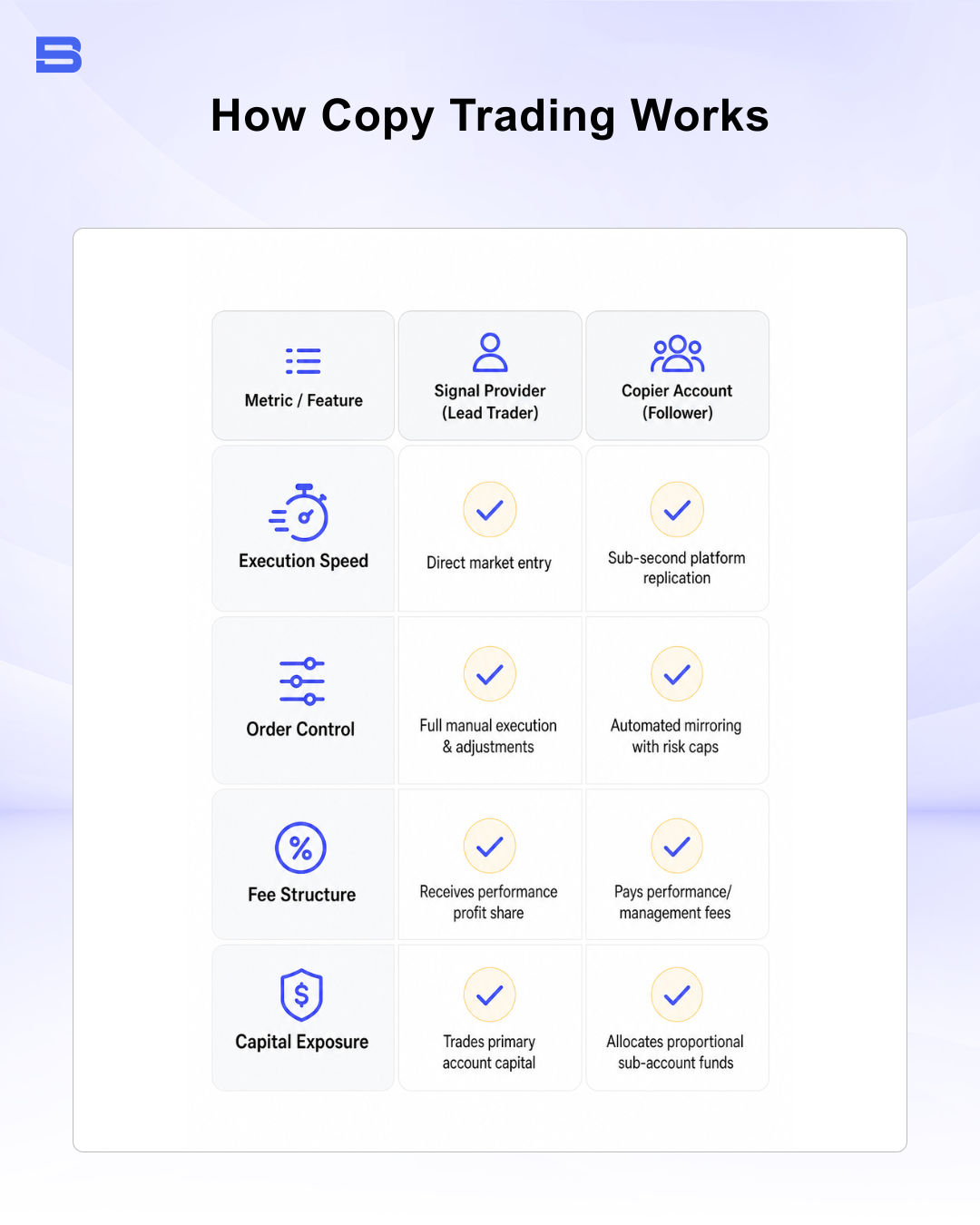
Copy Trading vs. Social Trading: Key Differences
While often used interchangeably, copy trading and market sentiment analysis through social trading represent distinct investment approaches.
Social trading functions as a financial community network where members publish market commentary, share chart setups, and discuss sentiment. Investors review these ideas and decide whether to enter positions manually using their own market analysis.
Copy trading takes social interaction a step further by automating trade execution entirely. Instead of reading trade ideas and evaluating support and resistance levels yourself, the platform handles entry, stop-loss adjustments, and trade closure on your behalf.
How to Choose Signal Provider Profiles Wisely
Evaluating a strategy provider requires looking beyond raw historical return percentages listed on platform leaderboards. High top-line profit figures often mask aggressive risk-taking that can destabilize your trading account.
Focus your evaluation on historical consistency, track record length, and equity curve stability over at least 12 months. Providers who maintain a steady win rate across multiple market regimes generally offer safer long-term allocation options than traders with volatile equity spikes.
Spotting High-Risk Martingale Strategy Tactics
Some signal providers attempt to hide floating losses by implementing a martingale strategy, doubling position sizes after every losing trade. While this tactic creates a smooth historical win curve on paper, it exposes follower accounts to account drawdowns when prolonged market trends occur.
Grid trading systems similarly stack multiple open orders without fixed stop losses during trending markets. Always audit a provider's open trade history to ensure they do not leave heavy drawdown positions open indefinitely to inflate win statistics.
Critical Copy Trading Risk Management Strategies
Copying professional traders does not eliminate market risk or shield your account from capital losses. Regulatory bodies like the Financial Conduct Authority (FCA) and the European Securities and Markets Authority (ESMA) emphasize that retail copy trading services require strict risk controls to prevent account drawdowns.
Spreading your capital across multiple non-correlated strategy providers helps protect your portfolio from single-trader failure. Diversifying between day trading, swing trading, and position trading styles ensures your funds are not overly concentrated in one market approach.
Leverage magnifies copy trading losses just as rapidly as gains, meaning a high-leverage strategy provider can trigger account margin calls during sudden market volatility. Always verify whether a provider trades high leverage before allocating significant capital.
Setting Strategy-Level Stop Loss in Copy Trading
Most modern platforms allow copiers to set account-level hard stop-loss limits independent of the signal provider's actions. If total equity allocated to a specific trader drops below your designated safety threshold, the system automatically closes all open trades and detaches your account.
Configuring a hard drawdown stop protects your capital if a lead trader suffers an unexpected loss of emotional control or strategy breakdown.
Managing Copy Trading Drawdown Limits
Understanding maximum historical drawdown provides a realistic preview of potential account fluctuations. A strategy provider with a 15% maximum historical equity dip is far easier to manage emotionally than a provider who periodically experiences 45% unrealized drawdowns.
Set your allocation boundaries based on peak-to-trough equity declines rather than short-term monthly gains.
Avoiding Manual Analysis With Copy Trading
Copy trading serves as a practical portfolio allocation tool for investors seeking market exposure without executing daily manual analysis. By prioritizing drawdown management, auditing strategy provider tactics, and setting firm equity stop losses, you can build a resilient automated trading allocation aligned with your personal risk tolerance.
- How to Build an Investment Plan That Actually Works for You?
- What Is the MACD Indicator and How to Use It
- What Is a Wedge Pattern in Trading?
- What Is Ichimoku Cloud Strategy? A Complete Trading System
- Mastering Elliott Wave Theory: Rules and Trading Strategies
- News Trading: Strategies, Execution Risks, and Risk Control
- What Is an Iron Condor Options Strategy?
- Backtesting Explained: What It Is and Why It Really Matters
- Grid Trading: Mechanics, Parameters, and Risk Strategies
- What Is Breakout Trading and How Does It Work?
- Mean Reversion: Technical Strategies and Risk Frameworks
- Momentum Trading: Indicators, Strategies, and Risk Control
- Hammer Candlestick: Structure, Meaning, and Strategy
- Doji Candlestick: Types, Signals, and Trading Strategies
- What Is the Sharpe Ratio and How to Calculate It
- What Is VWAP and How Do Traders Use It?
- Trade the Ascending Triangle: A Step-by-Step Practical Guide
- What Is the Stochastic Oscillator and How to Use It
- How to Trade the Descending Triangle Pattern
- High Frequency Trading: Speed, Algorithms, and Market Impact
- What Is Volume Profile and How to Use It in Trading
- What Is a Morning Star Pattern Candlestick?
- Trade with Parabolic SAR: A Practical Analysis Guide
- Evening Star Pattern: Structure, Rules, and Risk Controls
- Kelly Criterion: Formula, Position Sizing, and Risk
- What Is the NYSE Minimum Trading Price? Rules Explained
Disclaimer: The content on this page is intended for educational and informational purposes only. It does not constitute financial, investment, tax, or legal advice, and should not be interpreted as a recommendation to buy, sell, or hold any financial instrument or asset. Trading and investing involve significant risk, including the possible loss of your entire capital. Products such as forex, CFDs, and cryptocurrencies carry additional risks due to leverage, high volatility, and limited regulatory protection in some jurisdictions. Past performance of any financial instrument does not guarantee future results. Any market views, forecasts, or opinions expressed are those of the author at the time of writing and may not reflect current market conditions. Platform features, fees, and regulatory status are subject to change — always verify information directly with the relevant provider or regulator before making any financial decision. BrokerSpecs may receive compensation from third parties featured on this site. Always conduct your own due diligence and consider seeking advice from a licensed financial professional before investing. Portions of this article were prepared with the assistance of AI tools and reviewed by our editorial team before publication.